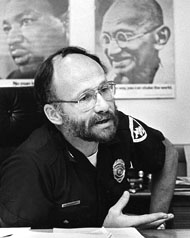


I know, I know… some of you think that I am too critical of our police. Maybe.
But in my defense I would like to say that I began this job over 50 years ago with high expectations for those of us who do the work. My high expectations have never receded.
Police in a free society have a special and unique role to protect liberty and reinforce the important values that make for a great nation. To expect less would be to minimize the great work that not only our nation’s police can do, but, in fact, continue to do on a daily basis.
Talking with my good friend and colleague Herman Goldstein about the “state of the art,” we highlighted these improvements in our nation’s system of criminal justice:
POLICE
- The breaking-down of gender, racial, and sexual orientation barriers in police hiring which has resulted in more diversity in the ranks of police which better reflects the communities they serve.[1]
- A growing increase in the academic level of police throughout the years from that of a high school diploma to at least 2-years of college. Similar increases in the length of pre-service training.[2]
- Reversing the focus on arresting and prosecuting prostitutes to viewing them as victims, and their customers and pimps as the offenders.
Intensive new interest in sex trafficking which is a more appropriate focus for dealing with prostitution. - Revising various questionable police practices (e.g. “lineups”) to prevent wrongful convictions.
COURTS
- Deleting records of misdemeanor violations after a certain period of time so that violators have one less barrier to employment.
- Enormous spread and success of innovations in the area of criminal courts (For example, see www.courtinnovation.com).
CORRECTIONS
- Major moves to reduce number of inmates in state and federal prisons — early release; changes in sentencing practices; reductions or abolition of mandatory sentencing, focusing on high cost of incarceration.
- Restoration of the idea of providing college-level education for inmates in prison.
ADMINISTRATION OF JUSTICE
- Decriminalization of marijuana; decisions not to arrest for minor possessions even if laws are maintained.
- Growing concern about, and limits placed on use of solitary confinement in jails and prisons.
- The existence of “innocence projects” which seek to gain release for those improperly convicted.
While things have improved, and are improving, in the field of criminal justice, much more needs to be done.
The people I am counting on to do this are those of you who are following this blog and feel that “fire in the belly.” That fire is a deep passion and a calling to seek top leadership and lead forward. When you get there, be a strong leader and an impassioned voice for the constant pursuit of excellence.
[1] Nationally, the number of women in policing has grown over the past 40 years. In 1970, women comprised only 2% of sworn officers. By 1991 that number was 9% and 12% in 2007. Today, small to medium departments have 9-10% women in their ranks and larger departments around 15%. A “glass ceiling,” however, seems to exist with regard to the small number of women in upper management ranks. With regard to race, most recent data indicate that 13% of our nation’s police are members of a racial minority. As to sexual orientation, little data exist regarding the numbers of Gay and Lesbian police officers. It appears that being an openly Gay or Lesbian police officer is more acceptable in our nation’s largest cities. There also exists a growing number of Internet sites about the topic of being “Gay and blue.”
[2] In a recent sample of 3000 police departments, 98% had an educational requirement for new recruits; 18% had ‘some type’ of college requirement; nine percent required a two-year degree and less than one-percent required a four-year degree. (Local police departments, 2003 (NCJ210118). Washington, D.C.: U.S. Department of Justice, Bureau of Justice Statistics.) The one-percent of departments requiring a baccalaureate degree may signify that professionalism for policing is stalling. However, it must be taken into account that there have been enormous improvements over the past 60 years with regard to police and education. Since the 1950’s, increasing numbers of local police departments began requiring at least some college. In the late 1990s, 65% of police officers had at least one year of college and 23% a four-year degree. The consensus today is that the average educational level of our nation’s police is thankfully on the rise.

 Improving Police: A Necessary Conversation
While I can see where someone with a 4 year college degree may have some education that would apply to law enforcement, such as writing skills, I don’t think that this should be a requirement for entry into our profession. I do agree with college education for leadership positions within the department. For us, a small department that pays poorly, we already have a hard enough time finding great recruits with a high school diploma.
Do you know of any studies that have looked at the use of force and/or public complaints against officers between the required 4 year degree departments and those without such requirements? I am curious to see if the education of the overall force translates into a better behaved police officer.
Keep up the great articles. I look forward to them daily.
LikeLike
In my sense and experience, I have found that education matters with regard to use of force. Here’s a couple of studies:
Click to access cross%20-%20higher%20education%20and%20use%20of%20force%20-%20do%20they%20relate.pdf
Click to access umi-umd-5263.pdf
LikeLike
Unless we can go back to the days of affordable or free college education, police departments are going to be hamstrung in getting a large pool of candidates who can’t afford to go to college or are heavily in debt which makes them vulnerable to corruption.
LikeLike
Working in government can breed apathy. Civil service rules, strong unions, contracts, government bureaucracy and resistance to any change in policing… Your blog and other leaders in policing like Mike Masterson keep me motivated and focused on moving the ball forward.
LikeLike
Mike is probably thinking the same thing I thought about when I retired. Where are the police leaders that will stand up, tightly grasp this torch, and carry it forward?
I really hope that you are one of them, chief!
LikeLike
Working in corporations as a manager particulary a CEO can breed contempt and apathy towards the police. Lobbyist money, right wing think tanks lke ALEC and the CATO Institute, corporate bureaucracy, lawyers protesting corporations and rich people, and having control of the city, county, state and federal government by corporations and rich people also provides resistence to any change in policing.
LikeLike
Maybe. I remain hopeful.
LikeLike
We also need improvement in going after corporations and rich people who commit economic crimes in this country. Look at GM and Toyota with regards to their defective cars, but doe the government arrest the CEOs and the upper management for their failure to warn the federal government? No, they do not and the company just paid a fine and the CEOs go scott free. Yeah, we don’t go after people who are supposely the pillars of our community and the flower of our so-called civilization.
LikeLike
When is a crime a crime? The question regarding criminal behavior that is corporate is a big one. And one that, to me, shows the power of money and privilege. Hurt one person and you’re a mugger. Hurt (or kill) hundreds and it’s a mistake for which no one can be held responsible. One of the problems of our society.
LikeLike