
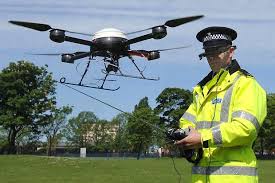
 The use of drones by police can be a slippery slope from helping citizens to intruding on them. Police must be cautious as they consider using drones or UAV (Unmanned Aerial Vehicle) and have an open and on-going discussion about their use in the community BEFORE they are deployed.
UAVs are continuing their climb in popularity among police in our country given their accessibility, cost, size, weight, portability, and payload possibilities. I predict they will soon become a universal tool across the country.
A small UAV can fit into the trunk of a patrol car. They cost thousands of dollars less than a patrol car or helicopter. This will make them especially appealing to budget-strapped police agencies.
They have great benefits, but a wise police leader will discuss their use with the community — and I stress this — BEFORE citizens see them flying about.
Already, the Mesa County (Colorado) Sheriff’s Office has used a UAV as a life-saving and cost-cutting tool in response to traffic accidents, fires, and apprehension of suspects. North of us, the Royal Canadian Mounted Police used a UAV to locate a disoriented traffic accident victim.
A UAV can be built with optical devices that provide high-resolution videos, still images, thermal imaging, night vision, tracking devices, and olfactory bio-surveillance systems. They can help police maintain situational awareness and accomplish life-saving and staff-hungry missions. But…
- Can they coexist with community policing?
It is possible. But the key here is community involvement from the get go, openness and solid policies and procedures. In addition, police need to consider the following:
How can UAV be safely deployed in a manner that will preserve community relationships and the trust and respect that are essential in every community policing effort?
- Will UAS deployment affect community trust? And what can police do to maintain that trust?
- Can police use UAVs only for life-saving missions and maintain their commitment to procedural justice, transparency, and accountability?
- Can police agencies balance the benefit of using UAVs for surveillance in a targeted public safety mission with the real or perceived threats to privacy within the community?
- What technological and operational considerations should police consider before deployment of a UAV?
- What about crafting a policy for UAV use that has the support of the community?
- What are the primary community apprehensions (and even resistance) that police are likely to encounter when planning for and deploying a UAV? And how can they best address these concerns?
In the years to come, the safe and responsible deployment of UAVs will be predicated not only on their airworthiness but also on the training its operators receive, standard operating procedures employed, and public acceptance.
Therefore, strong guidelines are needed to help police agencies develop sound procedures and policy protocols that are consistent with the principles of community policing.
[CLICK HERE for further discussion of this topic by the COPS Office.]
Here three recent news articles about police drones and community concerns…
- Are police invading your privacy?
- New San Jose Drone Awaits Guidelines.
- Police Drones (Huffington Post).
[So that I “practice what I preach,” (continuous improvement and customer feedback) please CLICK HERE and give me some anonymous feedback as to how this blog does or does not meet your needs. Thanks a million!!]

 Improving Police: A Necessary Conversation
Have you ever considered about including a little bit more than just your articles? I mean, what you say is fundamental and everything. But imagine if you added some great images or video clips to give your posts more, “pop”! Your content is excellent but with images and video clips, this site could definitely be one of the best in its niche. Excellent blog!
LikeLike
Some good ideas. Once in a while I post a video. More suggestions? Contact me.
LikeLike
A very good point. How sophisticated is our military satellite imaging today and how will it be used by police in the near future? Images of a sic-fi thriller!
LikeLike
Problems with drones is that there are software that allows someone to take over your drones and see what you see. I believe there was a story a few years ago where Afghans or Iraqis brought that software from a Russian computer firm and thus were able to wrest control of the drone from the American military. Can you imagine street gangs and organized crime getting their hands on that software not to mention having their own drones to spy on the police as well? If you go to the website, Photographing is not a crime, you have the police now arresting people for using their toy planes and drones for supposedly spying on the police.
You need to talk about that subject as well considering the fact that the police like to video people but are arresting people who video them even though the courts have rule that the police have no expectation of privacy.
LikeLike