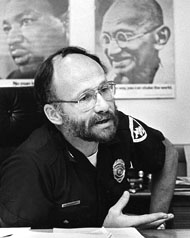

 It seems that the old dodge is still the new one. When one police chief was asked why his department, which served a predominately African-American citizenry, had few minority officers his response was, “No blacks apply. If they don’t apply, we can’t hire them!”
He was then asked why his department doesn’t go out and recruit at black colleges. His answer, “We don’t have the budget do that.” I would respond by saying his city cannot afford not to go out and recruit in order to diversity the police department. Can his city afford to pay for civil unrest, civil settlements, the lack of police cooperation in the community, and growing mistrust. Can they afford that?
But even if his department launched a nation-wide recruiting program there remain many reasons why a person of color (or any person for that matter) would want to join his police department.
Let’s understand this: If a city wants to change the complexion of its police department there must be funds, passion and commitment to do it. It also something else very important: to develop an organization that is attractive to candidates.
Almost three decades ago, John Naisbitt and Patricia Auberdence approached this topic in their highly-successful book, “Reinventing the Corporation.” Here’s how any organization hires (and retains) the best and the brightest.
HOW WOULD YOUR ORGANIZATION ANSWER THESE QUESTIONS FROM APPLICANTS?
Get ready! These are the questions the best candidates for your department will ask.
- Is your police department a place where I will experience personal growth? How will this happen?
- How does your department reward performance and initiative?
- What is your department’s vision and mission?
- How is your department structured? What kinds of networking occurs in the organization?
- How does your department stand on wellness, health and fitness? What incentives are there for me to maintain a healthy lifestyle?
- Is your department flexible about job arrangements? What are your policies on maternity and paternity leave, or caring for disabled parents? Is there day care available in the work place?
- How successful have women and minorities been in your police department? Please give me some examples.
- How is your department connected with a college or university? What is your department’s commitment to life-long education?
- What sort of in-service programs do you have for my continuous improvement and life-long learning?
- Is this a department where people are having fun? Please give me some examples. [i]
[i] Reinventing the Corporation, John Naisbitt and P. Auberdene, NY: Warner Books, 1985.

 Improving Police: A Necessary Conversation
My department has hired many minorities. They have the ability to “bid” on any area of the city they choose to work and it’s based on seniority.
Yet time and time again, you will find that almost all of them choose to work in any area of the city EXCEPTS the one in which they are most represented. Maybe the question should be “why won’t Black officers work in Black neighborhoods?” There is speculation that they don’t want to be seen as “working for the man” or arresting people they may know. Only they can tell you why they mostly avoid working in those areas of the city. But I see it as their issue, not the one of the administration or white officers.
LikeLike
This is what I would expect in a traditional police system. But there are ways to change this situation. First of all, would be for the administration to listen to the black officers and discuss (if there is) a need for officers of color to work in minority neighborhoods. I would be surprised that if the department was strongly into community-oriented policing, problem-solving and foot beat officers that officers of color might very well want to work in a “community-organizing” mode. Until the administration asks and listens we will never know whose issue this is. Thanks for responding to this. You bring up some very good points, Sabrina!
LikeLike
“When one police chief was asked why his department, which served a predominately African-American citizenry, had few minority officers his response was, “No blacks apply. If they don’t apply, we can’t hire them!”
Well, the chief should not stop trying to hire people of color, but there is probably much truth to this statement. If you as a black person believe that police are out to lock up as many black people as possible in order to increase stats and get promotions/transfers (Read “Cop in the Hood” by Peter Moskos for a critique of this style of policing), then you probably won’t want to join the PD. If departments really want to hire more black officers, they will have to change the way they do business before they will see an increase in the number of black applicants.
Police are that gatekeeper of the criminal justice system. They have the ability to promote major change in the system, even within the constraints of current law. Police discretion is a powerful tool that can be used to scale back mass incarceration and drug war excess. If police look beyond “stats” and the court OT that some officers like so much, then they will realize that they can begin to carve a new kind of policing out of the shell of the old system (yes, I’m paraphrasing Industrial Workers of the World rhetoric there).
LikeLike
Well said! Thanks. On target…
LikeLike
I agree that police departments should be more proactive in their hiring practices of minorities. Police departments should implement aggressive policies to hire not only African-Americans but also Hispanics and women as well. Over the last thirty years, the hiring of minorities including women and Hispanics have increased, which is great news, but there is still a lot more work that needs to be done in eliminating racial disparity between police officers and the communities they serve. Fortunately, police departments are no longer white male dominated. A police department’s personnel should mirror the community it serves. By increasing racial equality, the representation of the community’s interests will be increased as well because the officers and the community that the officers serve will share similar backgrounds of values and beliefs. This theory was supported by a study conducted by James Lasley in 2011. Everyone deserves equal representation. Let’s be honest, most of the violent crime that occurs in the U.S. happens in mostly minority and economically challenged areas. The relationship between the police and minority communities is strained to say the least and is more apparent today as seen in the recent events in Ferguson. There is a divide between police and minorities. It is an “us against them” mentality. Studies have shown that police are more likely to be advocates for their own racial group which leads to an under-representation for victims who are in the minority. Minorities, who are already distrustful of police, are less responsive to crime control efforts by the police. It has been shown that minority officers are more understanding of the needs of minorities which allows them to set an example for the community. This sensitivity to the community needs, allows minority officers to establish a role-model type of relationship as well as establish better relations with the minority communities. For example, to help ease tensions between police and minorities, instead of having a white officer in a predominantly black neighborhood that is unable to relate to the daily struggle that citizens in the community face, place black officers who share a similar background in these neighborhoods. Perhaps these officers may have a better chance of establishing relationships and gaining the trust of the citizens because they can relate based on their shared racial background, understanding of cultural norms, and experiences. Studies have shown that due to the distrustful relationship between the minority communities and the police there are serious consequences. Crime goes unreported and police do have cooperation from the citizens in order to make arrests. (academic sources available upon request)
LikeLike
Well said. The argument I give police about diversity in the ranks is that it makes everyone’s job safer — when you are trusted and respected you are safer! Thanks.
LikeLike
Dear Brookie,
I agree with you that police departments need to be more hands-on and enthusiastic about hiring greater numbers of minority and female officers. While I agree with you that Hispanic and African-American officers are under represented in the majority of departments, there is another minority that is even scarcer. Schroedel, Frisch, August, Kalogris, and Perkins (1994) reported that although Asian-Americans make up around three percent, back in 1994, of the country’s population they have received little to no scholarly research about their representation in bureaucracy and public sectors; there have been several studies conducted about the representation of women, Hispanics, and African-Americans but virtually no research on Asian-Americans (Schroedel et al., 1994). Asian-American officers are the most likely to be underrepresented regardless of police department location while representation of other minorities tends to improve or worsen depending on the area (Schroedel et al., 1994). When it comes to the subject of underrepresentation of women in policing I couldn’t agree with you more. Although times are changing and more departments try to hire women, policing is still seen as a predominately male occupation and many still believe that women are not cutout for police work. McCarty, Zhao, and Garland (2007) conducted a study that compared reported stress levels and burnout rates among male and female officers. While policing is still viewed as job that is too demanding for women, McCarty et al. (2007) found that there was no actual difference between stress and burnout rates reported by male and female officers, thus proving that women can handle the job. Proving that women can handle intense and stressful jobs like policing helps to open more occupational doors where females are needed. India is enacting changes to their laws that provide a female rape victim with a female judge (2008). By providing a young woman with a female judge she may feel safer and the female judge ultimately understands the woman’s perspective better than a male (2008). There are numerous situations where females and minorities are more suitable for jobs than white males. I will gladly post my sources upon request.
LikeLike
Some very good points about the realistic fact that within policing diversity is a strength, not a weakness. And you are right-on about Asian-America representation. Policing is a noble task and worthy of calling the best and the brightest within any democratic society.
LikeLike
https://improvingpolice.wordpress.com/2014/09/22/hiring-the-best/#comment-5311
Nicky Baker
I agree with Brookie, the police department needs to make a consorted effort to aggressively target minorities by implementing new recruitment strategies that will help aide to increase and diversify the police force as well as the communities they serve. This will help them optimize opportunities to create a balance in the communities and in the police departments. It is vital that the police share a commonality with the citizens in the communities in order that they foster a partnership which will give police greater access to information provided by the community, which in turn will lead the police to be more responsive to the community’s needs. Minority officers may have an advantage when it comes to dealing with problems in predominantly minority neighborhoods, both because of a greater understanding of cultural norms and because of increased community acceptance. It is frequently argued that without the cooperation of community members in reporting crimes and identifying criminals, there may be little that police can do either to prevent crime or to punish those who commit crimes. Being able to relate to the citizens in the communities often involves having walked in their shoes, lived in the communities and undergone their struggles. The key reformulation has been that the police and the communities that they are policing must try to become co-producers of crime prevention. Minority policing results in fewer false arrest and a decline in the crime rate. Minority officers do not view African Americans in the community as hostile and aggressive, however white officers feel that African American in the communities are hostile and aggressive simply because they just do not understand them which results in more arrest. It is imperative that Minority officers maintain a strong police presence in the African American communities to help eradicate crime, foster relationship and to ensure the safety of the community members.
LikeLike
Yes. Community-oriented, collaborative policing is not only the only effective way to police a community, but one in which the officers are more safe. That’s the paradox of so-called “soft” policing. Policing is primarily a matter of effective relationships.
LikeLike
Sir I agree that the recruitment of innovative police officers that believe in the dignity and worth of all people, will bring this nation closer to resolving the issues surrounding policing the mentally ill. Yet, it is also pertinent to note that a solution to these problems can also entail reform to the Corrections and Court system. The Bureau of Justice Statistics estimated that in 2006 there were 479,900 mentally ill persons in local jails. Many of these individuals have been accused of petty misdemeanor crimes and are released back into the public upon paying a fine or serving a short sentence. In many of these instances numerous psychological evaluations have been ordered at great expense to determine when the defendant is finally competent to stand trial, so the criminal justice system is often well aware which offenders suffer from mentally illness. Yet there is often very little judges can do to bar release until treatment has been received, as maximum penalties for misdemeanors are not conducive to allowing effective psychiatric care. As such, the mentally ill are often re-released back into the community with the hope that they will get better and not come back, or at least return without committing an offense too egregious. According to a 2003 study of 20,112 inmates in the Philadelphia jail system, 54 percent of those with severe mental illnesses were reincarcerated within a four year span. There is no doubt that recidivism rates for those who are mentally ill are high, and releasing these individuals without treatment endangers public safety.
One advocate for reform has been Judge Steve Leifman, who has called for creating a
new facility that is known as a “forensic diversion facility.” The program provides mentally ill offenders a sentencing alternative to jail time. Those admitted into the program are first entered into a higher-security area akin to a jail. Once stabilized, the individual is transferred to a different area of the facility for treatment. The facility will give those admitted an active role in planning activities, thereby further easing their release into society as they are allowed accountability during the treatment. While this program will likely not keep everyone with mental illnesses out of jail, it is an important step in the right direction.
LikeLike
John, very good points and important ones. Police work in a SYSTEM of criminal justice and need to be active and informed partners in making it work. Other approaches than using deadly force need to be developed when having a standoff with mentally ill/disturbed persons with an edged or blunt weapon. Police also need to partner in the probation/parole systems and work with correctional personnel in helping inmates successfully integrate back into society.
LikeLike
I agree with Brookie in that police should improve their hiring of minorities, and also with Nicole in that this does not only include racial minorities, but should also extend to women as well. There is a theory proposed by Wilkins, et al. and Lasley, et al. called Representative Bureaucracy Theory, and this theory holds that when more minority officers are hired on the force, then they will tend to represent their respective ethnic groups much better. In other words, the more minority officers hired leads to better representation of each minority group by police. This not only serves to better departmental perspectives on minorities, but also brings in newer perspectives overall; new groups bring new ideas. As such, doing so will help to eliminate or change the perspective Nicky discussed: that especially white officers view the African-American public as “hostile and aggressive,” which as he stated is wholly untrue. Therefore, the infusion of more African-American officers, in regards to this case, will undoubtedly reshape these misled ideas by white officers and hopefully lead to better police-community relations. As Dave suggested, Mosko’s “Cop in the Hood” challenges these misconceptions and demonstrates why they are such a problem: because our system is incarcerating African-Americans at a severely disproportionate rate, partly due to white officers’ belief that they are more dangerous citizens. Even in the wake of the Civil Rights Movement these ideas persist, and they can be partially changed through actively practicing the Representative Bureaucracy Theory (this alone will not solve the problem). Sources available upon request.
LikeLike
Good stuff here. In my experience regarding diversity it is all in the number. If there are only a few women, and a few people of color on a PD, it will essentially have little effect on organizational practices. When the numbers get significant — 20-30 or more percent, then things begin to happen for the better. Thanks for these thoughtful comments, Beel. One more thing: way back in the late 60s, Jerome Skolnick authored a book called “Justice Without Trial.” One of his points leading to the lopsided incarceration of African Americans was the concept of them as “symbolic assailants.” This stuck with me through the years.
LikeLike
Thank you, sir, for your informed response. I shall definitely look into Skolnick’s work. More to follow soon
LikeLike
There is positive news to report about the hiring practices of women and minorities among police agencies today. Four out of five agencies are reporting that they actively seek to hire minorities. Three out of four police agencies are targeting women for recruiting purposes. Another issue to be addressed in order to attract women into policing is deterrents. For example, one deterrent that has been identified that deters women entering law enforcement is the paramilitary image that current law enforcement has. It has been suggested that by changing the image of police to one geared more to community policing, more women would be attracted to law enforcement as a career. The traditional police model has been geared more to males by promoting aggressive and tough enforcement policies whereas community policing is about building relationships. Studies have also shown that women can perform the job of police officers as effectively as men can. Furthermore, studies have shown women police officers are able to de-escalate potential dangerous situations better than their male counterparts. Overall, having more women in policing would be beneficial not only for the police department but the community as well. (Sources available upon request)
LikeLike
Yes. Image and workplace atmosphere will make a big difference. A chief can say he wants to hire women and minorities and yet the organization itself turns off prospective candidates. Diversity means change, and change for the better!
LikeLike
I agree with John that more needs to be done in relations to the mentally ill in the criminal justice system. Many state supported mental hospitals have closed, thus, burdening the criminal justice system with the mentally ill. City jails have become the source of treatment centers for the majority of the mentally ill because the courts have deemed that jails and prisons have to provide care to the mentally ill. However, many of the mentally ill in the criminal justice system have not been properly identified. This happens because screening for the mentally ill is not a standard procedure in many of the criminal justice settings. Also, many of the procedures used to identify the mentally ill are not standardized. In response to this issue many police departments are developing specialized teams that are specifically trained to respond to and identify mentally ill people. More needs to be done in reference to the criminalization of the mentally ill. Presently, this type of criminalization allows an offender to become a “problem” for the criminal justice system instead of the mental health system. (sources available upon request)
LikeLike
I agree with John on the topic of correctional reform that he briefly mentioned. In order for the criminal justice system to move forward many of the laws and practices that are in place need to be changed. Many states’ prisons and jails are so overcrowded that inmates are forced to sleep on the floor or wherever there is room available (2007). Jails in California and many other states are so full that inmates are being released early to make room for new inmates (2007). One of the major problems at the heart of correctional reform is sentencing laws. One potential way to fix this problem is to establish a sentencing commission whose job is to implement fair sentencing for all (2007). The commission should be diverse in its make-up to account for different viewpoints and to lessen various discriminations against offenders based on their race, gender, etc. (2007). By establishing a sentencing commission discrepancies in sentencing may be reduced and the number of offenders sent to prison or jail may decline. However, the bigger problem right now is that our prisons and jails are so overcrowded that they are falling into disrepair and chaos (Rappaport & Dansky, 2010). The majority of the prisons in California are so overcrowded that inmate on inmate violence is inevitable and violence against staff members is becoming more rampant (Rappaport & Dansky, 2010). Another huge issue that is caused by overcrowding is that inmates do not receive the proper medical and mental health services that they need (Rappaport & Dansky, 2010). In order for prisons and jails to become places that help reform and remold inmates we must stop treating prisons and jails as storehouses and treat inmates as people, not cattle.
LikeLike
I do believe it is necessary to starting thinking “upstream” as to cause and effect. Let’s see, cost of a quality education and job versus putting a person in prison? If we do the math we will know the answer.
LikeLike
I agree with Brookie and John that there is a growing problem with how the mentally ill are treated in the criminal justice system. I believe that instead of letting the mentally ill become a problem we should try and identify them as early as possible. Many of the juveniles that enter into the juvenile justice system have a mental disorder (Shufelt & Cocozza, 2006). By identifying young offenders with mental disorders and connecting them with programs the criminal justice system may be able to help them cope with their disorder early in life (Teplin, Abram, McClelland, Washburn, & Pikus, 2005). Many of the young juvenile offenders who have a mental disorder often have a substance use disorder as well; many juveniles use drugs and alcohol to cope with the side effects of their disorders (Shufelt & Cocozza, 2006). Another issue that is arising is a growing number of juvenile girls are suffering from mental disorders; more girls are showing signs of a mental illness than boys (Teplin et al., 2005). Teplin et al. (2005) found that often juvenile girls have worse family situations than boys and are also more likely to be abused; this may explain why more girls than boys are showing signs of mental illnesses. Having so many new juveniles who require not only services from the criminal justice system but from the mental health system as well puts a major strain on both systems (Shufelt & Cocozza, 2006). In order for mentally ill juvenile youth to have any chance of avoiding a life in and out of prison the government must give the criminal justice system and mental health system more money to properly care for them.
LikeLike
It will be a major test of our nation’s police as to how quickly they can change their present tactics (and use of deadly force) regarding the handling of confrontations with those who are mentally ill.
LikeLike
I agree with Brookie in her statement that female officers perform the same as male officers, and it was enlightening to learn that women can de-escalate potentially dangerous situations better than men. Based on this one fact alone, it seems imperative that we increase the number of female officers on our police forces. Furthermore, I found a study that concluded that the presence of female police officers increases the number of reports filed for sexual assault and the number of sexual assault arrests made. What a find! And although it would seem to be common sense that women are more sensitive to the topic of sexual assault, men are also victims of sexual assault as well. So I think it’s safer to say that women are not necessarily more sensitive to the subject, but undoubtedly more aware. Either way the results are the same: female police officers are more successful in encouraging reports to be made and in making more arrests based on those reports.
There is another article detailing the Sexual Offenses Investigative Technique (SOIT) which states that both male and female victims of sexual assault preferred a female SOIT officer because of their capacity for empathy and sensitivity. Furthermore, the article concluded that male victims of sexual assault are far less likely to report their assault, and the ones that do often receive a negative response. So female SOIT officers make a profound difference for male victims, in being understanding and encouraging them to report their assaults, as well as for females. If female officers make such a positive difference, then why are they still ostracized as officers?
Well, another article describes how in the face of all these advances women have made toward equality, especially in policing, there still exists prejudicial treatment of female officers even though as a whole they have demonstrated their worth and ability. It may be just traditional misogyny rearing its ugly head, but it may also relate to the fact that some people will blatantly disregard and ignore hard data when it is presented to them; they cling to their misguided ideals. But this could all be pure speculation, yet I feel there is some truth to it; the world will always have bigots and hard-core idealists that rely too heavily on ideals alone. So this leaves the big question: what can be done to change the opinions of the public and other officers about the role of female police officers? (Sources available upon request)
LikeLike
Gender matters in policing. Good police departments embrace diversity in their ranks.
LikeLike
I also agree with Nicole and John’s statements that prisons are overcrowded, partially due to shutting down mental health centers. This has become a major problem in America, especially because of the shut-down of these mental health centers. If we do not have enough funding to support such infrastructure as mental health programs, then we are in serious trouble, and this is reflected in our prison system. Now, it can be argued that the money is there but it is being used for other purposes (i.e. Iraq), but I personally don’t have the figures on that to support the statement. And either way, prisons were overcrowded long before the recent recession hit.
Prison overcrowding itself has become an increasingly dire issue, as prisons all over the country are experiencing this with no clear solution. Some states even acknowledge the situation and claim that it is acceptable, such as Georgia’s federal courts’ decision that overcrowded prisons met minimum standards. Also, since the 1980s the number of non-violent offenders in prisons has increased drastically, and the sentences for many of these crimes have also increased. One particular example of this is the crack/cocaine disparity, in which through federal minimum sentencing guidelines judges are forced to issue ten year sentences to offenders caught with crack, more or less regardless of amount, and as such the number of long-term prisoners has greatly increased. (I won’t even get into the racial implications and ramifications associated with this.) So our system has become much more punitive, especially toward non-violent offenders, and the number of prisoners has swelled to 2.3 million. Not to mention California’s so-called “revolving door policy” in which parole stipulations are so strict that even being late to a parole appointment can earn a parolee a one-way ticket back to jail or prison. The issue of prison overcrowding is quite a complex one, and does not have any clear solutions; however, there are options to consider. Since a high proportion of prisoners are non-violent, and keeping them in prison not only costs taxpayers money but also keeps able employees out of jobs, then one solution could be to create some sort of work program in which prisoners are paid adequate wages (compared with present negligible wages) while still in prison, which teaches prisoners valuable and equitable skills that can be used when they get out. But, another problem with this is the issue of felony criminal records; many felons getting out of prison who wish to start a law-abiding existence cannot get a job because of their felony record, and as such they are many times forced back into crime.
We have a lot of problems on our hands, with no easy solutions, but maintaining open minds with progressive thinking can help us to find real solutions to these problems that benefit everyone, both victims and offenders alike. (Sources available upon request)
LikeLike
Beep, a nice overview. Given this situation, I expect police leaders to speak out. It affects them and their work. Reform is also needed upstream!
LikeLike