
Are you ready for this? Once more an event rousts me out of retirement and back blogging! The last time it was the death of George Floyd and caused me to add a chapter in my book, “Arrested Development.”
Now after 33 years as a police officer (25 of them as a chief of police), then onto seminary and being ordained as a priest in the Episcopal Church and serving two parishes for a total of 29 years, I am finding time to come back to a lifetime interest and pursuit – improving our nation’s beleaguered police and offering them a “better way” to do business!
What caught my attention was a recent deep-dive article by the New York Times concerning one American city and their police – Aurora, Colorado. I wish the problem was an outlier — but it’s not because it can happen (and perhaps already has) in your city.
What makes this article interesting is not its uniqueness, but rather its commonplace; a problem which plagues many of our cities today. It always begins with a questionable use of force by police on a person of color, which leads to a death, then public outcry, followed by an effort by police to minimize or justify the death. An all-to-familiar scenario.
After actions by police and paramedics which resulted in the death of Elijah McClain in 2019, the case seemed to be closed… then came the death of George Floyd in May 2020, a year later, and nation-wide protests. Soon everything changed in Aurora as well as in many other cities which experienced protest and property damage which has been estimated to have been $1-2 billion!
Aurora is a city located in the state of Colorado. It is the state’s third largest city. The city has over 386,000 residents (15% people of color) and employs over 700 police officers.
The current situation in Aurora is a case study and worthy of investigating the current situation in many American cities today. Given the politicization of policing today – the gap between “cops can do no right” to “cops can do no wrong,” seems almost impossible to breach. The necessary task we must do in America is to collectively “re-imagine” how we all wish to organize, train, field and supervise our police. This task becomes more difficult and distant every day. [It is my continuing opinion that the only possibility of real police reform and improvement in our nation will be within small, affluent suburbs whose residents who have never tolerated disrespectful or aggressive police behavior.]
In the following story, I have summarized what I believe to be the main points of dispute and discussion. What happened in Aurora can happen to many cities in America. As I have noted in my writings over the years, the question has always been, “In a democratic society such as ours, with dominant values of justice and mercy, how now shall we organize, hire and direct those we serve us by enforcing our laws and maintaining public order?” In the following article, I have highlighted what I believe to be the key points.
I have excerpted the text below from the September 15, 2023, article in the New York Times by Audra D.S. Burch, who is a national correspondent covering race and identity. In the last several years, that coverage has included exploring the legacy of George Floyd and how police departments around the country have faced calls for reform.
_________________________________
The Trials of Aurora: A Colorado City’s Deep Divide Over Policing
After Elijah McClain died in 2019, the case seemed to be closed. The George Floyd protests — and the backlash to them — would change everything.

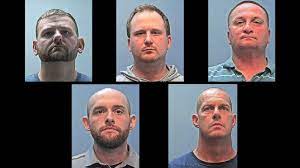
[Three police officers and two paramedics (above) — walked up before the judge one afternoon in January 2023. The courtroom was filled with family, friends and fellow police officers and paramedics. All five faced felony charges of manslaughter and criminally negligent homicide for their roles in the death of Elijah McClain, a 23-year-old Black man, in the summer of 2019. They all pled “not guilty” to felony charges regarding their action or inaction in the death of McClain]
“The aftermath of McClain’s death must be understood as taking place in two different worlds: before and after the killing of George Floyd by the Minneapolis police in May 2020, which ignited a national racial-justice movement that demanded accountability, reform and even the defunding of the police. But that reckoning, as it was often called, was followed by a backlash.
“No one in Aurora could have foretold how McClain’s death, the officers and paramedics involved and the city itself would all be swept up in that reckoning and the reaction to it.
“’It turned the city upside down,’ says Angela Lawson, Aurora’s only African American member of the City Council. ‘It brought out racial issues. It brought out disparity issues. It brought out the division that we actually have in our city.’
“Without the political pressure kindled by protests, first in George Floyd’s name and then in McClain’s, the case would have been left behind in 2019. Instead, it was propelled forward, first in the streets, then in the courts. The police officers and the paramedics will be prosecuted in three separate trials in September, October, and November [2023], the last chapter in a saga that has exposed deep rifts, with politicians, pastors and ordinary citizens holding starkly different views about their neighbors, their police force, and their hometown.
“In nearly three dozen interviews with Auroras — including McClain’s family and friends, former and current officials with the Police and Fire Departments, city and state politicians, faith leaders and residents — along with reviews of police reports, autopsy reports, first-responder protocols, internal memos, independent investigations, lawsuits and video footage, a portrait emerged of Colorado’s third-largest city in the midst of its own public trial.
“Aurora’s painful, conflicted journey over the past four years would raise uncomfortable questions about the meaning of public safety and illuminate both the promise and the limits of reform. There were real achievements — new legislation and restrictions from the city and the state, and in both the Police and Fire Departments… but not always as fast or far-reaching as activists may have wanted…
“The appetite for major changes to policing was loudest in Aurora and across the country immediately after George Floyd’s death and the waves of protests that followed, only to fade as the political winds shifted…
“The fundamental question now is what it takes to get policing in America right, and whether incremental steps — or even a consent decree meant to force change — can ever cover enough distance.
[The article goes on to report the actions that led to McClain’s death: “The surveillance camera at the convenience store McClain walked to in his neighborhood on the night of Aug. 24, 2019, recorded him buying Arizona iced teas. Although the temperature was in the upper 60s, he wore a jacket and a ski mask (a neck gaiter pulled up over his nose and mouth). His mother would later explain that he was anemic and often cold, so he wore masks to keep his face warm. [He] left the store and began walking through a neighborhood of low-slung apartment buildings and modest single-family homes, listening to music through earbuds and waving his arms. Though he was an unimposing figure at 5-foot-7, a passing motorist called 911 around 10:30 p.m. to report a person behaving strangely. ‘He looks sketchy,’ the caller said, according to a transcript of the four-minute call. ‘He might be a good person or a bad person.’ The dispatcher asked a series of questions. He answered that he did not see any weapons and did not feel he was in danger.
[The first arriving officer] Woodyard “stepped from his police vehicle and repeatedly told McClain to stop. McClain did not. In seconds, Woodyard put his hands on him. ‘Stop right there. Stop. Stop,’ he said. ‘I have the right to stop you because you’re being suspicious.’ McClain, who had never been arrested, responded that he was simply trying to go home. ‘Please respect the boundaries that I am speaking,’ he said, his voice cracking. ‘This isn’t going to go well,’ one of the officers told him. Much of what happened next would not be seen because all three of the officers’ body cameras dislodged or deactivated, though some audio could still be heard. The exchange rapidly escalated as the three officers forcibly moved McClain to a nearby grassy area. ‘He grabbed your gun, dude!’ Roedema told Rosenblatt. (According to the indictment, Rosenblatt would later say that he did not feel any contact with his service weapon.)
“The three officers tackled McClain. Woodyard grasped him from behind in a carotid hold, a controversial law-enforcement maneuver similar to a chokehold… [Read the full description HERE of the stop, McClain’s struggle and restraint, and paramedics injected 500 mg of ketamine which was later found to contribute to his death later at the hospital.]
“The controversial field diagnosis, characterized by a perception of aggression, distress and extraordinary physical strength, is found in some police training materials and used by some first responders across the country… and disproportionately used to explain the deaths of young Black men in police encounters. [McClain went into cardiac arrest in the ambulance. At the hospital, he never regained consciousness] …
“A history of violent encounters between the Aurora police and Black residents had led to deep distrust…
“The next morning, Sheneen McClain, Elijah’s mother, spoke to an Aurora police representative who said her son had been hospitalized after an altercation with the police the night before. She was mystified: The boy she raised, her second born, was a gentle soul who had become a vegetarian because he couldn’t bear to cause harm to animals and had taught himself to play the violin. Colleagues and clients at the Massage Envy spa where he had worked for about four years would tell local reporters they knew him as a caring, empathetic massage therapist…
“That September, the police finally allowed Sheneen to listen to the 911 call that summoned the police and watch the body-camera footage of the officers who confronted Elijah. She never believed that her son had committed a crime. What she heard and saw confirmed what was already in her heart. In early October, McClain held her first news conference, flanked by a civil rights attorney, local pastors, community activists and friends carrying ‘Justice for Elijah McClain’ signs. They called for an independent investigation and for criminal charges for the officers. ‘Once I saw the video,’ she told me, ‘I am doing everything I can to get justice for my son…’
“Three days later, the autopsy report was released… the forensic pathologist who conducted the autopsy, concluded that McClain’s death was due to ‘undetermined causes.’ He noted that ‘the decedent was violently struggling with officers who were attempting to restrain him. Most likely the decedent’s physical exertion contributed to death. It is unclear if the officers’ actions contributed as well.’ He added that ‘while on scene, the decedent displayed agitated behavior and enhanced strength.’ The report noted other possible factors, including the carotid hold, an ‘idiosyncratic drug reaction’ to ketamine or ‘excited delirium…’
“In a City Council meeting on Nov. 18, six conservative members sat on the dais wearing T-shirts emblazoned with the ‘Thin Blue Line’ flag; two said publicly that they wanted to show support to the police…
“Four days later, the Adams County district attorney… declined to file charges against the officers involved in McClain’s death, citing the autopsy report and insufficient evidence… [Chief] Metz called McClain’s death a ‘tragedy.’ But he insisted that based on what the officers said, ‘Elijah grabbed the grip of an officer’s holstered gun…’ (Metz then retired weeks later.)
“At the same news conference… the Fire Department… concluded that the patient care provided to Mr. McClain was appropriate given the circumstances… ‘exhibiting signs of excited delirium.’
The case seemed to be over: McClain had violently resisted arrest and had posed a threat to the officers, who struggled to subdue him as he tried to take one of their guns… It was done.
“The killing of George Floyd by the Minneapolis police during nine horrifying minutes recorded on video by a bystander on Memorial Day 2020 triggered an earthquake that couldn’t have been predicted…
“In Aurora, the new interim police chief, Vanessa Wilson, a veteran on the force for more than 20 years, presented herself as a reformer who wanted to restore the department’s reputation by ridding the force of rogue officers and personally connecting with the city’s Black community. On June 2, Wilson even marched and knelt with protesters against police violence…
“[Protestors in Aurora] did not chant George Floyd’s name once. Instead, they chanted, ‘Elijah McClain…’
“What seemed over and done just seven months before was now undone…
“[Chief] Wilson announced new policies in mid-June amid the growing protests, including a ban on the carotid control hold that was used on McClain. The new directives also called for officers to intervene when they witnessed misconduct…
“At a special City Council meeting three days later, [Chief] Wilson said… ‘We were attacked with rocks, and we had to defend our officers… My officers aren’t sacrificial lambs.’
On July 3, just days after the police chief’s defense of her department, she had to take a very different stance. Wilson told the public that she had fired three officers and that one more had resigned. The reason: The previous October, three of them took smiling selfies at the site where McClain had been stopped by the police…
“Hours after Wilson released the photo, at least 600 people massed outside Aurora’s District 1 police station to demand the firing of all the officers involved in McClain’s death. They refused to stand down, even using ropes, boards and picnic tables to block the station doors…
“As in other places around the country, many officers began to leave the department…
“’Immediately after McClain died,’ Doug Wilkinson, the former president of the Aurora Police Association (the force’s union), told me in an email, ‘after Chief Wilson took over, she threw the officers under the bus…
On Aug. 4, Wilson, now formally hired as Aurora’s police chief, had to publicly apologize again, after officers ordered a Black mother and her daughter, younger sister and nieces, ages 6 to 17, out of their parked car and forced the children to lie face down on the hot pavement… Wilson told a local radio station. ‘I hope the community knows that I’m serious about change, and I’m serious about moving this agency forward, and hopefully healing in the community as best we can…’
On Aug. 11, the state attorney general, Phil Weiser, announced an investigation into the Aurora Police Department’s patterns and practices…
“A group of independent investigators approved by the City Council released a withering report in February 2021, concluding that the police officers and paramedics mishandled the encounter with McClain every step of the way, from the initial decision to stop him to the unnecessary use of force…
On Sept. 1, 2021, the grand jury handed up a 32-count indictment of Officers Rosenblatt, Roedema and Woodyard and the paramedics, Cooper and Cichuniec, with all of them facing felony charges of manslaughter and criminally negligent homicide. But the Aurora Police Association, which its president says is supporting the indicted officers through its legal defense fund, took an adversarial stance in a statement… ‘Our officers did nothing wrong.’ It continued: ‘The hysterical overreaction to this case has severely damaged the Police Department. Inevitably, the public are the ones who’ve paid the price.’
“Two weeks later, Weiser’s state investigation of the department delivered another blow, concluding that it practiced racially-biased policing and used excessive force… the report said, African Americans accounted for half of all police interactions involving force, though they represented just 15 percent of the population…
“On Election Day, three Republican candidates, all endorsed by the local branch of the Fraternal Order of Police, won their races, ushering in a conservative majority…
That winter, Chief Wilson fired Doug Wilkinson, the president of the Aurora Police Association and an officer on the force, after he sent an email to the union’s hundreds of members complaining about the consent decree and the department’s efforts to increase diversity in hiring. ‘To match the “diversity” of “the community,” Wilkinson wrote, ‘we could make sure to hire 10% illegal aliens, 50% weed smokers, 10% crackheads and a few child molesters and murderers to round it out. You know, so we can make the department look like the “community…”’
“[Chief] Wilson was fired by the city manager, Jim Twombly, in April 2022 amid pressure from the conservative faction on the City Council. Twombly told me that the firing was not politically motivated… She had been better at reaching out to the community than at improving internal operations…
Thomas Mayes, a local pastor, says he was called by the Aurora police chief to a meeting of community leaders after McClain was hospitalized. “We knew this city could blow,” he said…
I asked him if he thought good policing was possible. ‘Oh, absolutely, absolutely. The policing problem is that you have 90 percent good police officers, but that 10 percent or 5 percent, whatever the scientific number is, is enough to taint it. It’s like saying, “I have a whole pitcher full of Kool-Aid with a few drops of arsenic in it.” It contaminates the entire pitcher…’
“The issues of race and policing remain some of the most vexing in America.
“Aurora had just brought in Art Acevedo, the former police chief in Austin, Houston and Miami, as an interim chief… But Acevedo told me he had made another change after McClain’s death. ‘We are not going to talk about excited delirium,’ he says. ‘We’re just going to be factual: What the suspect’s actions were. Here’s how we responded to that resistance. Here’s what we did.’
“He says that he took over a shrunken and demoralized force now facing the rigorous demands of the state’s consent decree. ‘You’ve got to make sure that people understand the policies, the procedures and the training that they’re being subjected to… we set the bar high, but then we don’t enforce the standard…’
“Omar Montgomery, president of the Aurora N.A.A.C.P… told me that the divide in Aurora over policing came down to a fundamental question that had entirely different answers on the two sides of the American divide. ‘It’s about how everyday people think about public safety. What does public safety look like — and does it look the same for everybody?’
[During Aurora’s upheaval, Jim Twombly was City Manager.] “He told me he believed that the officers involved in McClain’s death had ‘acted too quickly and went hands-on with Mr. McClain’ after ‘behavior that was not really threatening in any way… My biggest regret is that I didn’t step in more forcefully earlier in the Elijah McClain aftermath… And I think some of that was deference to the police leadership that, in retrospect, I shouldn’t have shown…’”
____________________
- Given this situation, the size of the police department, and today’s political climate, is police improvement possible? And what do we mean by “improvement?”
- The article appears to define improvement/reform as prohibiting choke holds and requiring officers to report misconduct on the part of their colleagues. What else needs to be done in Aurora? What ever happened to the President’s Task Force Report on 21st Century Policing?
- How is “good and democratic” policing defined? Was there any discussion of Procedural Justice and how its principles might help build trust of police by citizens?
- Given the exodus today of many police in Aurora, how might recruitment, selection, training standards be raised including the development of future police leaders who play a critical role in changing a “them versus us” culture within the department?
- In Minneapolis, some citizens were calling for the elimination of the current police department and establishment of a new and democratically-oriented police agency for the city. Can the current crisis lead to a community-wide discussion and potential agreement as to how laws are to be enforced and order maintained in the city?
- No doubt, in Aurora and most American cities, trust of the police has been severely fractured. What can be done to increase trust of police by people of color in our nation’s cities?
- What would a multi-year police improvement plan look like? How would improvement goals and outcomes be measured?
- What kind of systems are available to give police more immediate feedback on how they are doing? For example, here’s one way to build trust.
HERE is the latest update on the first trial — one officer convicted, the other acquitted.
“A Colorado jury split its decision in the 2019 death of a young, unarmed Black man, convicting one police officer but acquitting the other on Thursday afternoon, in a case that drew national attention after the murder of George Floyd. A mostly white jury of seven men and five women deliberated for just over two days following the three-week trial against Randy Roedema and Jason Rosenblatt, for the death of Elijah McClain. But jurors found only Mr. Roedema, 41, guilty of criminally negligent homicide and assault…”

 Improving Police: A Necessary Conversation
This is not so much an indication of a “systemic” problem as it is a simple matter of an officer either being ignorant of the limits of his authority or with bad habits allowed to continue due to poor supervision. Unfortunately, I have found far too many officers are simply ignorant of the limits of their authority. Or are not properly supervised. Then they fail to treat people with the dignity we all deserve as human beings. That starts a vicious downward spiral that sometimes leads to tragedies like this.
This statement says it all:
[The first arriving officer] Woodyard “stepped from his police vehicle and repeatedly told McClain to stop. McClain did not. In seconds, Woodyard put his hands on him. ‘Stop right there. Stop. Stop,’ he said. ‘I have the right to stop you because you’re being suspicious.’
No…an officer does not have the right to stop anyone unless that officer can articulate the facts and reasonable inferences that indicate a crime has occurred or is about to occur. This is the “reasonable suspicion” standard articulated in Terry v. Ohio and it provides the lawful authority for an officer to conduct a momentary seizure of the person or persons to investigate further.
The need to justify any seizure of an individual needs to be drilled into each and every officer and supervisors need to ensure compliance on every stop and arrest.
Once an officer makes a seizure, by saying or doing something that would cause a reasonable person to feel they could not leave or decline the contact, that person MAY NOT resist the officer. The officer is allowed to use “reasonable” force to stop the individual.
Without knowing anything further about this particular situation, a better course of action would have been for that officer to say “Excuse me Sir, may I speak with you for a moment?” In the absence of reasonable suspicion this is the limit of the officers authority in this case. A lack of cooperation from the “suspicious” person DOES NOT allow the officer to compel their cooperation or to use any force to do so. In the absence of reasonable suspicion, lawful authority, a competent officer must let it go or use a different tactic. Individuals have the right to simply walk away. This is what we are failing to train our officers on and supervise them for.
This was not, however, the case with Floyd. He was under arrest and the officers were exercising their authority legally UNTIL they failed to back off when he became compliant. Again, proper training and supervision was the problem. You never leave any individual laying on their stomach once their hands are cuffed behind them. We learned this in the 1980s and I’m sure Minneapolis trained their officers accordingly. Where was the Sergeant??? Where was the Lieutenant??? Just like in Memphis, the first individual fired should have been the unit commander, then the officers need to be held accountable in criminal court.
Race may be a factor, but poor training and incompetent supervision is a much more powerful explanatory variable in these cases. In my view.
LikeLike