“Surely the most dramatic finding in this project is that it is possible to ‘bend granite.'” — National Institute of Justice, 1993.
[An excerpt from "Bending Granite: 30+ True Stories of Leading Change."]

By David C. Couper

The picnic tables were weighed down with chicken and ham sandwiches,
big bowls of potato salad, fruit salad, seven-layer salad, potato chips.
One roaster held spaghetti with meatballs the size of baseballs. Another
pan featured pulled pork beside a mountainous platter of snowy buns.
Cakes, brownies, cookies filled another table. Lemonade and iced tea
were on tap and served from oversized glass pitchers. It was a beautiful
day on Madison’s South Side.

The event was the retirement party organized by local citizens for
a Madison Police Department community police officer. The salt-and pepper-haired officer was surrounded by kids, parents, grandparents,
friends, neighbors—everyone shaking his hand, giving him high-fives,
fist-bumps, elbow-touches, and big hugs. He had been the community
officer in this neighborhood for many years. No one here wanted to see
him go, but he was looking forward to a relaxed life of a retiree.
As the man of honor sat down with his plate of food, a disturbance
brewed across the street. A group of young men had been arguing. The
argument turned into shouting and then pushing and shoving. The officer
quickly put his plate on the ground and moved to get up to intervene.
As he moved, one of the neighbors put her hand gently on his shoulder,
and said, “You just sit down and enjoy your lunch, Bill. I will take care of this.”

And she did. She walked over to those young men and with unmistakable
authority, stopped the fight, and the party went on peacefully for
a long time. This is what community policing looks like—cooperation
and a shared commitment to a safe society.

This is what community policing looks like—cooperation and a shared
commitment to a safe society.

With community policing, the power is in the relationships between citizens and officers. Officers do not just arrive when someone dials 911.

They are in the neighborhood every day, visible in places where people
live and work. People know them personally, and they know the people.
Community policing empowers people both to solve their own problems
and to work together with police to solve problems collaboratively.
In this model, police officers are less enforcers and more keepers of the peace—as in keeping everyone safer. This was the vision of policing that I had when I became the chief of police in Madison. And the community policing principles such as decentralized decision-making, listening to our “customers,” seeking root causes, and using data for decision-making were the embodiment of quality management. But even the founder of what came to be known as “the quality improvement” movement,
W. Edwards Deming, doubted that this kind of approach would work
in government. Yet the years the city of Madison began implementing
Deming’s ideas into its police and other city services were golden. And
that is not just in my biased opinion. I love this definition:
Quality is a comprehensive approach to the organization and the
design of work processes. It is a way to think about stuff. It is a way to treat each other. It is a way to constantly improve everything we lay our hands on. (Cheaney and Cotter, 1991)

I served as Madison’s chief of police from 1972 to 1993. I call them
the “golden years.” Those days were a time when unique, challenging
ideas about systems, teams of people, and work caught fire and raised
the hearts, spirit, and productivity of city workers. Many of us who
were able to integrate these new ideas about systems, teams, and work
saw the positive results. The universal principles of leading change by
focusing on systematic improvement that had such positive impacts
then are the very ones needed now in every sector of our country. Here
is our story.

I was not interested in juggling another change that this new mayor was proposing.

In 1983, the newly elected mayor of Madison, Joe Sensenbrenner, was
moved by what he was reading and learning about W. Edwards Deming
and improving systems. I had been chief of police in Madison for ten years by then. At the time, I had my hands full trying to heal the wounds from the Vietnam “War at Home,” from fighting the police union, and from integrating a nearly all-white, all-male police department. I was not interested in juggling another change this new mayor was proposing. Instead, I sent a deputy to the mayor’s first discussion about Deming’s ideas.

It wasn’t that I didn’t believe in achieving excellence. I did. What I didn’t have was a plan to operationalize it. In my first year in Madison, I had offered this vision that fundamentally reshaped the purposes of policing:

1. Decentralize police services and develop neighborhood and
team policing; be closer to the people we serve.

2. Build a people-oriented organization sensitive to, and understanding
of, human behavior, which means hiring educated
police officers and working with community members to prevent,
diminish, and even eliminate crime and disorder.

3. Develop a high capacity for conflict management and crisis
intervention to reduce the acrimonious relationship between
police and students (in what is one of the biggest “college towns”
in the world) by developing new strategies and tactics to replace
tear gas and nightsticks.

I also presented the long-term goal of making “the quantum leap
necessary to field a behavioral and human services expert which shall be
known as a professional police officer” (see Couper and Lobitz, 2014).

A quality orientation separates the warrior cops from the guardians of
the peace—the men and women in policing who see their function as
crime fighters or rule-enforcers compared to those who see their job as
working closely with community members to achieve safe and orderly
neighborhoods. I wanted our officers to see themselves more as keepers
of the peace than law enforcers.

I read deeply into leadership literature. Tom Gordon’s Leadership
Effectiveness Training and Robert Greenleaf ’s concept of servant
leadership reinforced my nascent understanding of what Deming was
proposing and strongly influenced how I would lead and train leaders
in the Madison police department. I came to see the immense opportunity
to improve our work as a police agency by thinking in systems,
working together, getting closer to the community, and making databased
decisions. It also meant that I needed to change—to listen to
those who delivered the service (cops) as well as those who received
it (residents and businesses and service providers). Deming’s teaching
enabled me to put into organizational practice my own deeply held
values around participation, problem-solving, leadership, and continuous
improvement.

A behavioral and human services expert which shall be known as a professional police officer.

To better understand how community policing was going, every year I
would spend a month working side-by-side with front line officers on
all the shifts to keep me close to the work. I actually witnessed policing from the street up, and at the same time was able to send an unmistakable message about customer focus and learning as critical to effective leadership.

We ultimately moved from being a learning organization to one
committed to teaching and sharing with others what we were learning.
The twelve quality principles that were essential to our transformation
are described in my book, The New Quality Leadership Workbook for
Police (Couper and Lobitz, 2015).

1. Believe in, foster, and support teamwork.
2. Be committed to the problem-solving process; use it and let data,
not emotions, drive decisions.
3. Seek employees’ input before you make key decisions.
4. Believe that the best way to improve the quality of work or service
is to ask and listen to employees who are doing the work.
5. Strive to develop mutual respect and trust among employees.
6. Have a customer orientation and focus toward both employees
and residents and businesses.
7. Manage the behavior of 95 percent of employees and not the 5 percent
who cause problems. Deal with the 5 percent promptly and
fairly.
8. Improve systems and examine processes before placing blame on
people.
9. Avoid top-down power-oriented decision-making whenever
possible.
10. Encourage creativity through risk-taking and be tolerant of honest
mistakes.
11. Develop an open atmosphere that encourages providing and
accepting feedback.
12. Use teamwork to develop agreed-upon goals with employees, and
a plan to achieve them.

We began to experience the power of “we” in our cross-functional team meetings.

As these new and radical ideas took root, we began to experience the
power of “we” in our cross-functional team meetings. We began to use
trained facilitators at all our important, decision-making meetings. We
told our leaders to “lead by wandering around,” and for the first time we asked our officers about their work and deeply listened to their answers.

I decided to engage by scheduling a score or more of employee meetings,
asking them: “What needs fixing?” and “How can I improve?” (It
was, as they say, a “significant emotional experience.” On the days I held these meetings, I came home from work with tears in my eyes. But we
all got better.)

Through a newly established, community-wide organization called
the Madison Area Quality Improvement Network (MAQIN), I began
to see that what I was experiencing and learning not only applied to government but also local businesses, job creation, industry, better healthcare, and improved educational practices. We began to talk with, share, and learn from one another.

I personally sent out a “customer feedback” form to persons identified in every 50th case number.

Probably nothing more profound, yet so unrooting to police culture,
was the idea that members of our community were our “customers.” As
I began to teach these ideas outside of Madison, no idea received greater pushback and resistance than identifying community members as “customers.” Audiences were astounded to learn that I personally sent out a “customer feedback” form to persons identified in every 50th case number— and that included persons who had been arrested and jailed!

You cannot do your job if you do not have the support of the community,
and police officers should represent the community they serve. When I
first became the chief of police in Madison, we had 300 employees and
only one of them was black. The MPD was composed of white, male,
mostly high-school graduates.

I wanted well-educated officers. Even though we did not have a
formal four-year degree requirement, we eventually were able to attract
more applicants with baccalaureate degrees, including many from
minority backgrounds. I found that the most effective recruiting results
were obtained by likening police work to joining a domestic Peace Corps
and describing it as an essential job in our community in need of people
with solid backgrounds in social work, conflict resolution, and helping
professions.

We also provided postsecondary incentives by offering higher pay
for those working on or who had completed baccalaureate and graduate
degrees. Through aggressive recruiting and the compelling vision, we
communicated that we were a place for college graduates. We were able
to raise the educational level, integrate the department on both gender
and race, and receive praise from our community for doing so. To help
ensure increasing diversity in the department, I called for more diversity in the MPD Academy, the program for training new officers. If a search for new officers yielded no minority members or women, I sent
the hiring team back to the drawing board to try again. Despite initial
opposition from my fellow police officers, we recruited nationally from
the best, most diverse, and educated pool of potential officers, receiving over 1000 applications for a recruitment class. In time, half of the Academy classes were women and people of color.

I also instituted an Officer’s Advisory Council (OAC) which
played a major role in the leadership and administration of the police
department. The OAC decided policies on issues such as uniforms,
weaponry, vehicle purchase, and other issues impacting the daily work
of the department. I added the head of the union to my management
team. My idea of an elected employee advisory council and placing the
union head on my management team remained in place for a number
of years after my retirement. Many systems in hiring and training have
continued.

Data for decision-making was one of the principles of this transformation effort.

Data for decision-making was one of the principles of this transformation effort. How effective were we as a police department in implementing Deming’s ideas? I needed to know the answer to this question, so I requested an independent evaluation by the National Institute of Justice to measure the outcomes. Results of their three-year study showed that MPD had significantly changed for the better. They found that our new style of “quality leadership” was apparent throughout the department.

We had created a new, flatter organizational design—both structural
and managerial—to support community-and problem-oriented policing;
in effect, we were able to “get closer” to those whom we served.

They concluded that our attempt to bring comprehensive and effective
change to our operations was successful:

Surely the most dramatic finding in this project is that it is possible
to “bend granite....” It is possible to change a traditional, control-oriented police organization into one in which employees become members
of work teams and participants in decision-making processes…. This
research suggests that associated with these internal changes are external benefits for citizens, including indications of reductions in crime and reduced levels of concern about crime.

What did I learn from these efforts? First, it’s a lot easier to talk about making improvements than to do it. Second, doing it can be harder than you can imagine. Today, I would add a third: Sustaining change is even more difficult than making it.

Transformations—especially those that are so massive in scope as Deming taught—must have a totally supportive leader who is truly committed and seen to “walk the talk.”

To lead significant change in an organization like a police department
takes a healthy mixture of passion, patience, and persistence. What I
learned most was that organizational transformations—especially those
that are so massive in scope as Deming taught—must have a totally supportive leader who is truly committed and seen to “walk the talk.”

Today, in the 2020s, the United States leads all other democratic
nations in the use of deadly force against its “customers.” Looking at the issues post-George Floyd and others surrounding the lack of connection, trust, and accountability between law enforcement and the communities we serve, I have to say that many of the lessons we learned in the past about achieving excellence still have much relevance. Important methods still exist that can help police renew trust and support from the people we serve. Militarization is not the way forward, nor is training police recruits as if they had joined the Marines.

Militarization is not the way forward, nor is training police recruits as if they had joined the Marines.

After I retired from law enforcement, I did not forget what I had learned leading improvement efforts. As a church leader, I have brought many of the things I learned from Deming with me: the importance of customer feedback in deeply listening to others; continuing to practice
those twelve principles of leadership; and the importance of facilitating meetings so that everyone has a voice. What I learned not only helped me become a better police leader, but I think it also helped me to be a better person.

_______________________________________

References

Cheaney, L. and Cotter, M. (1991). Real people, real work. Statistical Process
 Controls, Inc.
Couper, D.C. and Lobitz, S. (2014). The new quality leadership workbook for
 police: Improvement and leadership methods for police Amazon.com.
Couper, D.C. ( July 1973). “The First Seven Months and the Next Seven Years.”
 Presentation to Madison Downtown Rotary Club.
Wycoff, M.A. and Kogan, W.G. (1993). Community policing in Madison: Quality
 from the inside, out: An evaluation of implementation and impact executive
 summary. National Institute of Justice.

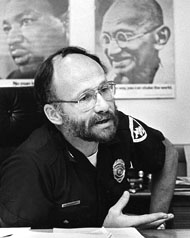
Rev. David C. Couper, now an ordained minister in the Episcopal Church, was Madison’s chief of police from 1972 to 1993. Under his leadership, the department was transformed as he brought educated women and minorities into a virtually all-white, all-male police department. The third edition of his book, Arrested Development (2021), articulates his concern about the increasing militarization of our nation’s police forces and their slow progress in changing to meet the new challenges they are facing.


Questions for Reflection and Discussion

1. Pick one of the author’s dozen practices from the list in this story
that you have tried or at least seen being tried in your workplace. Tell
what happened.

2. Do you think the principles or practices of leading change outlined
in this story can be used to address current systemic problems in the
workplace or society? Why or why not? Give examples either way.

3. Besides policing, what other institutions or organizations need serious
 transformation? Name and describe one of them that you are
involved with or work for.


 Improving Police: A Necessary Conversation