
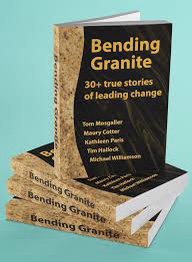
Bending Granite: 30+ True Stories of Leading Change
Surely the most dramatic finding in this project is that it is possible to “bend granite….” — National Institute of Justice, 1993.
[Excerpts from my chapter on changing police]
———————————————————
BENDING GRANITE
The picnic tables were weighed down with chicken and ham sandwiches, big bowls of potato salad, fruit salad, seven-layer salad, potato chips. One roaster held spaghetti with meatballs the size of baseballs. Another pan featured pulled pork beside a mountainous platter of snowy buns. Cakes, brownies, cookies filled another table. Lemonade and iced tea were on tap and served from oversized glass pitchers. It was a beautiful day on Madison’s South Side. The event was the retirement party organized by local citizens for a Madison Police Department community police officer. The salt-and pepper-haired officer was surrounded by kids, parents, grandparents,friends, neighbors—everyone shaking his hand, giving him high-fives,fist-bumps, elbow-touches, and big hugs.
He had been the community officer in this neighborhood for many years. No one here wanted to see him go, but he was looking forward to a relaxed life of a retiree. As the man of honor sat down with his plate of food, a disturbance brewed across the street. A group of young men had been arguing. The argument turned into shouting and then pushing and shoving. The officer quickly put his plate on the ground and moved to get up to intervene. As he moved, one of the neighbors put her hand gently on his shoulder,and said, “You just sit down and enjoy your lunch, Bill. I will take care of this.”
And she did. She walked over to those young men and with unmistakable authority, stopped the fight, and the party went on peacefully for a long time. This is what community policing looks like—cooperation and a shared commitment to a safe society…
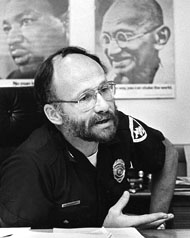
I served as Madison’s chief of police from 1972 to 1993. I call them the “golden years.” Those days were a time when unique, challenging ideas about systems, teams of people, and work caught fire and raised the hearts, spirit, and productivity of city workers. Many of us who were able to integrate these new ideas about systems, teams, and work saw the positive results. The universal principles of leading change by focusing on systematic improvement that had such positive impacts then are the very ones needed now in every sector of our country.
Here is our story. In 1983, the newly elected mayor of Madison, Joe Sensenbrenner, was moved by what he was reading and learning about W. Edwards Deming and improving systems. I had been chief of police in Madison for ten years by then. At the time, I had my hands full trying to heal the wounds from the Vietnam “War at Home,” from fighting the police union, and from integrating a nearly all-white, all-male police department. I was not interested in juggling another change this new mayor was proposing. Instead, I sent a deputy to the mayor’s first discussion about Deming’s ideas. It wasn’t that I didn’t believe in achieving excellence. I did. What I didn’t have was a plan to operationalize it…
A quality orientation separates the warrior cops from the guardians of the peace—the men and women in policing who see their function as crime fighters or rule-enforcers compared to those who see their job as working closely with community members to achieve safe and orderly neighborhoods. I wanted our officers to see themselves more as keepers of the peace than law enforcers…
I read deeply into leadership literature. Tom Gordon’s Leadership Effectiveness Training and Robert Greenleaf ’s concept of servant leadership reinforced my nascent understanding of what Deming was proposing and strongly influenced how I would lead and train leaders in the Madison police department. I came to see the immense opportunity to improve our work as a police agency by thinking in systems, working together, getting closer to the community, and making databased decisions.
It also meant that I needed to change—to listen to those who delivered the service (cops) as well as those who received it (residents and businesses and service providers). Deming’s teaching enabled me to put into organizational practice my own deeply held values around participation, problem-solving, leadership, and continuous improvement… We ultimately moved from being a learning organization to one committed to teaching and sharing with others what we were learning…
Through a newly established, community-wide organization called the Madison Area Quality Improvement Network (MAQIN), I began to see that what I was experiencing and learning not only applied to government but also local businesses, job creation, industry, better healthcare, and improved educational practices. We began to talk with, share, and learn from one another…
——————————————
You can find out more about what happened during the Madison police transformation: Read and digest the new book on the quality movement in the police department and beyond. There’s great learning here in these 30+ stories.

 Improving Police: A Necessary Conversation