Recently, one of my readers asked about the facts surrounding the death of George Floyd in the spring of 2020. I suggested a news article and, perhaps, that he review the voluminous Hennepin County court documents surrounding the trial of the four police officers involved. Subsequently, a former colleague of mine offered Floyd’s toxicology report here showing several, perhaps life-threatening, drugs in Floyd at the time of his arrest. Then a reader alerted me to the recent crowd-sourced documentary film, “The Fall of Minneapolis.”
I urge you to view it and then continue reading…
There is “wheat among the chaff” in the film, the chaff is there but should have little impact on the facts of this case. So, beware, think, and discern… For example: Floyd’s past criminal record, whether prosecutors in the case had defended gang members in the past, or whether the judge had worked in the past for the county prosecutor’s office really matters little. There exists, however, a tremendous amount of pain in this story – to both police, the family of George Floyd, the families of the convicted officers, members of the police department, and citizens of Minneapolis. It will be a long time before this is healed.
The film is extremely provocative and, as a former police officer and resident of Minneapolis, sad… very sad. The documentary offers a point of view which needs to be considered and, for me, a clarion call to improve the strategies and tactics of police, particularly in poor neighborhoods, whether you support or do not support what happened.
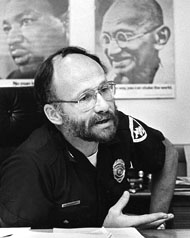
I totally understand the feelings of the Minneapolis police officers who were interviewed. But something also triggered me. I was an officer and detective there for seven years. I lived with my wife and children less than a mile from the scene of this event. I left the extreme politics of the department because I could see no future for me (a recent college graduate) and having a desire to lead other cops. Since that time, I went on to head up two municipal police departments – the Minneapolis suburb of Burnsville for four years and then over 20 years as chief of police in Madison, Wisconsin.
I left the Minneapolis Police Department because, early on, I saw no future there no way that my vision of policing could ever be realized.
At the same time, we must try and understand the police role most political leaders in urban cities in America demand: that police control the activities of poor, and often Black, neighborhoods. So when some citizens call to “eliminate the police” people of means and wealth in the community fear they will not be protected from the “others.” And so any attempt to change/improve the role and function of police in the city will ultimately fail because there can be no agreement on what that means because those who “have” will feel they will be less protected. After all, how often does a white man of means have any contact with a police officer other than at a traffic incident?
At the same time, other institutions, and functions of social control in society continue to under-perform and even fail – decent and fair-wage employment, universal healthcare, addiction services, adequate housing, free, or highly subsidized, higher education, justice in our courts, a prison system that rehabilitates, and belief that a good, safe, and decent is available for all regardless of race, color, or creed.
Over the years, I have kept watch on the city of my youth, efforts over the years to pull away from the political system of “new mayor, new police chief, and promotions based on political affiliation.” I was on the street in 1967 when people of color on the northside of the city revolted and burned down several businesses on Plymouth Avenue. I was a member of the tactical squad assembled to stop rioters from burning those businesses. Fortunately, Mayor Art Naftalin ordered us to “stand down.” The lesson I learned was that “people are more important than property.” It was to do me well in handling hundreds of protests in Madison over the years.
Therefore, I can understand Mayor Jacob Fry’s decision to abandon the Third Precinct building. After my experience at the scene of looting and burning, I asked to work out of the northside station and was able to create the first foot beat in a Black neighborhood. The experience changed my life as I, a privileged white man, came to better understand race and policing as a system of control and the importance of what was later to be called Procedural Justice.
My early academic training was as a sociologist. And that causes me to think beyond the events that led to the death of George Floyd and the arrest and imprisonment of four police officers on that fateful day at the intersection of 38th and Chicago.
Here’s some of my thoughts, some random, after following the events that occurred after Floyd’s death, viewing this newly-released film, my experience having grown up in Minneapolis, being a cop for 33 years, a published author and blogger, and observer of policing in America during the past 60 years:
- If I was to have somehow receive a counterfeit bill and used it for a purchase, how would that event proceed? I am an older white male. After all, could a person invertedly receive and pass on a counterfeit bill?
- How should I expect police to respond to such a matter? Because this is how it all began. Would I expect to be confronted with a pointed firearm by a responding police officer? Being sworn at and handcuffed as I protested my innocence? Clearly what happened was outside the boundaries of Procedural Justice (see the above link) or effective intervention techniques as you hear elevated, angry orders shouted by police officers.
- Would most police officers, having viewed these body camera tapes, not agree that this encounter could have been much better?
- When police officers are not respected and supported by those whom they serve, the only avenue they have left is the threat (and application) of violence. [For more on this, see Sir Robert Peel’s 19th century Principles of Policing on this blog.]
- If we want to understand what happened in Minneapolis, we must try to understand what happened at the very beginning of this encounter as shown in the body camera video of the responding officers in this film. How did all this start?
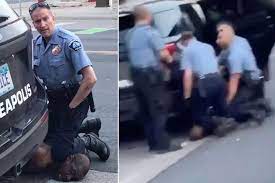
- We must also understand the power of that powerful image – the picture of Officer Chauvin kneeling on the neck of George Floyd seemingly unconcerned (appearing to many casual and distaining). Did this photo not have an historical reminder of slavery? A picture can speak a thousand words. This one did and it became viral and at the trial.
- I believe it is precisely these kinds of contacts between police and people of color that has generated (and continues to generate) the anger and violence within the community that exploded in Minneapolis (and many other cities across the country).
- You see, it doesn’t really matter that the initial arresting officer was black, because once a black man or woman becomes a police officer, he or she is no longer black but blue; the powerful police subculturemost always tops race.
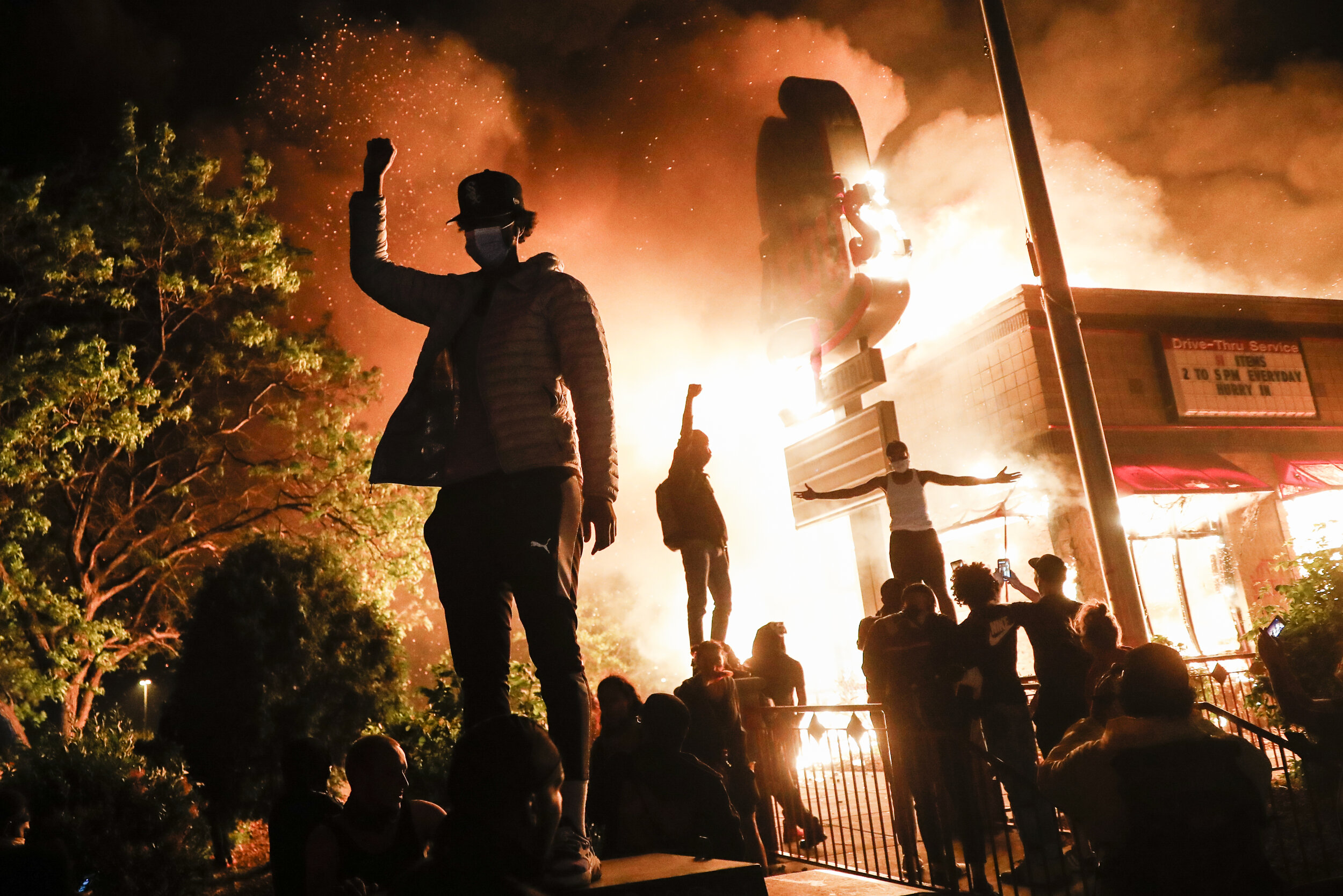
- So what happened is a community-wide uprising by people of color who are all-to-familiar with this kind of disrespectful behavior on the part of police. It was a time in which “enough was enough” and that anger exploded in and caused hatred toward police, property destruction, fires, and looting.
- Yes… it was bound to end this way. It was “murder” for many observers, and the feeling across the country that these officers must be convicted and go to prison.
- As a former police defensive tactics instructor in Minneapolis, I taught officers a very similar restraining technique for non-complying suspects: one or two officers were to do the restraining and handcuffing, another officer was to “bearhug” the suspect’s legs to prevent kicking or rising. The handcuffing officer was to kneel on the suspects back (but only to handcuff — not remain kneeling on the suspect’s neck!).
- Was justice served in Minneapolis? Was Lady Justice blind or did she remove her blind and see a wealthy, creative Midwest American city who had lost its way and needed correction?
- Should the trial have been held in Minneapolis given all the anger and property damage that followed to a quieter venue?
- Were jurors able to make a fair decision given their understanding of what would happen should they not find the officers guilty?
- Is this decision not unlike the jurors’ decision in the murder trial of OJ Simpson in 1995? What would have happened in the city of Los Angeles if the jury had convicted OJ? Was the decision not a set-back for the LAPD who had been disrespecting and aggressively stopping and frisking thousands of Black youths over recent years?
- When the call became “eliminate the police” in Minneapolis it was an opportunity to do just that – to re-imagine and re-create a new police function based on community input. Was than not a missed opportunity?
- But that was not to happen. The narrative became “the present department is okay, it’s just these bad officers who need to be punished” when, in fact, the whole department needed to be either improved or even eliminated.
- If the careers of four diverse police officers were to be sacrificed, was it worth it? I would have hoped that the sacrifice would have resulted in a much better police department to serve the city (college-educated, service-oriented, well-trained, respectful, controlled in their use of force, and led by mature leaders). That did not, and will never happen, in Minneapolis or any other urban American city. And that is a great loss.
- Review the film and let me know your thoughts.
Updates: The US Supreme Court will not hear Derek Chauvin’s appeal. More HERE. And in New York, a ban on police use of chokeholds and diaphragm compression is upheld.
———————
And Check out my book: “Arrested Development: A Veteran Police Chief Sounds Off…”

 Improving Police: A Necessary Conversation
Thanks for sharing this, David. It’s a point of view that few folks have seen on this troubling event. There are profound implications portrayed here for our system of justice.
Calls for police reform have largely been driven by folks who believe that the focus of our moral concern should be with the protection of the vulnerable.
The unconstrained view defines the vulnerable as anyone who is a member of a “historically marginalized group,” the social justice perspective.” On this side are those deeply concerned with what they perceive as an alarming, decades-long pattern of harmful and unfair treatment of black persons by police (Silver, Goff & Iceland 2022).” This perspective demands that police agencies be purged of their racially biased cultures and even defunded.
On the other side is the “social order” perspective where the binding moral concern is social stability. Those on this side are deeply concerned with a growing antipathy toward the police that undermines the rule of law. Examples of excessive force are rare and unfortunate but inevitable given the highly ambiguous and complex job that the police have today, especially in poor communities.
The problem comes in how you define the vulnerable. The social justice perspective has a moral foundation based on group affiliation and creates a hierarchy of victimization that does not include “privileged” white men like Derek Chauvin. It’s derived from the classic Marxist oppressor/oppressed narrative.
The constrained view would include those who are the victims of crime or those who live in constant fear of crime, the criminal justice perspective. Group affiliation does not matter, it’s the individual and individual rights that is the focus of our concern.
The situation is made much worse by those who denigrate all the police by portraying them as racially biased and brutal. Those who have a vested interest in doing so include activist police leaders, prosecutors, politicians, and judges, as portrayed here. Those who are suffering as the result of their action are the people of Minneapolis, especially the poor.
A favorite source of moral guidance comes from the ancient Stoics. According to Meskill (2023) “what is truly good is good in all contexts. If something can be bad for us in certain situations, then it is not the true good. It follows that the only true good is a virtue. So, by definition, being virtuous is never a bad thing. There is no circumstance in which it is bad to act virtuously.”
Of course, the actions of these officers were not virtuous in this case and they are being held accountable, but the much bigger problem is the harm caused by those who stand for justice but subverted it to advance an activist perspective and destroyed social order in this city, they have been rewarded. This is bad for everyone, the opposite of virtue, i.e., evil and immoral.
LikeLike
I appreciate your insider perspective and especially your experience as a new cop with MPD. I started to look at the “documentary” and then the source. It is not crowdsourced. It’s a propaganda piece by a very right wing media source. Look at their other pieces. I am an elder white woman of privileged means, living in Mpls for the last 45 years. My experience with policing from Mpls police has been at least unpleasant, if not threatening, from the beginning. I do not evaluate all police the same. I have lots of personal experience around Mpls Black people as well. The problem with the rotten apple analogy is that rotten apples have the power of life and death over good cops who dare to challenge the gang mentality. MN150 website has a good long history of the origins of the Mpls police force that show the basic mission was to uphold the control of slave holders, businesses faced with unionization, and maintain the caste system from its onset. Only when citizens rewrite the mission and support evidence-based non-violent models for more interventions, can well meaning change agents like yourself have the clout to change the expectations of violent crime fighting by the public that continue to infect the viewpoints of police. Right now local media like Next Door are used by mostly male right wingers to foster the No Go Zone fantasy of Mpls that serves their ideological purposes. I ride my bike in summer in north Mpls to my local Y, ride all over the downtown, and do not fear for my life. Gangs are a true danger to civilians as well as Black youth, but that is the role of special task forces. Best wishes to our new public safety leaders, and RIP Tony Bouza.
LikeLike
Thanks for you views. I believe it is important to listen to a wide ranges of perspectives and ideas when it comes to the difficult task of policing a free and diverse society such as ours. You said you did not think the film was crowdsourced. A number of sites talk about the film as being such. For me, the film present another way of looking at all that happened in Minneapolis… another view. Thanks again for commenting.
LikeLike
Some comments on this piece, which I came across in looking for reviews of the documentary “The Fall of Minneapolis”. (My background: I am a serving police officer in Ontario, Canada with 28 years experience, including patrol, public order unit (specialized crowd control unit); and criminal investigations. I have a university degree in political science. My big caveat is that Canada is a different country and different culture than the U.S. I can only comment with an outsider’s perspective.
In regards to the following paragraph: “At the same time, we must try and understand the police role most political leaders in urban cities in America demand: that police control the activities of poor, and often Black, neighborhoods. So when some citizens call to “eliminate the police” people of means and wealth in the community fear they will not be protected from the “others.” And so any attempt to change/improve the role and function of police in the city will ultimately fail because there can be no agreement on what that means because those who “have” will feel they will be less protected. After all, how often does a white man of means have any contact with a police officer other than at a traffic incident?”
You seem to be confusing elimination of the police with “changing” the police. People calling for the elimination of police are very clear about what they want: getting rid of police. See Mariame Kaba’s June 12, 2020 opinion piece in the New York Times “Yes, We Mean Literally Abolish the Police”: https://www.nytimes.com/2020/06/12/opinion/sunday/floyd-abolish-defund-police.html
Police change and reform constantly occurs. In your career, you have surely seen lots of changes. I know I have. It’s a reality that the police department you join as a recruit will not be the same as the one you retire from 30 years later – policies, uniforms, technology, tactics, all are constantly evolving. I haven’t seen these changes cause worry to any segment of the population – other than officers who may not agree with any given change.
In regards to the list of points, I’ll start with 1) and 2). Could a counterfeit bill end up in the hands of an older white man? Sure. From my experience years ago working downtown Toronto, race had nothing to do with it. Counterfeit bills were typically used by low income petty criminals, often drug addicts. Any way, so what? The police didn’t pick George Floyd out of a hat. They were responding to a call about Floyd committing a criminal offence.
On point 3, yes. When I watched the approach to Floyd’s vehicle and the drawing of the handgun by the officer, I was taken aback. It’s not the way I’ve ever seen the initiation of contact play out. Having said that, I return to my caveat about being an outsider to the American situation. Your country’s population is by all accounts saturated in firearms. That’s a situation that is foreign to me. I get the sense frankly that your country is a war zone, so I can see why police – especially in a city with high rates of gun crimes – would be quick to draw.
Aside from the drawing of the side arm, the swearing by the officer also seemed over the top to me – especially given that he knew that his body camera was on. So, I would generally agree that better training would be appropriate if the approach seen on the video is the usual one taken by officers in the agency.
Point 4) “When police officers are not respected and supported by those whom they serve, the only avenue they have left is the threat (and application) of violence. [For more on this, see Sir Robert Peel’s 19th century Principles of Policing on this blog.]”
I have no idea what you mean by this. A general lack of support by any given segment of the population does not justify violence, nor have I ever seen it lead to violence by police. How many times have we had people refusing to give information regarding an occurrence being investigated? This is common. We don’t respond by assaulting them, we say “OK” and move on. The application of force by police in regards to George Floyd was due to Floyd’s resisting arrest. It’s abundantly clear from the body cam video. And I did not see anything excessive by police. In fact, they quickly called for an ambulance. Not something that they would have done if their intent was to kill.
The documentary makes a convincing case that Floyd died of a heart attack (I believe one of the pathologists says this) probably brought on by his exertion when he resisted arrest, and aggravated by the drugs in his system. (Frankly, I never did understand how pressure on the back of the neck would interfere with breathing – the wind pipe is at the front of the spinal column, not at the front.) What the film is saying is incredibly troubling: that at various levels of the justice system, participants conspired to conceal evidence for the purpose of reaching a pre-ordained verdict. Justice is supposed to be blind, but it doesn’t look like it was in this case. It’s frankly impossible for me to see how the jury could have concluded that Chauvin had the intent to murder Floyd. Even if the placement of his knee WAS on the back of the neck; and even if that pressure DID contribute to Floyd’s death, then a conviction for the UNINTENTIONAL contribution to Floyd’s demise would be the appropriate outcome (such as manslaughter).
I would agree with the idea of hiring people with post secondary education. Police departments will need to pay better salaries to get those people, especially in cities with high costs of living and high rates of violent crime . A quick check on-line for what the average salary is for an officer in Minneapolis shows an average salary of $67,600, which is less than what we make – and I currently live and work in a city with a population of about 130,000. So if the members of Minneapolis’ city counsel who are calling for better hires aren’t willing to provide better salaries, then frankly they’re just being performative.
LikeLike
Thanks for your views on this. Much improvement work needs to be done to build trust in all the communities and people police serve. I wish you a positive career!
LikeLike