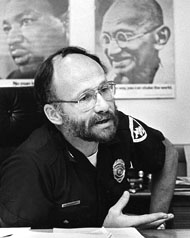

One of the things I have always recommended to my officers (and those considering policing as a career) is that they must work to cultivate activities and close relationships outside the police agency as well as inside. Police work can have a debilitating effect on one’s relationships and world-view. That is why it is important to be a well-rounded, emotionally intelligent person, committed to personal growth and learning.
Professor Jesse Cheng recently sent me a copy of an important article he has written about the effects of “hyper-vigilance” on police officers. Maintaining the balance and mental health of our nation’s police officers is essential in a free society and, in light of the recent spate of police suicides, make this paper an important addition to our knowledge about policing and mental health..
I have summarized a number of key points Prof. Cheng makes in the article. [My emphases in bold]. You can access the full article HERE.
Addictive Hypervigilance and Uncontrolled Use of Force
Prof. Jesse Cheng
“This hypothesis posits that a behavioral addiction to hypervigilance may be contributing causal factor to some instances of uncontrolled police use of force…
“Stated more precisely, a hypothesis of addictive hypervigilance proposes that officers can develop a behavioral addiction to a reactive, fight-or-flight physiological state that promotes the misperception of threats, impairing affected officers’ ability over time to exercise appropriate restraint in the use of force…
“First, hypervigilance promotes the misperception of threats.
“Second, hypervigilance can constitute a behavioral addiction.
“Third, and consequently, as officers overestimate threats and increasingly lose self-control in pursuit of the rush state, addiction to hypervigilance impairs the ability over time to exercise appropriate restraint in the use of force…
“To be clear… this tentative recommendation remains purely conceptual in nature, responding as it does to a still-untested hypothesis. The general approach raised here, however, would align with emerging visions to reorient policing practice in the U.S…
“Under the hypervigilant perceptual set, officers embrace the mentality that in a hostile world filled with unknown dangers, caution requires a mode of heightened alert in encounters with the public.Practitioners are to interpret ‘most aspects of their environment as potentially lethal’ (Gilmartin, 1986: 445)… ‘even the most innocuous situations need to be processed’ (Gilmartin, 1986: 446)…
“Officers find themselves, literally, in survival mode. Their senses feel sharp; their minds race, poised to instantly set their bodies in motion at even the subtlest sign of danger. Thus, the hypervigilant mentality, which practitioners are conditioned through their training and experience to view as essential for survival, produces an actual survival response that manifests in their very physiology…
“The hypervigilant officer invokes this heightened state while on street duty, regardless of whether genuine threats ever materialize. Consequently, ‘the officer is altering his physiology daily [even] without being exposed to significantly threatening stressor situations’ (Gilmartin,
1986: 446)…
“The heightened state produces a ‘feeling of energy, wit, and comradery’ among members of the force, fed by a group survival instinct in the face of unpredictable dangers (Gilmartin, 1986: 447)…
“Gilmartin cautioned that this artificially elevated state while on the job comes with a price: a sustained crash once the officer clocks out. Here, Gilmartin referred to the apathy, physical exhaustion, and emotional detachment all too familiar to members of police families. The misunderstandings and conflicts that result with these loved ones ironically often drive street officers into even deeper time and emotional investments in their professional role, at the expense of wider relationships and social identities…
- “Hypervigilance promotes the misperception of threats…
- “Hypervigilance can constitute a behavioral addiction…
- “Addiction to hypervigilance impairs the ability over time to exercise appropriate restraint in the use of force….
“To summarize, the addictive hypervigilance hypothesis proposes that officers can develop a behavioral addiction to a reactive, fight-or-flight physiological state that promotes the misperception of threats, impairing affected officers’ ability over time to exercise appropriate restraint in the use of force…
“When Gilmartin warned about ‘pseudo-paranoia’ and the misperception of threats, he remarked that overinvestment in the job, and the extended hypervigilance that comes with it, ‘can lead to a pathological interpersonal and intrapersonal mode of interacting if other social roles are not of major importance in the officer’s life’ (1986: 446). Therefore, he urged that when off duty, officer should mindfully ‘practice perceptual sets’ involved in other social roles (spouse, parent, friend, hobbyist), intentionally developing and activating these other aspects of self-identity as ‘a form of reality testing’ (Gilmartin, 1986: 448). Through the intentional cultivation of multiple mentalities, officers can develop the ability to balance different roles and perceptual sets to more accurately gauge threat levels that lie beyond law enforcement’s inner circle.
“In short, well- adjusted officers train themselves to have the self-control to invoke various mindsets as appropriate so that they are not viewing everyone, including their loved ones, with the on-guard mentality of a street cop…
“[R]ole modulation emphasizes disciplined self-control with the recognition that reactive antagonism threatens officer safety in the long run (Rahr and Rice, 2015; Stoughton, 2015)…
Conclusion
“This chapter has drawn from Gilmartin’s work to present a hypothesis of addictive hypervigilance. Further conceptual and empirical exploration of this hypothesis is encouraged to evaluate the possibility of addictive hypervigilance as a contributing causal factor to some instances of uncontrolled police use of force. The chapter also developed Gilmartin’s clinical recommendations to tentatively propose an expanded practice of role modulation that may be essential for addressing the problems associated with addictive hypervigilance, should the hypothesis find empirical support. Finally, the chapter suggested that an expanded practice of role modulation would have benefits that accord with recently articulated visions of the profession in the U.S.”
_______________________________
Professor Jesse Cheng is a noted scholar of capital defense mitigation, restorative justice, and empathy and the law, and teaches at DePaul University. He earned his JD from Harvard Law School and his PhD in Sociocultural Anthropology from the University of California, Irvine.
_____________________________
Reference list
Gilmartin KM (1986) Hypervigilance: A learned perceptual set and its consequences on police stress. In: Reese JT and Goldstein HA (eds) Psychological Services for Law Enforcement. Washington, DC: US Government Printing Office, pp. 445-448.
Gilmartin KM (2002) Emotional Survival for Law Enforcement: A Guide for Officers and Their Families. Tucson, AZ: E-S Press.
Rahr S and Rice SK (2015) From warriors to guardians: Recommitting American police culture to democratic ideals. New Perspectives in Policing Bulletin. Washington, DC: US Department of Justice, National Institute of Justice.
Stoughton S (2015) Law enforcement’s “warrior” problem. Harvard Law School Forum 128: 225-234.

 Improving Police: A Necessary Conversation