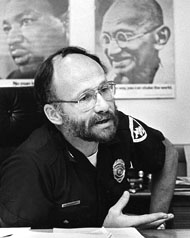

[Note: The national focus after the death of George Floyd in 2020 to have shifted once again to our nation’s campuses. We have now come back to the campus protests of the 1960s which was a major part of my early police experience. Yet we must remember we are in a different protest era fueled today by social media. Is mass protest an effective political strategy? After all, didn’t the campus anti-war and civil rights protests of the late 60s and early 70s result in a most conservative backlash? But whether protests politically work or not, they quickly become the realm and responsibility of police. One of my mentors told me on coming to lead the police department in Madison, Wisconsin, “The first day of the protest, David, was about ending the war in Vietnam, the second day, and every day after, it was about the violent way police responded.” Again, how police use force to carry out their duties remains a national issue — from quelling campus protests to stopping an armed suspects. I hope we all remember the cautionary words Sir Robert Peel wrote over 150 years ago when he organized the police in London. “That police recognize always that the extent to which the co-operation of the public can be secured diminishes proportionately the necessity of the use of physical force and compulsion for achieving police objectives.” And that applies on the campus and in the town. My blog today is a call to reduce the number of number of persons killed by police each year. I believe it is both necessary and achievable.]
- Know the numbers. There is a major problem in our nation and it has to do with police use of deadly force in carrying out their duties. Here are the numbers. And this chart shows what police use of deadly force looks like in other countries around the world. [Out of 63 reported nations, we are 29th.]
- Adopt the European Union Standard of “absolute necessity.” While Graham v. Connor remains the LEGAL standard, a police agency can establlsh a working POLICY for police similar to what occurred among progressive police agencies before Tennessee v. Garner prohibited using deadly force against any “fleeing felon;” that is, these agencies established a rule/policy as to when their officers could use deadly force.
- Remember, this is a moral decision (concerned with the principles of right and wrong behavior.)The Police Executive Research Forum (PERF) discussed this in their publication on use of force which identifies “sanctity of life” as a moral value for our nation’s police and consistent with our nation’s founding values — “life, liberty, and the pursuit of happiness.” The leading police chiefs of our nation are members of this professional organization. This is the opening statement:
- “Ultimately, this report is about the sanctity of all human life—the lives of police officers and the lives of the people they serve and protect. The preservation of life has always been at the heart of American policing. Refocusing on that core ideal has never been more important than it is right now. American policing is at a critical juncture. Across the country, community members have been distressed by images of police officers using deadly force in questionable circumstances…”
- Begin and continue a community-wide discussion. Why the non-negotiable use of physical force by a government must be tempered by respect and care for life. The values we hold, drives the decisions we make, and the actions we take.
- Train and lead accordingly. Adopt “less-than-deadly” methods of stopping a dangerous person NOT armed with a firearm. [For example, see my recent post about one such method. Support the development of “less-than-deadly” measures. Check out Alternative Ballistics and an article in Police1 about one such method.]
- Support the development of less-than-deadly measures. Review police agencies in Europe that actually train their officers in “less-than-deadly” firearms use.
- [Before you react too strongly to this, many of us years ago who carried shotguns were trained to stop a knife-wielding suspect by “skipping” buckshot in their legs. Review methods and tactics by police in other nations who do not regularly carry a firearm.
- What do unarmed police do when confronted by edged weapons? Police in the United Kingdom, Norway, New Zealand, Ireland, and Iceland are not primarily armed.]
- Actively and vocally support local and national efforts to control and manage the possession and use of firearms (and ban military assault weaponry) in our country. Something must be done about the excessive number of firearms in our society which exacerbates, threatens, and drives this problem.
You may not agree with me. And that’s okay. But as professional, educated police professionals, we need to encourage and cooperate in this discussion while embracing the important value which centers on policing a free, democratic, and diverse society — the sanctity of all human life.
The current number of annual deaths by police is an unacceptable number and must be reduced.

 Improving Police: A Necessary Conversation
Please stop exaggerating this David. Only a very small fraction of all police encounters involve any use of force. Only 1% of folks who had any contact with police report any use of force by officers. Of those arrested nationwide, only 1 out of 5 report any use of force at all. That is citizen survey data, not police data, from NIJ.
Yes, police killings are increasing but so is societal conflict and violent crime. Under these conditions why would it be reasonable to expect these number NOT to increase?
The common factor in each of these killings is the lack of compliance with police directions. The simple solution is to insist that all citizens, regardless of their “victimized” status do what the officers tell them to do.
The Unites States in not Europe, we have a very different culture and violence is part of it. The police exist to protect us from victimization, please stop painting our police as victimizers.
LikeLike
Tell that to the mothers. If other democratic counties can use less force, I would imagine we can, too. I will say it again — we can lower these numbers. I know we will not agree on this. But it is simply the right thing to do! Period.
LikeLiked by 1 person
Funny, I don’t see police officers being killed by other cops when the cops refused to accept citations for speeding or being arrested for drunk driving and then they fight the cops for having the gall to arrest them or cite them.
People still get killed even when they complied with the police orders. Furthermore,, how do you expect mentally ill people to complied with police orders when they are not in their right minds? What is your reply to that question?
LikeLike
Floyd – a despicable human being who didn’t hold life sacred – died of a fentanyl overdose.
Please do better research.
>
LikeLike
Hmm. Not what the jury decided. Even “despicable” deserve care and protection or what will we have become?
LikeLike
Yeah and about a month or two ago, a law enforcement officer tried to arrest a young Hispanic kid and died from a heart attack because of it; yet, the DA and the cops are trying to blame the cop’s death on the kid. The cop probably died because he didn’t bother to keep himself in shape along with not eating the right foods.
There was a South Carolina cop who didn’t hold life sacred because when an Afro-American tried to run away from him, the cop calmly took out his gun and shot the gun if he was shooting game and then planted a gun on the decease in order to justified the shooting.
LikeLike