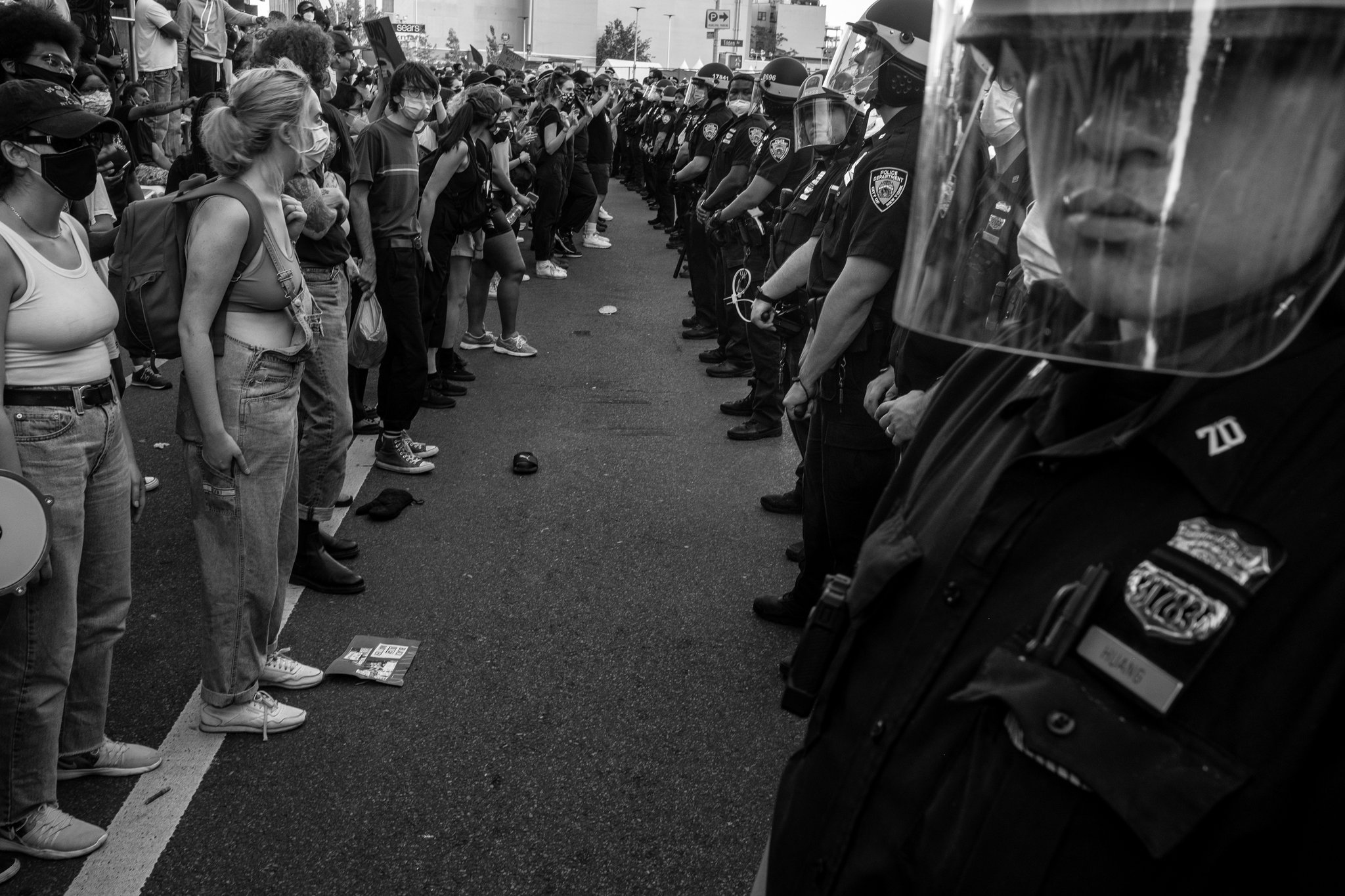
Once again, citizens have taken to our streets and campuses, occupied buildings, camped out and protested a major world event. What has happened, my friends, is America — that’s our right, who we are, and what we do. It is a legal, guaranteed right, in the first amendment to our Constitution. We have a right to “peaceably protest” when we feel grieved by our government. And it’s called democracy!
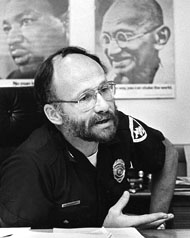
Fifty years ago, we in Madison, Wisconsin decided there was a better way for police respond to the protests that raging at our university. After observing, policing, protesting segregation and the war in Vietnam, we studied the problem and developed “The Madison Method.” And it worked. For twenty years, using this method, we responded to protest without having to resort to physical force (it’s true!). Later, British researcher, Clifford Stott, provided data supporting a “soft” initial approach to handling rowdy, and often violent, football crowds. He found that planning, negotiating, and a “soft” approach (versus an armored approach) works!
With the war in Gaza being debated and protested, we have seen a variety of ways police have responded to these events. The approaches ranged from full armored assault to soft negotiations. Overall, it appears to me that our Madison Method has worked. But why didn’t police in response to all the protests use what I would call the current “best method?”
Thinking about this has led me to add another ingredient to the Method; a pre-cursor to having The Method work — it is TRUST! Unless the police agency has a record of being fair and trustworthy, the protest will quickly move to fear of the police. What I learned over my three decades of policing protest is this: If the police respond violently to peaceful protesters on the first day, the next day and the days following, the issue was the bad behavior of the police.
The Madison Method is the correct way to respond to public, legally-protected protest in a free, democratic, and diverse society. At times, that may mean that daily business and traffic may be shut down. People are more important than property.
However, when protesters are assaulted by other protestors, or property is being flagrantly destroyed it is no longer “peaceful” and controlled. In these situations, police must be prepared to use regulated force by highly-trained and closely supervised officers. Force may be necessary, but must be openly and publicly reviewed and ways developed to improve how police respond to these incidents.
______________
The Madison Method
Seven Principles of Handling Crowds and Demonstrations
[Note: This is to be passed out among protesters and media personnel before any action is taken]
- We PROTECT community members’ constitutional rights to assemble, petition the government and engage in free speech.
- We are IMPARTIAL and remain neutral regardless of the issue.
- We maintain OPEN DIALOGUE with community members and the news media before, during and after demonstrations.
- We MONITOR demonstrations and marches to protect individual rights and ensure public safety.
- We BALANCE the rights of demonstrators with the rights of the community at large.
- We use RESTRAINT in the use of force. We protect people first and property second.
- We, as PEACE OFFICERS pursue CONTINUOUS IMPROVEMENT of our method.
_____________________________
Read today’s post on police handling of the recent campus protests from The Marshall Project — including my comments.
See also this review from The Marshall Project back in 2020, “Why So Many Police Are Handling the Protests Wrong,” after the George Floyd protests. Still much to learn.
Here’s my blog from 2011 wherein I write about police response to protests during the Occupy Movement.

 Improving Police: A Necessary Conversation