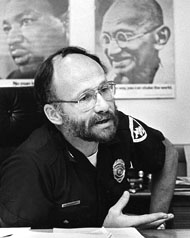

[Back in the old days before Madison Police learned from their past experiences.]

[The first test for Madison Police under my command was the historically violent Spring Mifflin Block Party. Our new approach worked and continued to work for twenty years of protests and large crowds!]
The Madison Method of Handling People in Crowds and Demonstrations
1: Always begin with a “soft” approach and plenty of dialogue. If possible, we begin speaking with the organizers of a demonstration before the event. A soft approach means that officers do not wear hats, appear relaxed and friendly, and openly talk with people in the crowd. Dialogue means two-way conversation, which also means listening to the unpopular opinions and suggestions from others.
2: Always be prepared to negotiate. We maintain continuous conversation with organizers and crowd members. We state our position up front: we are here to defend your right to demonstrate, but we cannot allow you to hurt others or destroy property. Whether or not we support your position, we will remain neutral. That is our job. We will not allow others to harm you if you hold an unpopular position. If you want to be arrested to make a statement, we will help you do that and will treat you respectfully and not harm you while in our custody. In turn, we expect you to cooperate with us.
3: Be able to protect officers working with the crowd. If the situation warrants it, we have a tactical unit (with full protective equipment) on standby in a location near the demonstration but out of sight. They are available as an emergency response to protect or rescue officers in or others in danger of being harmed. Their mission is to protect people first and property second. Deploying the emergency response team is a last-ditch tactic and will indicate that we have not been effective in managing the crowd with softer methods.
4. Use specially trained officers. The best officers to use in crowd situations are officers who are specially selected and trained for this kind of work, and who have the personality to use a soft approach under sometimes trying circumstances—self-control is essential. Not every police officer can do this kind of work.
5: Avoid using outside police officers. Police from other cities and locations usually do not have the training or ability necessary to work with us. Most of them do not have soft crowd management experience or knowledge of our city, nor could we count on them being responsive to our direction. It is extremely important to us that that we take personal responsibility for the handling of crowd events in our city and avoid relying on outside police agencies.
6: Avoid anonymity at all costs. Police officers assigned to handle crowd duty are to be easily identifiable, with their names and badge numbers clearly visible. We avoid any measures or practices that reduce the police to be anonymous agents. Anonymity or any depersonalization of police conducting crowd management encourages negative crowd behavior. It can also lead to unaccountable behavior on the part of the police.
7: Have visible leadership. During high-profile demonstrations, police command officers needed to be visible, communicative, and willing to take charge. There was no such thing as a “routine” large gathering of people without prior preparation and planning, and command officers being present.
_____________________
Some history on how The Madison Method came to be.

 Improving Police: A Necessary Conversation
this post and you are awesome. Thank you so much.
LikeLike