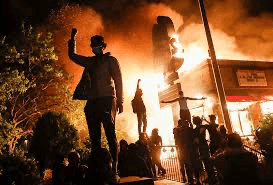

[Protestors demonstrate outside of a burning fast food restaurant, Friday, May 29, 2020, in Minneapolis. Protests over the death of George Floyd in Minneapolis in May, 2020. AP Photo/John Minchillo)]
Two news article grabbed my attention this week. The first came from The Marshall Project which is an outstanding source for criminal justice issues. The Report asks the question I have continued to ask about police reform and improvement, “Why does change come slowly, or not it all, to American policing?” For example, what has happened after George Floyd’s death in Minneapolis? For the most part, the answer is not reform, but retrenchment!
From The Marshal Report:
“It’s been four years since the murder of George Floyd by Minneapolis police officers. Some justice reform measures have passed in response to protests across the U.S. Many others have stalled. The authors of a book about Floyd say ‘the backlash feels more enduring than the reckoning itself.’ Floyd’s brother, Philonise, started crying when asked about the slow pace of police reforms. ‘You’re still trying to pass the same law for your brother. And the city and the world stood with you, and we still haven’t gotten, like, any kind of change. What is it going to take?'”
Continuing on this issue, Reuter News also looked at the slowness of police reform and the introduction of the George Floyd Justice in Policing Act. They report that it has been four years since the bill was introduced. Roadblocks in Congress has yet to move it into federal law.
“The George Floyd Justice in Policing Act – which was initially introduced in 2021 to stop aggressive law enforcement tactics, misconduct, and racial bias – has faced repeated roadblocks in Congress and has yet to move forward.
“Efforts to reach a bipartisan police reform deal failed in 2021. Among the issues lawmakers discussed were changes to ‘qualified immunity’ laws that protects police officers from some excessive force lawsuits. Experts say while criminal justice reform efforts in part fueled the 2020 election cycle, policing is unlikely to be a top issue in the 2024 presidential election…”
And so it goes, year after year. So what’s missing? I would say that there is not a collective voice from police leaders in this nation about what needs to be improved. Looking back now over sixty years of my practice and observation, lying low has always worked when it comes to resisting change. Police leaders simply cannot or will not agree on what must be done. And that’s a tremendous loss to citizens and police officers alike.
The proposed federal legislation calls for reducing “qualified immunity” for police, creating a federal registry of disciplined officers, barring chokeholds, requiring body and dashboard cameras, identifying “patterns or practices” of bias and misconduct, an “independent process” to investigate police misconduct complaints, prohibiting the transfer of military grade weapons to local police, and restricting “no-knock warrants.
There also is (finally) a most needed attempt to do something about what really needs to be done — controlling uses of deadly force in our nation. This is an issue I have championed my entire career – highly controlling how and when to use deadly force But, unfortunately, the proposed legislation will only apply to federal police.
The legislation moves away from the “reasonableness” of Graham v. Connor to necessity; to permit the use of deadly force only to prevent death or serious bodily injury — and to use it only as a “last resort.”
The reality, however, is that even if this legislation is passed it will have little impact on our nation’s local system of policing that is highly decentralized, poorly compensated, minimally trained, and led by leaders without job security and who are overly influenced by a subculture not committed to the principles of a free, democratic, and diverse society.
And then there’s the issue of guns and gun rights when it comes to keeping our communities and our police safe. We press on…

 Improving Police: A Necessary Conversation
Hi David — I thought the Reuters article was particularly weak. It claims that little police reform has happened, but the only evidence is failure to enact a piece of federal legislation, and the opinions of a couple of activists. Admittedly it’s hard to measure, nationally, how much has changed, but the article neither tries to, nor does it acknowledge the challenge of measuring change across 18,000 agencies. The article was more click-bait than real reporting.
LikeLike
Well, Gary, I have watched police reform efforts continue to fail year after year. At this stage in my life I continue to hope that the sanctity of life, respect for all persons, collaboration with community members, and continuous improvement would be hallmarks of American policing. When we do something to be more in line with other European democracies and their low rates of deadly force by their police I will known we have done something important. Police in our country shoot too many people each year. I know these numbers can be reduced, that’s what frustrates me. Thanks for commenting on this.
LikeLike
Hi David — I posted a follow up comment here but it doesn’t seem to have been approved?
LikeLike
About the Reuters article? I see it has been approved. Was there another?
LikeLike
Gary Cordner, Director of Training in the Baltimore PD shared this: “Yes, I followed up with some information about Baltimore. Uses of force in Baltimore have been significantly reduced and everything else we measure has gotten better over the last 3-5 years. Police use of force in Maryland, by law, must be necessary and proportional. Significantly narrower than Graham.” Good to know! Thanks!
LikeLike