
The Editor of Police1 recently noted that this year’s “What Cops Want” survey has focused on officer wellbeing. Out of the 2,833 respondents to the survey, many officers cited the lack of time as a significant barrier to achieving mental wellness and stress relief. One solution highlighted by some respondents was the introduction of sabbaticals to address this issue:
- “Mandatory sabbaticals….”
- “More time off with the expectation that we will be left alone and not contacted by work for literally anything.”
- “Sabbatical policy to allow officers a real break and time for a mental reset as needed. Award a lump sum of time off every few years for veteran officers.”
Read the recent article on police sabbaticals HERE.
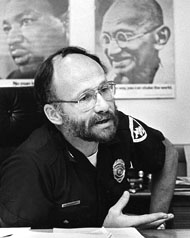
I remember reading this report on officer wellness and remembering that I would not have accomplished what I did in my 25 years as an innovative chief of police without having taken a mid-career sabbatical. I also remembered that I had commissioned a group of my officers to boldly look into their future.
Along with my effort to craft a visible, tangible future for the department, this group of mid-career officers began to think about a preferred future. After meeting together for a year, they issued their report which contained three major themes with supportive arguments:
• Move closer to the community.
• Make better use of technology.
• Improve workplace wellness.
I remember their report also recommended a “de=briefing lounge” available for officers to process what they experienced that day’s shift. (I am sure the after-shift drinking, and bar culture is just as prominent today as it was in my day!)
Almost 20 years into the job and eight years into my career as Chief of Police in Madison, WI I was burned out. I was fighting the union, integrating the department, implementing Problem-Oriented and Community Policing and the stress was mounting.
At home, my marriage was falling apart as my wife at the time was also feeling the stress and wanted me to quit and go back to Minneapolis where, she said, “people liked us!” We didn’t have a sabbatical program in Madison. We should have. But I needed to take action regarding my health and wellness!
I need to get healthy — maybe even reinvent myself. I separated from my marriage and asked the mayor for a six-month (and unpaid) leave of absence. He graciously agreed and I took off with a loan from the city’s credit union. I travelled, wrote poetry, skied in the mountains, and visited life-long friends,
I came back after three months, rejuvenated and just in time to settle back into leadership and embrace the Total Quality Management teachings of Dr. W. Edwards Deming whose ideas had recently come to our city.
During this time a met a woman who changed my life and we were married for 40 years until she died after a long illness in 2020.
Policing a free society is a demanding job. An important part of the necessary changes needed to improve policing in America is to make sure we take care of those whom we call to serve as our police. And that means selecting educated men and women, caring for them, providing them with high quality training, supervisors with high EQ, and the organizational expectation they work closely with those whom they serve as compassionate community guardians — not “armed warriors!”
Here was my vision for the department in the 1970s. Three major goals.
- Decentralize police services and develop neighborhood and team policing. The police department has been centralized since the mid-1800s. We need to get out of a centralized location and work closer to the people we serve.
- Build a people orientation—a sensitivity to and understanding of human behavior. I would be recruiting high-quality, educated police officers and training everyone, especially those in leadership positions, about this broader role for police. Traditional policing responded to problems but was not interested in finding their causes. We would work with community members to prevent, diminish, and even eliminate crime and other community disorder.
- Develop our capacity for conflict management and crisis intervention in addition to our traditional law enforcement duties. Reduce the acrimonious relationship that now exists between the police and students. After years of fighting about the [Vietnam] war, new strategies and tactics needed to be taken to handle public protests by means other than tear gas and a nightstick.
What was missing was a recognition of the importance of making sure we had both mentally and physically fit officers.
A few years later in my career, I again cast another bold vision into the future; a way for the community to judge how we were doing:
“Eight years from now. we should have successfully made the quantum leap necessary to field a behavior and human services expert which shall be known as a professional police officer… Police officers of the future will be human behavior experts as well as community workers… These future police officers will also have an advocacy role within our communities. They will identify government and social problems and solve them with the resources of the government and the community.”
I suggest it is fair to say that we, the men and women of the department, plus the community, accomplished all this and more.
As we embraced the quality movement, we came to understand that the quality of an organization begins first INSIDE, then radiates OUTSIDE to the community. Our vision ended up being quite simple: “Quality from the inside, out!”
And the inside is the men and women, persons commissioned as police officers and those who support their work. To achieve our vision we came to understand the importance of caring for those of us who deliver the services — not just in their training and supervision, but also to be concerned about their health and wellness.
It is now time to implement paid sabbaticals for our police (more on sabbaticals) and, incidentally, that which I came to receive and enjoy after I left my 33-year police career to join the clergy where I have now served for nearly a quarter of a century!
Today, sabbatical time is enjoyed by university professors and clergy. It is time now for government to follow — it is now time because it is the right thing to do; police matter just as much as clergy and professors. Healthy professors, pastors, and now police, will add to the health and betterment of our society.
[Here is some research on the transformative power of sabbaticals and also how to prepare for one.]

 Improving Police: A Necessary Conversation
It will never happen in my lifetime, paid long term sabbaticals.
LikeLike
Never say “never!”
LikeLike