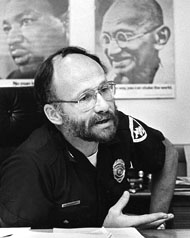


Over the years, I have watched many professional groups being challenged by persons outside of, and even critical of, them. As a young graduate student, I listened to one of my professors, Bob Fulton, report on his work surveying the funeral business. Year after year, morticians would invite him to share his research findings about their work and how their customers perceived them. Each year, he said, the finding was not good. But they would invite him back year after year to hear the bad news. Even if the new was difficult to hear they knew they needed to hear it if they were to improve what they did.
What about policing? I don’t think I ever heard any bad news at one of my many professional meetings. Often, it was more about building barricades against our critics. One year, I was program chairperson for the annual meeting of the Minnesota Chiefs of Police in the late 1960s.
I thought we needed to hear from our critics. So, I put together a program that allowed our critics to speak to us. They included leaders from student, Native American, Black, and then-Gay communities. When my colleagues heard about the program, they were angry, “How could you do this to us? We’re not attending!” But they did. They showed up, listened respectively, and learned a lot about how those on the cutting edge of receiving police “services” were affected.
Now a new book by Prof. Philip McHarris gives police some “bad news” regarding their practices. It This book is something police need to hear and process and to consider that today’s police might need to be reimagined. It‘s worth a read and some deep thought about the future of policing in America.
I have begun this three-post series with an excerpt from McHarris’s book on what that future might look like.
______________________
It’s 2105. There Are No Police.
“It’s 2105. There are no police. There haven’t been for decades. We’ve learned about them in school and through reading. And really, we learned about what police were from our parents, who learned from their parents. We have been taught that in the United States they existed since slavery. At first, they were called slave patrols; their role was to prevent slave rebellions and capture enslaved people who tried to escape. Hard to believe, right?
“And while policing evolved over the years and took up different forms, its violence toward Black people and other communities oppressed at the time ran rampant for centuries. We learned that throughout the 1800s and 1900s, police basically did whatever they wanted to. Black communities resisted in sometimes subtle, sometimes loud ways. In the mid-1900s, uprisings mostly in direct response to police violence spread throughout the nation.
“In 1968, Dr. Martin Luther King Jr. called riots the language of the unheard. That language roared, and it continued to roar in the decades following, but each time it did, the government, as it was called, found ways to preserve and expand the power of police. That state of affairs continued and continued…
“There were moments of uprisings, other moments of sustained activism, and don’t get me started on all the reforms. But the cycle continued. Activism and unrest helped to create more breathing room at times, as many of our grandparents tell us. But in that breathing room, some people became comfortable. Other people thought the issues were a thing of the past. Until they weren’t. And the cycle went on and on and on.
“Then everything changed. Someone was killed by the police; people all across the country and world rose up—but it wasn’t just against policing. It was sparked by the police, but it was about so much more. People had been connecting the dots between policing and the lack of important resources that help strengthen communities. The moment helped make many people understand that police were not only a tool to manage inequality…
“Today, in 2105, you’ll notice that what’s different is not just the lack of police; everything is different. The entire way we respond to and try to prevent conflict, violence, and harm is different. Police and prisons weren’t replaced by single things but by a constellation of approaches that led to a safer and more just world.
“The process to bring us to a point where the masses could redesign society in a way that prioritized people and not punishment or profit took a long time. And it wasn’t clean or simple, but the approach to cultivating safety was thorough. Those organizing around safety concerns started by canvassing and hosting community meetings in which everyone was asked: What is safety to you? What are your main concerns about safety?
“They made sure not just to ask about interpersonal harm and violence. Things such as food security, housing, land, and employment all came up. Through a transformative lens of safety, we came to a much more holistic understanding of how to approach people’s needs. So rather than having police stations, now we have community safety hubs. We have safety mobilizations and teams to deal with just about any problem you can think of. Fewer concerns arise as a result of the active preventive efforts, but when they do arise, they’re managed peacefully and transformatively—and without the presence of violence work…”
_____________________________
Is it possible to think of such a society as no longer having police as we know them? Philip McHarris thinks so. He is not alone.
Tune in tomorrow for Part 3 on the Future of Policing in America. Feel free to add your comments.

 Improving Police: A Necessary Conversation
No police? It sounds a bit like a search for utopia. Maybe I have been influenced by the history of policing and the current direction it is taking, but so far (based on this limited glimpse), I see McHarris’s thesis being aspirational more than attainable. Now I don’t see that as a bad thing. I just don’t believe man will be successful in creating a society completely free of the need for police. Fewer police and less emphasis on policing would certainly be possible were the social determinates of crime and disorder delt with in a serious manner. At first blush, just my thought for what it is worth.
Thanks very much David. I have already ordered the book and am looking forward to reading it.
LikeLike
I agree, Karl, the book is aspirational… however I do like to dream about a community that can feel and be safe by working together. No police? But, perhaps, elected peacekeepers, guardians, and conflict managers…
LikeLike
Thank you for presenting provocative ideas simply, in ways that compel readers to assess their biases about policing and community relations.
LikeLike