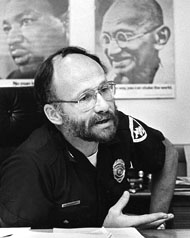

A recent report by the Cato Institute caused me to re-evaluate a practice I had learned as a detective and supported as a chief of police; that is, our legal right to use deceptive tactics when interrogating suspects and witnesses.
What could be wrong?
It turns out, a lot!
The Cato Institute has strong ties to the political philosophy of classical liberalism. It is a think tank which promotes liberty, limited government, free markets, and peaceful international relations through accessible research. Their focus areas include issues relevant to Americans’ lives and well-being, with the goal of influencing ideas towards liberty and finding common ground across the political spectrum.
The report moved me to think about the importance of trust in policing and how the practice of deception could work against the important goal of developing high-level of trust between police and citizens. Here’s the introduction to the report:
“Sanctioned by the courts and taught in police manuals, deceptive tactics are employed by virtually every police department across the country. Officers seeking to elicit a confession will routinely lie to suspects about the evidence and make statements that imply leniency. While effective at times, deception is ethically dubious and can result in severe consequences for suspects. The United States is an outlier in allowing police to deceive suspects, as the practice is prohibited or highly restricted in most peer nations, including England, France, Germany, and Japan…”
I think is worth discussing this currently “legal right” and whether or not it is worth to continue it in light of this report which is deep and well-done. The following is their conclusion:
“The widespread use of deception during police interrogations in the United States raises profound ethical concerns and practical consequences that warrant thoughtful examination by policymakers. While deceptive techniques may aid criminal investigations in some cases, these practices risk eliciting false confessions, incentivizing testimonial lies by police, eroding public trust, and undermining the legitimacy of the criminal justice system. The costs of police deception underscore the need for limitations and oversight of these methods. Reforms such as curtailing deceptive tactics, limiting circumstances in which such tactics are permissible, increasing accountability through videotaping, and instituting greater judicial scrutiny deserve serious consideration to ensure ethically sound policing aligned with core societal values. Though curtailing deception may require difficult trade-offs, its substantial downsides necessitate careful analysis to balance investigative efficacy against the integrity of the justice system and protection of civil liberties. Thoughtful examination of deception’s risks and benefits is crucial to identify interrogation policies that uphold justice, protect the innocent, and maintain public faith in law enforcement.”
You can download a PDF copy of the report HERE.

 Improving Police: A Necessary Conversation
David,
I was reading the CATO report when your email popped up. This all reminds me of a friend’s (a law enforcement professional) PhD dissertation on testimonial deception by police officers. He found the deception started with the initial writing of police reports. I thought his findings were interesting but unfortunately not particularly surprising.
Karl
LikeLike
Sir
I was wondering if you were aware of the “Police Transformation” that is currently going on across the world (including the U.S.) – I’m very familiar with the U.K.; Canada; and the U.S.
The Transformation is “positively” remaking Policing.
The Transformation is the most significant effort in “Improving Policing.”
Let me know if you would like to discuss – in a Zoom call that I would be happy to arrange.
If you are already deeply aware of the “Transformation” – no need to respond to this Email.
All the best,
Mario
LikeLike
Certainly interested. Can’t believe I’ve missed it! Tell me more.
LikeLike
Chief Couper
I’d be happy to discuss this in a Zoom meeting where you can ask questions, and I can point you into the right direction (I’ll issue the meeting invitation) – just give me a few dates and times that would be convenient for you. I’ve been involved in the Police Transformation Projects for more than a decade – The full profile of the Projects would take weeks to discuss and absorb – we’ll start with a 50,000 ft overview.
Please send me an email at mario.vitti@too-critical-to-fail.com
All the best.
Mario
LikeLike