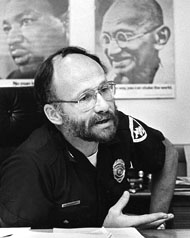
[Note: The following news column was submitted to three leading American news sources. USA Today stepped up and published what we believe to be an important statement on the state of policing in America and what must be done. You can read the edited column HERE. While we were limited to 950 words, the original 1500-word essay has been posted below.]



Cease Fire: Time to Reduce Police Violence: Over 1,000 deaths every year. Two senior police leaders say this is unacceptable. We can do better.
By David Couper and Noble Wray
________________________________________________
Why did Sonya Massey in Springfield, Illinois have to die? Couldn’t that county deputy have done lo something other than shoot her in the face? It seems that a questionable use of deadly force happens on a national scale far too often. We know their names, don’t we? — Alton Sterling, Philando Castile, Freddie Gray, Walter Scott, LaQuan McDonald, Tamir Rice, Eric Garner, George Floyd and more. We know this is problem of police violence and it will not be fixed by putting bad cops in jail. It can only be fixed by making major changes and improvements in our system of policing.
We are senior police leaders. We come from two generations of policing, two 30-year police careers, and two racial experiences. We have a singular mission today: to help our nation develop a system of policing that is fair, impartial, supports our nation’s sacred values, and protects all of us. We feel we achieved a measure of this in Madison, Wisconsin, one of the most progressive and safest cities in America. We have some recommendations; steps that will reduce these deaths and significantly improve our current system of policing.
For the past decade, police in America have killed over 10,000 citizens: last year was the highest year on record:1,173; almost three persons die every day. Some of those who died were armed with a firearm. Many were not. And, proportionally, too many were young and Black. We are two senior police leaders who say this number is unacceptable and can be reduced. Among the free nations of the world, we are the deadliest. These tragic numbers can be reduced when we improve our nation’s system of policing.
These deaths are brutal, lasting traumatic events in which trauma to our communities. These deaths impact not only the family and loved ones of the deceased, but also the police officers who are responsible for the death.
We, as a nation, can do better. We are a smart, advanced, creative and technological nation. We should be able to develop the will, technology, and training to significantly reduce the number of citizens who are shot and killed by police each year. In the European Union, the number of persons killed by police each year during the last decade range from zero to less than 50 deaths. Despite protests and legislative efforts, the number of deaths by police in our nation has not gone down since 2014 and this year the number appears to be increasing.
To do this nationwide, we propose seven steps which we believe will be effective initiatives; strategies we learned during our combined 60 plus years of police service.
Long ago, from private night watchmen to slave patrols, the present patterns of policing were set in stone. Few institutions in our society are as resistant to change as our police. Far too often, this rigidity seems to show up after a young man of color dies during an encounter with police. When this happens, his community erupts in grief, then anger. Many see the young man’s death as unnecessary, even avoidable. The most recent example is the tragic and avoidable death in July of Sonya Massey by a sheriff’s deputy in Springfield, Illinois.
Every such death is a step away from the stated goal of police, which is posted on many police vehicles: “to protect and serve.” It is difficult for many citizens to see how that statement applies to those who, through personal experience, do not trust police.
The law today because of the 1989 U.S. Supreme Court decision in Graham v. Connor, which uses the words “reasonable objectiveness,” does little to help police reduce these numbers and encourage them to set a reasonable moral standard regarding use of force. We believe the standard should be the one currently in effect within the European Union: absolute necessity.
In response to a questioned shooting, police often deny, defend, and deflect. Frequently, police leaders, along with union officials, state the officer “did his duty,” and go on to publicly reveal the deceased person’s arrest record as if to justify his death. These actions do not engender trust or confidence. What if police joined in the sorrow, admitting their failure not to have saved the person? After all, should not every loss of life in America by an agent of our government be viewed as a tragic failure?
We are also concerned about the role of police unions like the Fraternal Order of Police in these matters of public policy. While we support the right of police officers to organize, meet, and confer regarding wages, hours, and conditions and of work, we believe police unions need to stay out of politics and endorsing political candidates. Far too often, police unions work against the very changes that are needed today.
In a free society, we believe those who lead our police have a dual responsibility; they are to lead their police officers but must also represent and care for members of their community. This has always been difficult and not being able to balance this challenge has ended the career of many police chiefs.
Unless community leaders require police to develop strong community-based policingstrategies, there will be little progress. The situation we have today is not because of a few “bad cops.” What we have is a long-standing problem within our nation’s system of policing; a huge, locally-oriented system of approximately 16,000 agencies and 600,000 employees. But the enormity of the problem should not prevent us from doing the right thing, making the right decisions, to reduce police violence and improve the system.
Historically, our government assembled four presidential commissions over the past half-century to report on police and the criminal justice system: President Herbert Hoover’s Wickersham Commission (1929), President Lyndon Johnson’s Crime Commission (1967), followed by the Kerner Commission on the cause of protests and urban violence (1968) and most recently, President Barack Obama’s Task Force on Policing (2015). The recommendations from these commissions made clear what needs to be done. The problem is our nation’s lack of follow-through.
We have come to understand the major problem in policing is how force is used interlocked with an organizational attitude of anti-intellectualism. That is, scorning research, failing to learn the lessons of history, rejecting continuous improvement as a goal, and an unwillingness to adopt proven, methods of problem-solving.
The result of this failure to “know and grow” is an embedded subculture that cannot or will not agree as to what, when, and how police officers are to do the difficult job of policing today.
This confusion was never more obvious than after the 2014 killing of Michael Brown by a police officer in Ferguson, Missouri and six years later when George Floyd died in the custody of police in Minneapolis. In both instances, our nation was rocked by protest. Soon after, the two of us spoke out with other progressive police leaders about the negative effect of militarizationwas having on our nation’s police since September 11, 2001. Instead, police must function more as guardians than warriors; that is, to be helpers and protectors rather being seen as faceless members of an occupying force in a hostile land.
Change, however, takes time and major improvement will be difficult, but it can be done, and the time to begin is now. It begins, we believe, with those seven steps which, if implemented and sustained, will result in a fairer, trustworthy, less-violent system of policing that’s consistent with our nation’s sacred values.
1. Educating. Hire only four-year college graduates and screen them for their Emotional Intelligence and commitment to public service. Make sure all current police officers understand their role in our free, democratic, and diverse society.
2. Respecting. All officers are required in all situations to act with respect toward others. Constantly train them to be able to manage conflict, de-escalate violence, and embrace everyone’s right to life.
3. Relating. Train officers to practice respectful behaviors and to intervene when a colleague is about to make a mistake (see Procedural Justice and Peer Intervention.) And to function more as guardians and community peacekeepers than outsiders.
4. Representing. Hire women and people of color reflective of the community served and apologize for past misdeeds. In policing, all diversity is an organizational strength. Make sure all officers understand the ugly history of race and policing in our nation and how it affects policing even today.
5. Training. Require at least a year of initial recruit training and require probationary officers to be closely-paired with a senior field training officer for the first two years of employment.
6. Using Force. Change the current legal standard for deadly force by police to that which currently exists in the European Union: one of absolute necessity.
7. Innovating and Legislating. Challenge our nation’s technology leaders to develop less-than-lethal ways for police to restrain dangerous offenders and to incapacitate fleeing motor vehicles. Support strong controls and limitations, licensing, and regulation of firearms and actively work for sane gun legislation.
In summary, we hope and pray that when police fully understand the damage of their failure to collectively think and grow has had on their work, and how it has prevented their departments from becoming learning organizations, they will enthusiastically work with their community leaders to implement these steps.
There’s a lot at stake here. We have the knowledge to greatly improve the police function in our society. We thought when we attracted and hired more educated and diverse men and women, things would change. It hasn’t.
Police must understand, as we did years ago, that policing is a calling and demands service above oneself. It is time we confront and improve the way of do the business of policing so that it is consistent with our national values. Policing in a free society should be practiced by men and women who are honest, trustworthy models of those values. We should accept no less.
________________
David Couper began his policing career in 1960 in Edina and Minneapolis, MN after a tour with the Marines. He headed up the Burnsville, MN (1969-1972) and Madison, WI (1972-1993) police departments. Shortly before his retirement, his peers in the Police Executive Leadership Forum (PERF) chose him to receive their national police leadership award. He holds a master’s degree in Deviant Behavior from the University of Minnesota and the author of “Arrested Development: A Veteran Police Chief Sounds Off…” Since 2011, he has continued to share his thoughts on the blog Improving Police. He currently serves as a priest in the Episcopal Diocese of Wisconsin.
Noble Wray worked with David in the 1980s and 90s as a police officer. He went on to serve as Chief of the department from 2004-2014. Afterwards, he was asked by U.S. Justice Department to implement national 21st policing reforms. He consulted and taught police in over 400 agencies throughout the country focusing on implicit bias in policing. He holds a B.A. and Honorary Doctor of Philosophy in Social Welfare from the University of Wisconsin in Milwaukee where he grew up as a youth.
___________

 Improving Police: A Necessary Conversation