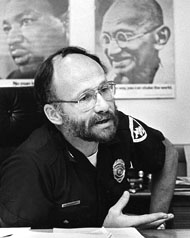

On July 14, I asked to provide the Madison Police and Fire Commission some input to their process of selecting a Chief of Police for the city in which I served as chief for over 20 years. Under Wisconsin Statute 62.13, police and fire commissions need to be appointed to oversee the hiring and firing of city police officers and fire fighters. And most interestingly, police and fire chiefs have tenure and can only be removed from office by the commission.
This was my input.
________________________________
Statement to the Madison Board of Police and Fire Commissioners
From: David C. Couper, Former Chief of Police, Madison, Wisconsin (1972–1993)
Re: Selection of the Next Chief of Police
Madam Chair Mary A. Schauf and Members of the Board:
Thank you for the opportunity to offer input regarding the selection of Madison’s next Chief of Police. I do so as one who served this department for over two decades and who has, since retirement, continued to monitor and advocate for ethical and effective policing across our nation.
In my 1983 book, How to Rate Your Local Police, I emphasized that leadership is the single most important factor in shaping a police department. It is, even today, unwaveringly true. The person you select must exemplify the following qualities:
- A clear, ethical philosophy and understanding of policing in a democratic society.
- A commitment to transparency, accountability, and continuous improvement.
- The ability to build and sustain community trust.
- A deep understanding of diversity, equity, and inclusion—not as buzzwords, but as operational values and importance to the task of policing a diverse nation.
- The courage to stand firm on matters of justice and constitutional rights, even under political pressure. Later, I will explain how this courage will be tested in the months to come.
Questions to Ask the Finalists:
I encourage you to ask each candidate:
- What has the department learned from the deaths of Paul Heenan, Tony Robinson, and Ashley DiPiazza?
- What specific steps for improvement have been taken since those tragedies?
While officers in these cases were criminally cleared, each resulted in multi-million-dollar civil settlements—a powerful indicator that something went wrong. It is only through honest reflection and a culture of learning that lasting reform can occur. That commitment to continuous improvement has been a foundational value of the department since I first established it as a goal.
Trust: The Cornerstone of Policing
The next chief must understand that trust is essential. Without it, policing devolves into coercion and control. In the 1980s, we pioneered citizen feedback surveys sent to a sample of individuals after police contact. The results, for years, remained in the 4.5+ range on a 5-point scale. With today’s technology, there is no excuse not to know, in real time, how the department is performing—especially regarding respect, use of force, and solving the presented problem.
My Continued Commitment
Though I left office over 30 years ago to pursue ordained ministry, I’ve remained engaged with policing issues. In 2012, I published Arrested Development: A Veteran Police Chief Sounds Off..., now in its third edition since George Floyd’s death. I continue to write at improvingpolice.blog, which has over 1,500 posts and 750,000 views.
A Legacy to Know and Honor
Madison once led the nation in community-oriented policing. It is important our city’s police continue to do so. During my years, I believed in “quality from the inside out,” and our mantra became, “Closer to the people we serve.” We championed inclusion and diversity, believing deeply that a police force should reflect the community it serves. I would hope—and expect—that every current officer knows this legacy beginning during the first week of the police academy.
A Final Concern: Policing and Immigrants
The next chief must also confront a growing challenge: Will Madison continue to be a sanctuary city for undocumented residents seeking citizenship and safety? This is not about shielding those who commit violent crime or sell drugs. It is about protecting families, workers, and children from a federal immigration enforcement system that often violates core values of justice and decency. I urge you to select a chief who will resist efforts to turn Madison police into a well-compensated arm of ICE—particularly when such enforcement is carried out in the company of masked, unidentified agents acting without transparency or accountability. That is not who we are. Recently, Los Angeles police refused to help ICE agents. Instead, they were instructed to make video documentation of the detentions and record the names of the ICE agents involved.
In closing, I thank you for your service to the city and urge you to choose a chief who will continue Madison’s tradition of ethical and creative community-based policing—a leader who can be trusted to serve all people with fairness, courage, and compassion.
P.S. Looking back through the years, my sense is that the next Chief of Police must become a Madisonian—a lover and resident of our fine city. Unless the men and women of the department see that their leader is committed to building a life and career here, that leader will never fully gain their trust. At best, they will manage the department—but never lead it forward into newer, better, and more creative ways of serving this community.
Respectfully,
David C. Couper
Chief of Police (Ret.)
Madison, Wisconsin
Episcopal priest and police reform advocate

 Improving Police: A Necessary Conversation