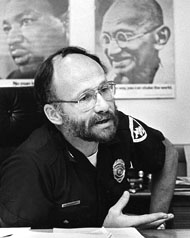

During my 20+ years as Chief of Police in Madison, Wisconsin, I led a department that became nationally known for its fairness, innovation, and humanity. We pioneered what became known as The Madison Method—a unique approach to public protest that emphasized dialogue, restraint, and respect. We built an organization that came to reflect the community it served, with one of the highest numbers of women in uniform in the nation. We demonstrated that policing could be both effective and just, both firm and fair. My sense is that what we built years ago essentially continues today.
Today, as I watch the Trump administration double down on militarization—deploying masked federal agents and National Guardsmen into our cities—I feel compelled to say: this is not the answer. America doesn’t need soldiers in the streets. It needs police who are constitutional guardians, trusted partners, community-oriented, and emotionally educated professionals.
The Wrong Direction
Sending troops into Washington, D.C. tourist corridors or threatening Chicago, Detroit, New Orleans and other cities with federalized forces is political theater, not public safety. It erodes trust, inflames division, and undermines democracy. What our cities need are police who build legitimacy through fairness, restraint, and connection with the communities they serve.
For decades, reform has focused too often on punishment—catching officers when they fail. But catching a few “bad cops” cannot, and has never, changed police culture. What we need is a proactive, culture-improving model: one that identifies, rewards, and replicates the kind of policing that protects and saves lives.
The Camden Example
Camden, New Jersey has shown a way. Instead of using body-camera footage only to find mistakes, supervisors review it daily to highlight excellence—times when officers de-escalated conflict, treated people with dignity, or protected life in the face of danger. They publicly commend those officers, making it clear that restraint and respect are the gold standards – that to which they aspire. [Read more about Camden HERE]
The results are striking: excessive-force complaints dropped from 65 in 2014 to just 3 in 2020. That didn’t happen by accident. It happened because Camden made de-escalation, fairness, and respect the markers of success—not arrests, not tickets, not seizures.
Behavioral science tells us what every parent and teacher knows: what gets rewarded gets repeated. If we want constitutional policing, we must recognize and celebrate it. Here’s a way to do it.
Develop a Gold Standard for 21st Century Policing
From my experience, a truly modern department must embody these principles:
- Education. Officers must be professionals, and professionals must be educated. Research shows that college-educated officers receive fewer complaints.
- Emotional Intelligence. Great officers manage their emotions wisely. They know how to listen, empathize, and de-escalate.
- Procedural Justice. People comply with the law when they believe the process is fair. Every encounter either builds or erodes legitimacy.
- Controlled Use of Force. Effectiveness is measured not by arrests or rounds fired, but by the absence of crime and disorder. That was Sir Robert Peel’s vision, and it remains an important one. In short, the more force used by police, the less support they have in their community.
- Community-Oriented Policing. True policing is done with the community, not to it. Trust is the currency of safety. A police department without trust is like a bank without capital—bankrupt and unable to function.
- Constitutional Guardianship. Police exist to protect rights, not to serve political interests. They must see the sanctity of life as their highest calling.
Learning and Teaching Organizations
Peter Senge once wrote about the Learning Organization. The best police departments are both learning and teaching organizations. They continuously examine themselves, adopt best practices, and adapt. But they also share what they learn with others.
That’s what we did in Madison—opening our doors, modeling community policing, and showing others that another way was possible. Camden is modelling the same today. If they can transform culture, so can others.
Imagine If…
Imagine if Derek Chauvin had worked in a department where his body-camera footage was regularly reviewed by his leaders—not just to catch violations, but to ask: Did you de-escalate? Did you protect life? Did you honor the Constitution? Imagine if promotions depended on documented examples of fairness and restraint. Imagine if officers were routinely praised by their leaders for keeping the peace without firing a shot.
Would George Floyd still be alive? We cannot know. But we do know this: a culture that rewards life-saving behavior, grounded in community trust, is far less likely to produce death on the street.
The Choice Before Us
Trump’s vision is clear: troops in the streets, federal control, generate fear and politicize law enforcement. But that is not who we are—unless we allow it to be.
We must strongly demand that our police are locally-led, educated, well-trained and community-connected. They must also be emotionally intelligent, procedurally just, and constitutionally grounded. We must demand all of this. It is not utopia. It is achievable. Madison did it. Camden is proving it. Others can too.
But only if we demand it and only if we reward it. Only if we refuse to accept anything less than this.

 Improving Police: A Necessary Conversation