
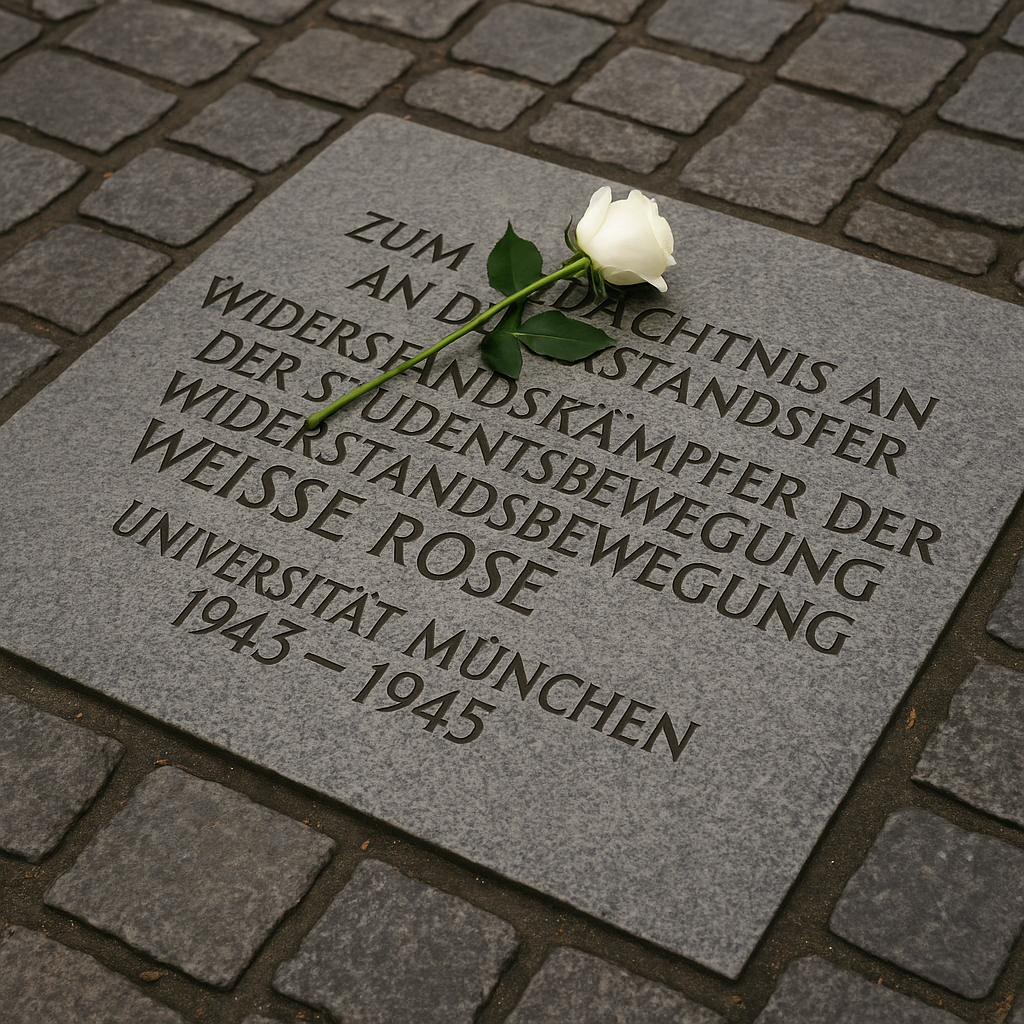
Memorial to the White Rose student resistance group at the University of Munich (1943–1945). Ordinary young people risked their lives to speak truth against tyranny.
Past practices of resistance seem ineffective against a 24/7 social media cycle on the Internet in which fact and fiction reign. Letters to the editor, workshops, or small-scale protests often feel like drops in an ocean of disinformation and creeping authoritarianism.
Nevertheless, history shows that democratic resilience doesn’t come from one tactic alone—it requires layered, sustained action that builds both power and networks. Here are some concrete strategies progressive, democracy-loving citizens can use: During World War II, not every person in Europe surrendered to the will of the Nazis. Some resisted—quietly, nonviolently, and often at great personal risk. In both Germany and Scandinavia, people of faith found ways to stand against an authoritarian regime that demanded loyalty above conscience.
Today, as America faces growing authoritarian and populist currents, their stories are not simply history lessons. They are warnings—and guides.
1. The Courage to Speak Truth
In Nazi Germany, the Confessing Church refused to let their Christian faith be twisted into nationalist ideology. Leaders like Dietrich Bonhoeffer, Karl Barth, and Martin Niemöller preached that no state could claim ultimate loyalty—only God could. Bonhoeffer even joined underground networks to support Jews and resist Hitler, knowing it could (and eventually did) cost him his life.
Lesson for us: Religious and civic leaders today must resist the temptation to baptize authoritarian politics in the language of faith or patriotism. Silence is complicity; truth spoken clearly is resistance.
2. Shelter and Solidarity
In Denmark, the story of the “boatlift” remains one of the most remarkable acts of collective courage: in 1943, ordinary citizens—farmers, teachers, pastors, fishermen—organized to smuggle nearly all of Denmark’s 7,800 Jews to safety in Sweden. They succeeded because the entire society refused to look away.
In Norway, when the Nazis ordered schoolteachers to indoctrinate children with fascist propaganda, over 12,000 teachers refused. Many were imprisoned, but they never broke. Their refusal helped preserve the soul of the nation.
Lesson for us: Communities can protect the vulnerable by refusing cooperation with unjust demands and by creating networks of sanctuary. Local governments, schools, and police must be partners in protection, not in persecution.
3. Small Acts of Conscience
Not all resistance was dramatic. Some Germans hid their neighbors in attics, refused to raise the Nazi salute, or circulated banned writings like the “White Rose” leaflets.
In 1942–43, a small group of Munich university students—including Hans and Sophie Scholl—secretly printed and distributed leaflets called “The White Rose,” condemning Nazi crimes and urging Germans to resist Hitler through nonviolence.
Thousands of copies circulated before the Gestapo caught up. Hans and Sophie Scholl were arrested and executed by guillotine in February 1943. Their courage—and the quiet defiance of the White Rose—remains one of the most powerful examples of moral resistance to tyranny.
Lesson for us: Resistance often looks ordinary—refusing to spread disinformation, standing with targeted groups, or protecting neighbors when government agents come knocking.
4. Networks of Trust
Effective resistance was rarely the work of lone heroes. It grew from networks—churches, classrooms, neighborhoods—where people supported and sustained one another in courage.
Lesson for us: Facing authoritarianism today requires communities of accountability. One voice can be silenced; networks of voices cannot.
5. Breaking the Grip of Fear
The Nazis thrived on fear and silence. Those who resisted found that solidarity broke the spell. Fear loses power when we act together.
Lesson for us: Authoritarianism depends on compliance. When we refuse to comply with unjust commands and stand openly with those under attack, fear’s grip is weakened.
Why This Matters for America
America is not Nazi Germany. But authoritarian and populist movements follow familiar patterns: scapegoating minorities, demanding blind loyalty, punishing dissent, and eroding democratic norms.
- Police and city officials must refuse unlawful or unconstitutional orders.
- Faith leaders and educators must reject efforts to twist their institutions into tools of control.
- Citizens and neighbors must choose solidarity with the vulnerable over silence and fear.
The stories of WWII resisters remind us: it can happen here. But they also remind us: resistance is always possible.
The Call
We may not be asked to hide neighbors in our basements or smuggle families across borders. But we are asked to speak truth when lies dominate the public square. We are asked to protect the vulnerable in our communities. We are asked to stand together when fear seeks to divide us.
This is how democracy is preserved.
This is how authoritarianism is defeated.

 Improving Police: A Necessary Conversation
The trouble is that despite the fact that we Americans pride ourselves on being anti-authority and standing up to authority, we really are a bunch of sheep. We have been taught to respect and obey authority from the cradle to the grave. If we stand up to our parents, priests, bosses, and cops, we are treated with disdain, contempt and get punish for it.
I got more respect for the people of Central and South America who despite the fact that they get crush and killed by right wing junta aided and abetted by the US government and American corporations, they are more than willing to stand up to authority. You can’t say that about Americans.
The only Americans who are allowed to stand up to authority are wealthy people and corporations.
LikeLike