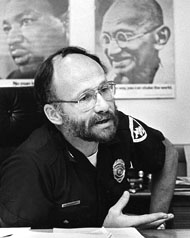

I have always looked for creativity, innovation, and growth in policing — the continuous improvement Dr. W. Edwards Deming taught so powerfully in the 1980s. And today, I’m happy to report that some agencies are rediscovering those lessons.
Across the country, I see police departments returning to principles we developed in Madison, Wisconsin, over fifty years ago — principles about how police can most effectively respond to public protest, a right guaranteed by our Constitution.
Our experience in Madison became known as “The Madison Method,” a strategy grounded in dialogue, respect, and cooperation — not confrontation.
From Madison to Spokane — and Beyond
Recently, The Spokesman-Review in Spokane, Washington, published an encouraging article by Alexandra Duggan describing how Spokane police are using what they call “dialogue policing.”
“Instead of the typical way people might see police at protests, Spokane Police’s ‘dialogue’ officers focus on mixing into the protest by establishing positive connections, building rapport and talking with participants, helping people exercise their First Amendment rights.”
Their “dialogue unit” officers wear light-blue shirts instead of standard tactical black — signaling that they are there not as enforcers but as partners. They walk with demonstrators, speak with organizers, and coordinate safe routes for marches.
The goal is simple but profound: de-escalation before escalation.
The Madison Method of Protecting and Serving People in Crowds and During Protests
When we developed The Madison Method, our aim was simple but essential: to protect constitutional rights while maintaining peace — through communication, negotiation, and respect.
Here’s how we did it:
- Begin softly — and keep talking.
Every operation started with a soft approach and plenty of dialogue. If possible, we met with organizers in advance. Officers removed hats, appeared relaxed and approachable, and engaged openly with people in the crowd. Dialogue was always two-way — it meant listening, even to unpopular opinions. - Always be ready to negotiate.
Communication with organizers and participants continued throughout the event. We made our position clear: we are here to protect your right to demonstrate — but we cannot allow harm to people or property. Whether we agreed with their cause or not, we remained neutral. If someone wanted arrest as part of their statement, we cooperated respectfully. Our expectation was mutual cooperation. - Protect those who protect others.
A tactical team, fully equipped, remained nearby but out of sight — a contingency for emergencies only. Their mission was to protect people first, property second. Their deployment meant our softer methods had failed, and we regarded that as a last resort. - Use specially trained officers.
Crowd management requires officers with patience, emotional control, and a calm temperament — those able to stay steady under provocation. Not every officer can do this work. The best were carefully chosen and trained for it. - Avoid using outside agencies.
We seldom brought in officers from other jurisdictions. They lacked our training, knowledge of the city, and understanding of our philosophy. Maintaining local control and responsibility was essential to ensure accountability and trust. - Reject anonymity.
Officers assigned to demonstrations wore clear identification — names and badge numbers visible. Anonymity undermines accountability and invites hostility. Transparency, by contrast, builds trust. - Show visible leadership.
Command officers were present, visible, and communicative during large gatherings. There was no such thing as a “routine” crowd event. Leadership in the open mattered — it set the tone for professionalism and calm.
These principles made The Madison Method not just a tactical approach but a moral and professional commitment: to act as guardians of democracy, not controllers of dissent.
The Madison Method Lives On
In my book, “Arrested Development: A Veteran Police Chief Sounds Off…” I describe how this method worked in practice, particularly in Chapter Seven, “Three Examples of Effective Protest Management in Madison.”
Decades later, researchers like Professor Clifford Stott in the U.K. have confirmed these principles empirically. His recent article, “Dialogue Policing and Democratic Protest” (The Police Chief Magazine), demonstrates that when police approach protests through dialogue and legitimacy, conflict decreases and cooperation grows.
That’s continuous improvement — and that’s policing in a democracy.
What Spokane and Columbus Are Teaching Us
Departments such as Spokane, Washington, and Columbus, Ohio, are showing what it looks like when police truly serve as guardians of both peace and liberty.
As Spokane Officer Karl Richardson put it:
“There’s a realm of understanding, or a common ground of at least knowing each other that wasn’t there before.”
That’s the ground on which constitutional policing must stand.
When we embrace dialogue, empathy, and listening, we don’t just manage protests — we strengthen democracy itself.
Learn More
Full article: “Spokane police officers at the ‘No Kings’ protest were different. Here’s why their strategy may be working.”
On the research: Professor Clifford Stott: “Dialogue Policing and the Democratic Protest.”
Deming’s philosophy of improvement: The W. Edwards Deming Institute
.

 Improving Police: A Necessary Conversation
Dave,The Spokane dialogue policing and the Madis
LikeLike
Un saludo estimado David Cooper. Un saludo desde Colombia. Te escribe Yhon Edwin Ramírez Roa de la policía de Colombia. Me parece espectacular tu análisis, tus definiciones y compartir este material que aporta a fortalecer la CIENCIA DE POLICIA; también estamos construyendo a partir de la Policía de Colombia a través de los hombres y mujeres de la Unidad de Diálogo y Mantenimiento del Orden – UNDMO, donde esperamos en algún momento ser referencia a nivel internacional de policías en el mundo con nuestros aportes como lo es hoy día el tuyo, en materia del funcionario de policía en su rol como “policía de diálogo.
Atentamente,
YHON EDWIN RAMÍREZ ROA
Email: yhon.ramirez@correo.policia.gov.co
Celular +57 3177665646
LikeLike
Muchas gracias por visitar mi blog y por su interés en mis ideas sobre cómo gestionar la seguridad en una sociedad libre y abierta. Si hay algo en lo que pueda ayudarles a lograr su visión de la labor policial, no duden en contactarme. Paz y bendiciones para todos ustedes en la Agencia de Policía de Colombia.
LikeLike
It’s kind of funny how many police departments actually thank the No King protestors for keeping the protests calm and peaceful. Maybe these police departments should be looking at hiring these protestors as police officers and get rid of their bad cops.
LikeLike