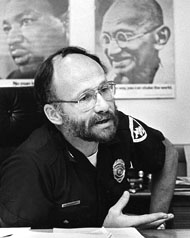
Are You a Model for Modern Policing? Why Not?

Across our nation, policing stands at a crossroads. Public trust is fragile, officers are under intense scrutiny, and the fabric of democracy itself feels strained. In moments like this, the old command-and-control style of police leadership not only fails — it becomes dangerous. Today, more than ever, we need top-shelf, collaborative, community-oriented leadership in our local police departments: leaders who listen, who share power, who build trust rather than demand obedience, and who understand that constitutional authority is not force — it is responsibility. The future of democratic policing will not be secured by fear, hierarchy, or hard-charging tactics, but by humility, accountability, and the courage to lead with our people and our communities, not over them.
When I became chief of police in Madison years ago, we began to build a department around a simple belief: policing in a democracy requires extraordinary leadership throughout the organization — rooted in trust, dignity, and continuous improvement. It was also based on the idea that every police officer is a leader.
In Arrested Development, I wrote about how traditional, command-and-control policing too often stifles initiative, drives out good officers, and erodes public trust. Later, in The New Quality Leadership Workbook, I offered practical tools to help police leaders transform their organizations and themselves.
Today, the need for this kind of leadership has never been greater.
The following self-assessment is designed to help those who are leaders, and those who aspire to leadership, take an honest look in the mirror. It reflects the principles that guided our work in Madison and continue to guide my thinking today — principles focused on people, systems, humility, and democratic policing.
- Use it as a checkpoint.
- Use it as a conversation starter.
- Most of all, use it to grow.
Police leadership isn’t about power — it’s about service, courage, and the constant work of personal and professional improvement. It is not designed just to help you at work, it will also help you at home, with your family and other important relationships.
Questions Police Leaders Must Ask Themselves
Vision & Values
- Do the people I lead clearly understand our mission, values, and expectations?
- Can officers tell — by my daily behavior — what principles guide this department?
- Am I leading in a way that strengthens democracy and community trust?
Respect & Trust
- Do my officers feel respected, supported, and trusted?
- When I speak with staff, do I listen as much as I talk?
- Is there fear in my department? If so, why — and what am I doing to remove it?
Systems & Improvement
- When problems arise, do I look first at systems and training, or do I blame individuals?
- How often do I ask officers and community members for input before making decisions?
- Do I use accurate data and feedback to guide improvement, or do I rely on tradition, past-practice and emotion?
Teamwork & Collaboration
- Do officers work as a team — or do they compete, isolate, or mistrust each other?
- How often do I reward teamwork rather than individual achievement?
- Have I made it safe for people to bring me bad news?
Community Focus
- Are we policing with the community — or at the community?
- Do residents feel they can approach you, speak freely, and expect fairness?
- Would I want my own family treated by my officers the way we treat the public?
Courage & Accountability
- Do I encourage officers to intervene when a colleague crosses the line?
- Have I built a culture where ethical courage is praised — not punished?
- Do I hold myself to the same standards I expect from others?
Risk, Learning & Innovation
- Do I reward honest mistakes and learning — or punish them?
- When was the last time I tried something genuinely new?
- Have I created an environment where improvement is expected, not optional?
Self-Reflection & Humility
- When was the last time I admitted I was wrong?
- What have I learned this month from my officers? From my community?
- Am I growing — or have I stopped?
[Summary of the Twelve Principles of Quality Leadership.]
Three Deep, Final Questions
- Would I follow me?
- Does my leadership restore trust — or erode it?
- Am I building a department fit for a democracy — or fit for an empire?
Leadership is never finished work. It demands humility, self-examination, and the willingness to change — especially in a time when public trust in policing hangs in the balance. I offer this tool not as judgment, but as invitation: to every police leader who believes our profession must evolve, who understands that authority without accountability is dangerous, and who knows that courage is measured not only in moments of crisis, but in the quiet discipline of continuous improvement. If we expect our officers to grow, we must lead the way. Our democracy depends on it.
[Search this blogsite for a lot more about leaders and leadership. There are a score of posts on theses subjects.]

 Improving Police: A Necessary Conversation