To My Brothers and Sisters in Blue:
To you who wear the badge across America today: We are at a crossroads that will define the future policing in America. For over half a century, I have witnessed dedicated officers working tirelessly to build community trust, transparency, and a partnership with the residents we serve.
Now, that progress is being threatened by a new era where federal agents—often masked, unaccountable and unidentified—are colonizing our cities and counties. When these agents (they are not police) use paramilitary tactics, ignore constitutional rights, and operate without local oversight, they aren’t just targeting individuals; they are destroying the very trust you and I have spent our careers building. If we stand by while our neighbors are harassed and assaulted, we lose the streets for a generation.
As a retired police leader with 33 years of service, I know the weight of your oath. I am asking you to choose the integrity of that oath over the pressure of federal authorities.
The Role of Local Police in Community Safety
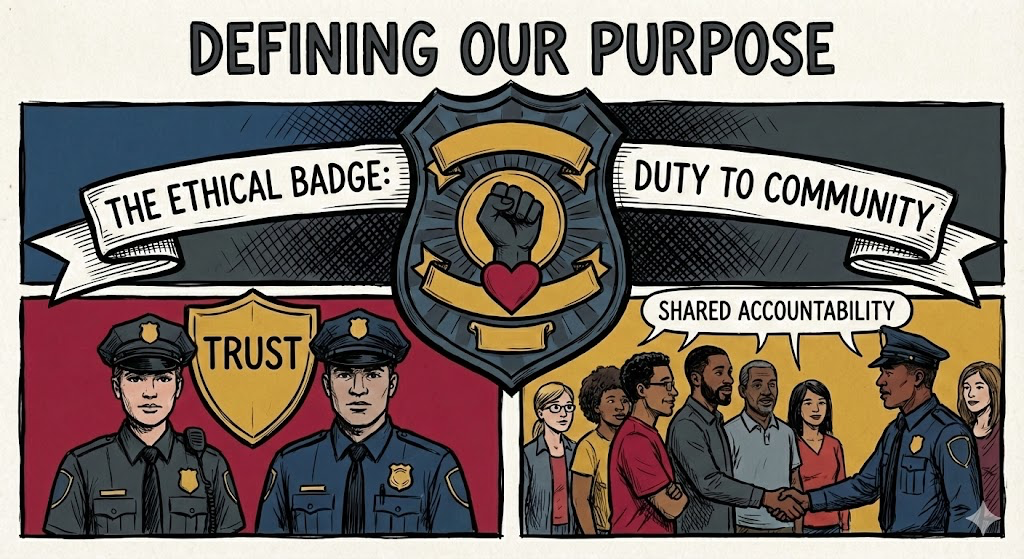
The following questions are based on our Policing Code of Ethics, which mandates that a police officer’s fundamental duty is to serve the community and safeguard lives. In light of recent federal immigration enforcement tactics, I suggest we ask our local leaders for clarity on two critical safety protocols:
Documentation and Reporting
When residents call 911 because they are being harassed, assaulted, or detained by unmarked, masked individuals in their neighborhoods, instruct your officers to respond to the scene specifically to document and report the event.
- The Context: In many cities, federal agents have assaulted and detained suspects on the basis of their race or accent and refused to identify themselves.
- The Goal: To establish a local police presence to act as neutral observers—ensuring that a formal, independent record of the encounter exists to protect residents from illegal detention or unreasonable use of force. These violations can be presented to county or state attorneys for review.
Intervention
If a local officer witnesses a federal agent exceeding their authority—such as using unreasonable physical force, entering a private space without a judicial warrant, or unlawfully endangering a resident—inform them we have a “Duty to Intervene” either by reporting the incident, or in the case of life-threatening force, to protect and physically intervene.
- The Context: The killing of Renee Nicole Good in Minneapolis illustrates the fatal risk when federal agents operate without direct supervision or local oversight.
- The Goal: To state that “professional courtesy” does not extend to illegal acts committed by federal agents. Our police are to act as guardians of our residents, willing to step in when any official—regardless of agency—violates the law or endangers a life.
Why This Matters Right Now
- Preserving Public Trust: You have spent years building trust and support among your residents. Allowing federal agents to come into your jurisdiction unidentified, masked, using excessive force, often unsupervised and with paramilitary tactics destroys that trust.
- Professional Integrity: Our “Duty to Intervene” is the highest expression of our profession; to choose the integrity of our oath over the pressure of federal authority.
- Preventing Escalation: Clear local protocols and community support prevent the chaotic “clashes” that would give the federal government a pretext to invoke the Insurrection Act. Disciplined, accountable law enforcement protects everyone.
Handling Pushback
| If they say… | You respond with… |
| “We don’t have jurisdiction over federal agents.” | “You have jurisdiction over public safety in this city. If a crime or an assault is being committed in your presence, your oath to protect the resident is primary. State law still applies to everyone on our soil and our authority takes precedence when federal agents step out of the scope of their authority they use unreasonable physical force.” |
| “We don’t want to get in the way of a legal investigation.” | “We aren’t asking you to stop a legal investigation. We are asking you to document the conduct. If the conduct is legal, the legal review of your report will show that. If it’s not, your presence is the only thing protecting our residents from harm.” |
| “This will put our officers at risk/create conflict.” | “The greatest risk to your officers is the total loss of community trust and support. If they see you standing by while residents are harassed, you’ve lost the streets for a generation. Professionalism and documentation lower the heat; they don’t raise it.” |

 Improving Police: A Necessary Conversation