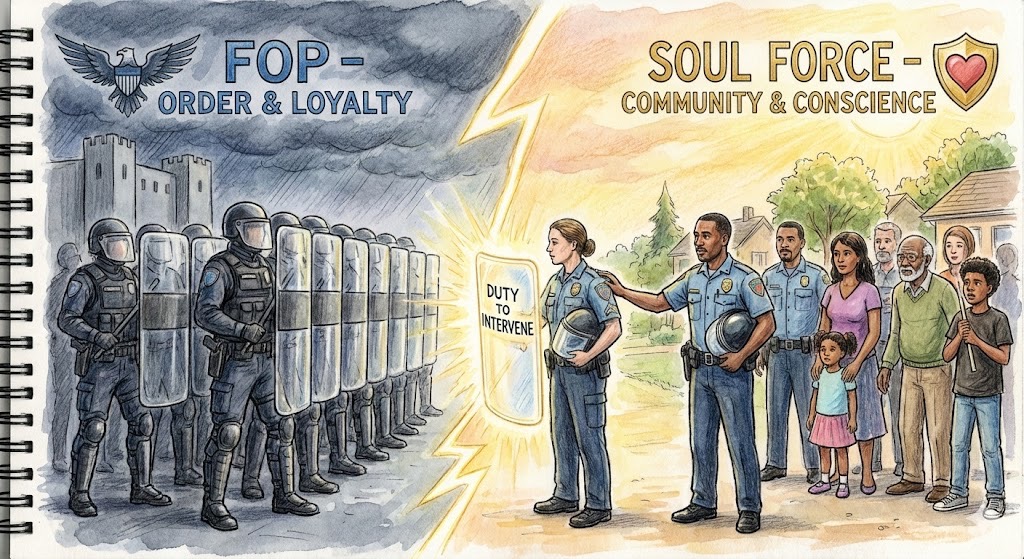
Today, I am addressing the institutional conflict that exists between the largest nation police union in the United States — The Fraternal Order of Police (FOP) — and the evolving moral mandate of modern policing today called the “Duty to Intervene.” This mandate serves as the essential tool for police to reclaim trust and support in their community in the face of federal enforcement overreach.
The Blue Wall vs. The Moral Shield: Reclaiming the Soul of Policing
American law enforcement currently finds itself at a crossroads between two irreconcilable philosophies. On one side stands the National Fraternal Order of Police (FOP), an institution built on the unwritten rule of absolute solidarity. To the FOP, the badge is a boundary; they advocate for seamless cooperation with federal agencies like ICE, viewing any local hesitation as a betrayal of officer safety. On the other side is a growing movement for a higher morality in policing—a vision where the officer’s primary oath is not to a colleague’s badge, but to human dignity and the constitutional rights of the community along with that officer’s oath of office and his/her Policing Code of Ethics.
The FOP’s insistence on institutional loyalty creates a dangerous ethical vacuum. By prioritizing the unwritten rule of mutual aid above all else, the union risks turning local police into facilitators of federal tactics that many communities perceive as tyrannical. This isn’t just a political disagreement; it is a threat to the very legitimacy of the profession. When a community sees their local police standing by—or worse, assisting—as federal agents conduct “snatch-and-grab” operations, use physical force that contradict that officer’ training, the covenant of community trust is shattered.
The bridge across this divide is the Duty to Intervene. Codified in the wake of George Floyd’s death in May, 2020. Five years after his death, the landscape of American law has shifted. What was once a suggested best practice in a training manual is now a statutory requirement in many states. This rule mandates that any officer who witnesses a colleague using excessive force, violating a person’s constitutional rights, or engaging in unlawful behavior must intervene to stop it.
The Duty to Intervene rule transforms intervention from an act of betrayal into a professional and legal mandate. While the FOP emphasizes the duty to assist, the law now dictates the duty to stop a peer from doing wrong.
When applied to the presence of federal agents, the Duty to Intervene provides a clear framework for moral courage. It suggests that true loyalty is found in loving restraint—preventing a fellow officer from making a career-ending, soul-corroding decision; therefore, intervening against an unlawful federal action is not an obstruction of justice; it is the highest form of officer safety, protecting the officer from moral injury, internal discipline, and even criminal charges..
The dilemma for the rank-and-file is significant, as the FOP’s conservative stance remains the default for many. However, for policing to survive as a respected profession, it must realize that its power does not come from federal backing, but from local consent. Standing up to tyranny is not a rejection of the uniform; it is the only way to ensure our local police still stand for justice.
Why the FOP Position Threatens the Future of Community-Oriented Policing
1. The Erosion of Community Legitimacy Policing effectively requires “procedural justice.” When local officers are seen—even by association—as facilitators of federal tactics that a community perceives as tyrannical, the fragile bond of trust evaporates. For a department to function, victims must be willing to call 911 and witnesses must be willing to testify. If a community views the local police as an extension of an occupying force like ICE, they will stop cooperating, making the entire city less safe for everyone.
2. The Fallacy of Solidarity over Ethics The FOP’s unwritten rule that officers must always assist each other, as well as federal agents, creates a dangerous ethical vacuum. By prioritizing the safety of a colleague over the rights of a resident, the union essentially argues that the police are a separate class from the public. This reinforces an “us vs. them” mentality that is the antithesis of community policing. Standing up to wrong-doing means recognizing that an officer’s highest duty is to the law.
3. The Long-Term Safety Risk The FOP focuses on the immediate physical safety of agents during a protest or enforcement action. However, by alienating large swaths of the population, they create a more hostile and dangerous environment for local officers in the long run. A police force that is feared and loathed by its residents is a force in constant peril.
The ultimate test for American law enforcement is no longer found in the strength of its tactical response, but in the clarity of its moral conviction. By choosing Duty to Intervene over the blind solidarity of the FOP and the negative aspects of their subculture, officers do not betray the badge—they redeem and strengthen it. They move from being a closed caste of “order-keepers” to being the frontline guardians of our Constitution. True officer safety is not found in an “us versus them” alliance with federal authority, but in the “loving restraint” that prevents a colleague from crossing the line. To save the soul of policing, rank-and-file officers and their leaders must realize that their authority is a sacred gift from their community, and that gift is only maintained when they have the courage to stand with the people, even—and especially—when it means standing against injustice.

 Improving Police: A Necessary Conversation
This is a compelling argument, David. As a police chief, I was not a fan of the FOP in my later years nor MAP, the Chicago area union. After accomplishing their initial goals of getting wages and benefits raised in the 1980s, they fought for more power and sought to erode management rights at every opportunity, standing squarely in the path of needed reform. The collectivist nature of unions tends to undermine progress, individual initiative, merit and competency, in my experience.
That being said, the push for more and more restrictions on the traditional role of the police is quite troubling. The implication that local police have any authority over federal officers or can, in any way, hold them accountable for perceived civil rights violations in the enforcement of federal law is just plain silly. Trying to generate conflict in this way is clearly heading in the wrong direction, at best.
Individual instances of misbehavior have been blown way out of proportion by those who are warring on the police, it’s a mistake to generalize excessive force to the entire population of police officers and paint them all with the broad brush of “Nazis” and authoritarian thugs. Yet this is exactly what we are seeing from those who lack a reasonable understanding of the policing function or our federalist system.
The constant attacks on the police are driving the very phenomenon you speak of here, circling the wagons. It is also causing a mass exodus from local policing sometimes to the feds, where the job is much simpler and much less risky. Cops are not in the morality business; they are in the law enforcement business. They need things simple and you are asking way too much from them.
The “duty to intervene” is driven by an obscenely exaggerated and subjective perception that federal agents are violating citizens constitutional rights, they are not. Our police, at the local, state, and federal level, are dedicated professionals, some of the very best people you will ever meet. Occasionally, mistakes are made by individual officers. Having hysterical activists threatening, insulting, doxing, obstructing and PROVOKING them contributes to these mistakes. It’s easy to stop this.
I am personally shocked that a local or state police leader would refuse to respond to federal agents calling for assistance and stand with local elected goofs who say “FU@# ICE.” Elected officials that restrict the police like this are rebelling against legitimate federal authority, violating their oath of office, distracting from massive corruption (fraud), and destroying their cities in a futile effort to hold onto power. Minneapolis will never recover from this, the police up there should rebel or resign. Your moral “high ground” is a fantasy in this environment, this is not a moral question, it is a legal one.
The solution is to simply abandon sanctuary policies and allow local police to assist and work along side federal authorities to counter the obvious problems with mass immigration. People need to stop demonizing ICE so that they can get their job done more quickly and efficiently and get out of these cities, they don’t want to be there either.
Unrestricted migration and open boarders do not enrich us, it burdens us, destroys our culture, and creates chaos. It might “feel good” to defend those who appear to be fleeing oppression and violence, and to protest against the rule of law in this regard, but such action is not righteous, it only generates more hate. It gives rudderless people who are struggling for meaning in their lives a warped cause to believe in. As Lenin said, they are “useful idiots,” people unknowingly exploited by the powerful toward dark ends. In some cases, these folks are placing themselves at physical risk, as evidenced recently. This reminds me of St. Michael’s prayer (the patron saint of the police) it is Satan prowling the earth seeking the ruin of souls.
LikeLike