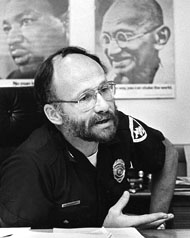
What Chief O’Hara Learned in Minneapolis
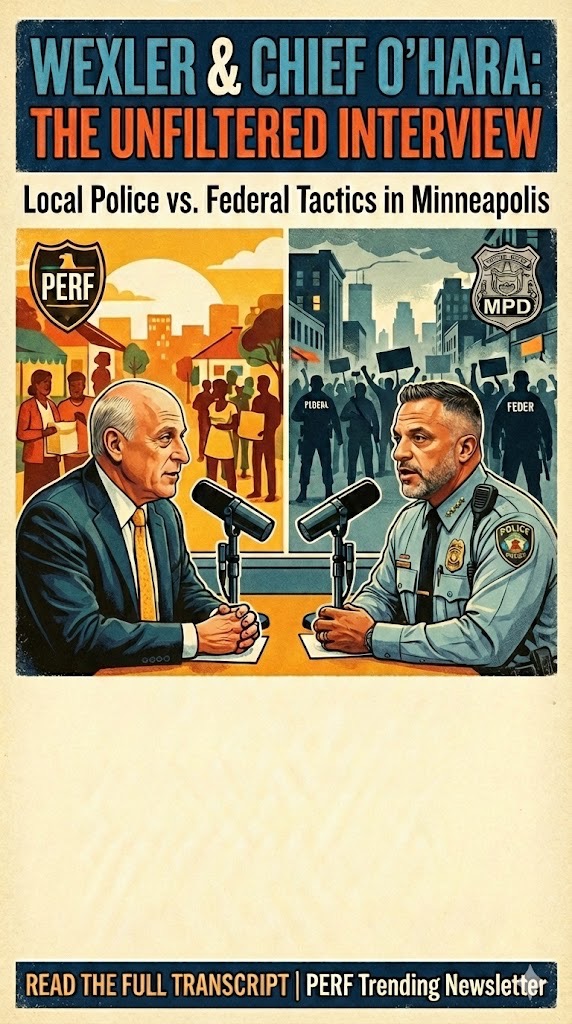
The following interview summary offers a sobering look at the crisis currently unfolding in Minneapolis. Chuck Wexler, Executive Director of the Police Executive Research Forum (PERF)—an organization where I am proud to be a Life Member—speaks with Minneapolis Police Chief Brian O’Hara. Originally published in their newsletter, PERF Trending, this is a chilling read for those of us who have dedicated our careers to policing our nation’s cities.
______________________
The Reality on the Ground: Tactical Chaos
Chief O’Hara is remarkably blunt about the tactics used by federal agents, characterizing them as “undisciplined” and resembling policing 20 or 30 years ago. He notes several key failures:
- Lack of De-escalation: Federal agents showed no effort to de-escalate, often escalating tensions in volatile areas like Lake Street.
- Disorganized Coordination: He describes federal team tactics as uncoordinated, with agents often appearing to work against one another.
- Transparency Gaps: Federal agencies reportedly failed to report use-of-force incidents (such as the use of chemical irritants) that were independently verified by community video and local police.
The Toll On Local Resources
The surge has placed an “overwhelming” burden on an already understaffed Minneapolis Police Department (MPD).
- Staffing Crisis: MPD is down to 600 officers from 900 in 2020. The surge forced O’Hara to cancel days off and mobilize the National Guard just to answer basic 911 calls.
- The “Buffer” Role: O’Hara argues that local police must act as a buffer. While some view their presence as “protecting ICE,” he insists their goal is to prevent violence and protect residents from the fallout of federal actions.
Questions for Chiefs: A Framework for Preparation
The core of O’Hara’s advice for other police leaders centers on a series of proactive, diagnostic questions. He argues that a Chief must answer these before the “surge” arrives to avoid a total collapse of community legitimacy.
1. The Policy and Legal Framework
- What are our local ordinances or policies regarding federal cooperation?
- How do these policies change—or hold firm—in a different political environment?
2. Tactical and Operational Parameters
- How will we handle a 10–15% spike in calls for service related specifically to federal activity?
- What are our specific parameters for showing up to crowd control?
- The Perception Problem: If the community sees us at these scenes, will they believe we are there to facilitate federal raids? How do we counter that narrative?
3. Community Trust and Outreach
- How can we educate the community on our practices so they understand we are not taking sides but maintaining peace?
- How do we ensure that vulnerable populations (Latino, Somali, etc.) still trust us enough to call 911 for unrelated crimes?
- The Cost of Silence: If the community stops cooperating with investigations out of fear, how much less safe does the entire city become?
4. Leadership Sustainability
- How do we manage the “airplane rule”—putting on our own oxygen masks first—when the duration of the crisis has no end in sight?

 Improving Police: A Necessary Conversation
Well, how many cops are in the National Guard? The part of the problem with maintaining staffing police level is when you have a good number of cops in the Reserves or in the Guard so when they get call up, you don’t have a replacement system to fill in the gaps.
LikeLike
The commentary and observations from Chief O’Hara brings to mind the UK’s experiences in the very early stages of the conflict in Northern Ireland.
The local authorities deployed a reserve police force commonly known as The B Specials, officially the Ulster Special Constabulary. Originally raised ion the 1920s to combat the IRA. My uncle a full-time professional solider served time in pre WWII Northern Ireland and said he had uncomfortable experiences at check points they manned; this was their territory, they rules and didn’t care whether outsiders were in uniform they were not welcome.
Fast forward to the 1960s-70s Since the police force was then essentially from the protestant community and the B specials very much steeped in their local communities their actions were not unbiased – they were disbanded in 1970.
I recall watching the news one night and footage of this force marching in column rifles slung over shoulders for all the world like a paramilitary force, one member turned to the cameras and stuck his tongue out.
Definitely not a help to the situation
Every time I see ICE in action the phrase ‘B Specials’ comes to mind.
Take care and best wishes
Roger UK
LikeLike
Thanks… a good reminder about not repeating what didn’t work for us in the past!
LikeLiked by 1 person