
If Democracy Is To Hold, Local Police Must Resist
I have watched American policing change—sometimes painfully slowly, sometimes faster than anyone thought possible. I have also watched it fail. I write now because we are entering one of those moments when failure is no longer theoretical, and silence is no longer caution. It is surrender.
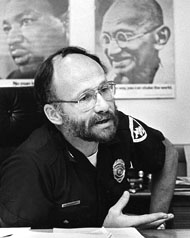
I spent more than thirty years in policing, including serving as chief of police in Madison, Wisconsin, during a period of profound institutional transformation. I then spent another three decades observing, writing, and documenting how policing either strengthens democracy or corrodes it. I have led police organizations through moments when standing up was controversial, uncomfortable, and politically risky but necessary. This is such a moment again, and the stakes are higher than at any time in my life.
Across the country, federal immigration enforcement is being carried out through tactics that rely on secrecy, intimidation, racialized targeting, and legally questionable authority. Masked agents detain people in public spaces. Administrative warrants not signed by judges are treated as a license to enter homes. American citizens are stopped, handcuffed, questioned, and even jailed. Communities—primarily communities of color—are left frightened, confused, and unsure who is exercising power over them or why. This is not simply an immigration issue. It is a matter of defending our aspired goals as a nation.
We know a line has been crossed. In Minneapolis, Minnesota, federal immigration agents shot and killed a defenseless woman who was a U.S. citizen. The fatal shooting of thirty-seven-year-old Renee Nicole Good—a tragedy captured on video—was a predictable outcome of a gross failure in selection, training, leadership, and mission. We police leaders tackled this problem years ago. Police departments today now explicitly forbid officers from discharging firearms at moving vehicles or intentionally placing themselves in front of moving vehicles to create justification for force. These are the essential guardrails of public safety that federal agents are currently bypassing.
We must question how these agents are being selected, trained, and led. After watching operations by U.S. Immigration and Customs Enforcement (ICE) in our nation’s cities over the past year—so unlike local, community-oriented and trust-based policing many of us worked our entire careers to build—I find myself agreeing with Mayor Jacob Frey’s blunt demand: “To ICE, get the fuck out of Minneapolis.”
Once we remove the threat of masked, abusive, unidentifiable enforcers from our neighborhoods, we can return to the hard, unglamorous work of fixing a broken immigration system. We must start sorting out those who truly abuse our laws while offering a path to citizenship for those neighbors who live, work, and obey the law alongside us. We all know them—they are our neighbors, not criminals.
This moment matters. Not because Minneapolis is unique, but because it is not. Across the country, local police departments are being placed in an untenable position: Stand aside while federal agents operate masked, without identifiable uniforms but wearing vests with the word “police” on them, using tactics that violate basic norms of transparency, accountability, and restraint—acting outside a police officer’s oath of office and their code of ethics.
Those who enforce our laws in a free and diverse society must be lawful. They are not simply service providers or an arm of executive convenience. They are guardians of our Constitution, entrusted with extraordinary authority because they are supposed to operate openly, under law, accountable to the people they serve.
Federal immigration agents are bound by the same responsibilities—not to a President, not to a political agenda, and not to fear.
When local police allow federal agents to operate within their jurisdictions, using tactics that local police themselves would never be permitted to use, something fundamental breaks. When abuses occur, trust and support of both federal and local officers collapse, whether local officers participated or not.
I know this because I lived through a major institutional change in American policing. When I became chief in Madison in late 1972, the police department had one Black officer in its ranks and was overwhelmingly male. Women were not in uniform; a few worked with juvenile offenders. People of color were absent from ranks meant to serve an increasingly diverse city. Protesters—especially anti-war and civil rights demonstrators—were viewed as adversaries to be controlled and punished rather than citizens exercising Constitutional rights.
Changing that did not happen without resistance. It required deliberate leadership, political risk, and years of internal struggle. We recruited women into patrol and leadership positions. We diversified an all-white department. We dramatically changed how police interacted with protesters—not as enemies, but as fellow citizens whose rights we were duty bound to protect.
Equally important, we changed how we led our officers. The culture of policing does not change because a chief declares it so. It changes when authority shifts from command-and-control to collaboration, from fear-based discipline to team problem-solving, listening to others, and accepting accountability. It took a decade before I felt confident we had changed our organizational culture.
I recently joined an online discussion with several dozen accomplished past and present police chiefs, researchers, and academics focused on the future of policing in the United States. The conversation was sobering. Staffing shortages are real and recruiting is difficult. Young people no longer want to be cops. But the most striking theme was the growing fracture between federal and local law enforcement, particularly around federal immigration enforcement. Masked federal agents operating without transparency or accountability are confusing the public and eroding trust in local police. A physical confrontation between local police and federal agents—once unthinkable—no longer seems implausible.
How do democracies erode? Columnist Thomas Friedman of The New York Times recently argued with fellow Times columnist David Brooks that the United States may yet survive the Trump era if its major institutions hold. Democracies rarely collapse overnight; they erode when major institutions retreat into caution, ambiguity, and silence. Local police are one of those institutions.
If local police decline to act when federal agents exceed their lawful authority and operate out of the scope of their employment, erosion of our national norms accelerates at the street level, where it matters most. Local police leaders can no longer avoid today’s fundamental question: What are you going to do when federal agents exceed the scope of their authority in your city?
I suggest there are three principles police leaders must act on now.
They must refuse to participate in federal immigration enforcement. Immigration is a civil matter. When local departments entangle themselves in it, trust collapses, crime reporting declines, and entire communities withdraw from civic life. This is not theory; it is documented reality.
They must intervene when federal agents violate the law. Duty-to-intervene standards do not disappear when the badge is federal. When unlawful force is used or detentions lack proper judicial authorization, local police retain both the authority and the obligation to act.
They must protect every resident in their jurisdiction, regardless of immigration status.Constitutional protections apply to all persons, not just citizens. The oath of office contains no political exception. This is not radical; it is the rule of law.
The fear across our nation is real, but it cannot govern us. Critics argue that intervention will provoke retaliation and deepen fear. Immigrant communities themselves sometimes plead with police not to act, fearing escalation.
Yes, that fear is real. But fear cannot be the governing principle of how we police our towns and cities. If it were, no meaningful reform in policing would ever have occurred. Every advance in police effectiveness in a democracy has required leaders willing to accept short-term discomfort in defense of long-term trust.
This moment will be remembered by whether our local police leaders stood up—or stood aside.
They cannot control federal policy, but they can control what happens in their cities, on their streets, and under their authority. They can insist on transparency and accountability by federal agents. They can refuse participation. They can intervene when people are being abused. They can remind the public—and themselves—that policing exists to protect our freedoms and their guarantees, not to erode them.
Our Constitution begins with an aspiration: “We the people”—a promise to secure liberty and justice for everyone. That promise endures and survives only when our institutions act to defend it. If local police hold the line, our democracy still has a chance. If they do not, erosion and fear will accelerate. And history will not ask whether this moment was comfortable. It will ask whether our local police leaders did their duty when it mattered most.
–David C. Couper. Mar-Apr Issue, 2026.
_______________________________

 Improving Police: A Necessary Conversation