Introduction
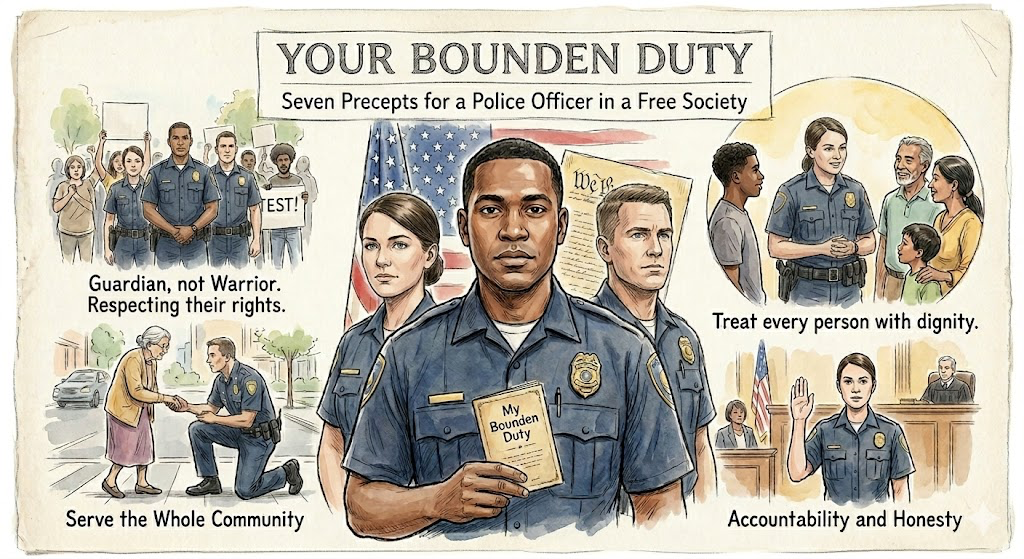
When I was a young boy growing up in the Episcopal Church, I was given a small pamphlet called My Bounden Duty. It was a simple, serious document — a list of obligations that came with belonging to something larger than yourself. I have been thinking about that phrase a great deal lately. Because if there was ever a time when American police officers needed to reckon with their bounden duties — their sacred, binding obligations — it is now.
After more than thirty years in policing, and another thirty years watching, writing, and reflecting on it, I believe these are the seven precepts that define what it truly means to wear a badge in a free, democratic, diverse, and constitutional society.
1. To uphold the Constitution — above all else, above all others.
Every officer swears an oath not to a political party, not to a mayor, not to a president, but to the Constitution of the United States. That oath is not a formality. It is the foundation of everything. A police officer is first and always a constitutional officer — a guardian of the rights, liberties, and dignity that the Constitution promises to every person on American soil, citizen or not. When political winds blow against that oath, the officer’s duty is to hold firm. Silence in the face of constitutional violation is not loyalty. It is surrender.
2. To be a guardian, never a warrior.
The warrior sees the community as a battlefield and the people in it as potential threats. The guardian sees the community as home — a place to protect, serve, and belong to. These are not merely different tactics. They are different souls. American policing has for too long trained warriors and then wondered why it has a trust problem. Our communities do not need occupiers. They need neighbors with badges — men and women who bring restraint, empathy, and moral courage to every encounter. We don’t need police who are warriors. We need police who are guardians.
3. To treat every person with dignity and respect — always.
This is the heart of procedural justice, and procedural justice is the heart of legitimate policing. Every person an officer encounters — the suspected criminal, the frightened immigrant, the grieving parent, the rowdy teenager — deserves to be treated as a human being of worth. That means listening. It means explaining. It means making decisions that are fair and transparent. It means never demeaning, humiliating, or dehumanizing another person under color of law. When police make mistakes, it is almost always because they have failed at this. And when they get it right, trust grows — and the job gets safer.
4. To serve the whole community — especially those on the margins.
A police officer in a free society does not serve only the powerful, the propertied, or the politically favored. The badge is a promise to everyone — including and especially those who have the least power to protect themselves. The poor. The mentally ill. The homeless. The immigrant. The person of color who has learned through hard experience not to trust the police. Democratic policing means that the most vulnerable members of a community receive the same protection, the same dignity, and the same justice as anyone else. If policing serves only those at the top, it is not democratic policing. It is something else entirely.
5. To use force only as a last resort — and never beyond what is necessary.
The authority to use force is the most serious power a free society entrusts to any of its citizens. It is not a tool of convenience, not a shortcut to compliance, and never a punishment. Force — when it must be used — should be the minimum necessary, applied with control, and followed by accountability. Every use of force that was not truly necessary is a small act of tyranny. And every officer who uses restraint when restraint is hard — who de-escalates when escalation would be easier — is doing democracy’s most difficult and most important work.
6. To be honest, transparent, and accountable — even when it is costly.
Democratic policing cannot survive without trust, and trust cannot survive without honesty. That means officers must tell the truth in their reports, in court, and in the street. It means departments must be transparent about what they do and why. It means that when an officer does wrong, the institution must say so — clearly, publicly, and without defensiveness. Accountability is not the enemy of good policing. It is the proof of it. A department that holds itself accountable is a department that has the courage to deserve the public’s trust.
7. To remember that the police are the people — and the people are the police.
Sir Robert Peel, the founder of modern democratic policing, said it plainly nearly two hundred years ago: the police are the public, and the public are the police. Officers are not a separate caste. They are citizens — neighbors, parents, members of the community — who have been given a specific responsibility and specific authority in trust. That trust is not permanent. It must be earned, daily, in every encounter, in every neighborhood. Community-oriented policing is not a program or a strategy. It is the only way to police a free and diverse society. And it begins when officers remember that their power comes from the people they serve — and is accountable to them.
[Note: These bounden duties apply to any person who has authority to arrest for criminal or civil infractions ; regardless as to whether they are federal, state, county or municipal law enforcement officers.]
These are not suggestions. They are moral and legal obligations. They are what it means — what it has always meant — to serve with honor as a police officer in a free, constitutional and diverse society.

 Improving Police: A Necessary Conversation