

The following is yesterday’s report from The New York Times.
Ferguson continues to be a very important incident for students of policing. It is a tragedy from which much can be learned.
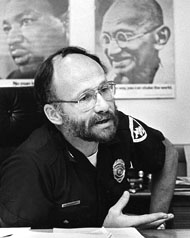
The photograph I have posted here speaks volumes.
After you read this article, I suggest you read some of the comments which follow. I believe they suggest where we might be headed with regard to police-community relations.
In addition, I was interviewed by BBC Radio with a number of other folks. [To listen, CLICK HERE.]
FERGUSON, Mo. — “In the five days since an unarmed young black man was fatally shot by a police officer here, the selective release of information about the shooting, and especially the anonymity granted to the officer, has stoked frustrations in this largely African-American community north of St. Louis, where residents describe increasingly tense relations with the police.
“The police chief, Thomas Jackson, has repeatedly declined to identify the officer, who has been put on administrative leave. But on Wednesday, the chief did offer a new detail about the shooting, which has kindled nights of racial unrest and an unyielding police response with tear gas, rubber bullets and arrests.
“Chief Jackson said that the officer who shot Michael Brown, 18, on Saturday was struck in the face during the encounter and treated at a hospital. Touching his own cheek, the chief said that a side of the officer’s face was swollen from what the police have described as a struggle in which Mr. Brown assaulted the officer and tried to take his gun — an account disputed by a witness, a friend of Mr. Brown’s who said his hands were raised when the last of several shots was fired…”
To read more, CLICK HERE.
FERGUSON: QUESTIONS AND ANSWERS
Michael Brown, an unarmed black teenager, was shot and killed Saturday by a police officer in Ferguson, Mo., a suburb of St. Louis. The killing ignited several nights of protest and has drawn outrage on social media outlets.
What do both sides say about how Mr. Brown was killed?
The circumstances of the death are in dispute. Mr. Brown and a friend were walking home from a convenience store when friends and witnesses say they were stopped by an officer for walking in the middle of the street. They say that Mr. Brown’s hands were in the air when the last of several shots was fired. The police say that Mr. Brown was shot during a fight over the officer’s gun. The F.B.I. has opened a civil rights inquiry into the shooting, and the case is being investigated by the St. Louis County Police.
What has happened in the town since the shooting?
A convenience store was set on fire, and at least 11 other local businesses have been looted. Police officers have fired tear gas and rubber pellets at demonstrators and have arrested at least 40 people since Sunday. On Tuesday, the Federal Aviation Administration barred aircraft from flying below 3,000 feet over Ferguson after the police said that department helicopters were shot at. On Wednesday, local leaders called for protests to be held only during daylight hours.
How diverse is Ferguson? How does it compare to the rest of St. Louis County?
While most of St. Louis County is white, Ferguson and neighboring towns are predominantly black. Blacks were once a minority in Ferguson, but the city’s demography has shifted in the last decade after white families moved out to surrounding suburbs. Ferguson, a town of 21,000, is a “relatively stable, working and middle-income community,” said Richard Rosenfeld, a crime trends expert and professor at the University of Missouri-St. Louis. “But it does have its pockets of disadvantage.”
What is the makeup of the police force and how do they operate in the town?
Ferguson Population
- Black, 63%
- White, 33%
- Other, 4%
All Stops by Police
- Black, 86%
- White, 12%
All Arrests
- Black, 92%
- White, 7%
The town’s leadership and the police have remained predominantly white. Of 53 commissioned officers in the Ferguson Police Department, three are black. A racial profiling study shows that while blacks make up 63 percent of the city’s population, they account for 86 percent of traffic stops.
Is Ferguson generally a violent area?
Not when compared to neighboring towns. The violent crime rate is far lower in Ferguson than in Jennings, and it is comparable to two other similar-size adjacent towns.
By Larry Buchanan and Haeyoun Park of “The New York Times,” August 14,2014.

 Improving Police: A Necessary Conversation
Thanks for spreading awareness about what’s happening in Missouri. Glad there’s a person with so many decades of peaceful community policing keeping an eye on it.
Here’s a link to what veterans are tweeting about when they see the military grade hardware the Ferguson cops are using and how they are presenting themselves to the community. https://storify.com/AthertonKD/veterans-on-ferguson?utm_content=storify-pingback&utm_medium=sfy.co-twitter&awesm=sfy.co_hpXF&utm_source=t.co&utm_campaign
LikeLike
I disagree with the way the police chief has managed this crisis. Who is advising him? I’m the police chief of a department of comparable in size and complexity. Unfortunately, my department has had two officer involved shootings within the last three years. One was a questionable (by the community) shooting of an unarmed black suspect by a (you guessed it) white officer. I did not impulsively defend the officer’s actions. The facts needed to be determined by an impartial investigating agency. That was eventually done. I DID release the name of the officer involved in the shooting within 48 hours. I believe it was and is fundamentally the right thing to do. Doing so curbed the rabble rousers in the black community. Doing so also soothed an anxious community of concerned people who rightly were asking questions about the shooting. I don’t lead an accredited agency like Ferguson and many others boast to have. I always felt the only accreditation we needed was from the community we serve. You get this approval and sustain this approval by doing what is right. I just don’t get the desire to officially withhold the name or names of officers involved in shootings; particular in situations like this one. The names almost always tend to unofficially get leaked out anyway. I think this has been a case of too much adrenalin and too much pride in the decision making room at this department. I think this has been handled poorly and with little sensitivity.This has been made a bigger crisis than it had to be.
LikeLike
Nice reflection and thanks for helping put all this in perspective!
LikeLike
Well done, Chief Baker regarding your situation. Regarding Ferguson, well the police tried to make their crisis seem like it was nothing – He went for my gun scenio. Or they tried to see if the guy had a prior criminal record and then use it to smear the guy’s character.
LikeLike
The problem is that these cops have brought it on themselves because for years they were always complaining about how outgunned and outnumbered they were on the streets In addition, they tend to hire military veterans who don’t give a care about the US Constitution and the Bill of Rights whether they were in the military or had left the military. To many military soldiers, it was all about having a gun strapped next to them and having the power of life and death when it came to wrecking people’s lives, and being in the military and/or on the police force gave them carte blanch to do so. Moreover, military people have this attitude of “you or me” due to their combat experience and it get carry over and reinforce at the police academy.
Another thing is that it shows that racism is still alive in America. Many cops had learn racism of all forms when they were growing up and then it gets reinforce and institutionalizes in basic training where they are taught to demonizes the enemy and then they carry it with them when they become cops. You look at the number of times military veterans use offensive words against the Iraqi and the Afghans and then it gets carry over when they get jobs in law enforcement. You wonder how many of the Ferguson cops were racists in the first place and how many of them were in Iraq and Afghan where their racism was reinforce even more.
One time for sure. We have not learn from the British Army in Ireland about the dangers of using regular military forces, para-military forces, and a militarized police to resolve the political, social, and economic problems when dealing with the general population even within our own borders.
LikeLike