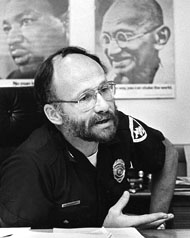


Police professionals keep on top of what’s happening in fields related to theirs. Psychology is one, business is another.
Another reason why we need smart, educated, relational police is in the following interview by Sarah Green in the March, 2015 issue of the Harvard Business Review.
+++++++++++++++++++++
“Fierce debates about biased policing continue to resonate across the United States, and they’re playing out on front pages again after a special investigation into the Ferguson, Missouri police department. The investigators concluded that the white police officer who shot Michael Brown, a black man, was justified in his use of force. But they also found that the Ferguson police department had over-policed the town’s black population. And they turned up multiple email messages rife with virulent racism.
“Of course, police departments are not the only organizations confronting some uncomfortable truths about their biases — corporations have been in the hot seat on this as well, although there the recent discussions have mostly centered on gender, whether it’s equal pay, the lack of women in C-Suites and on boards, or the treatment of women in industries such as technology.
“Whether it’s racial or gender bias, there is a lot at stake. To figure out how police departments are responding, I spoke with Anna Laszlo, director of Fair and Impartial Policing, a consultancy that has helped to train police departments and law enforcement agencies. Among others, they’ve worked with police departments in Milwaukee, Baltimore, Los Angeles, Detroit, Minneapolis, St. Louis, and Tucson. What follows is an edited version of our conversation.
“HBR: Do the standards of bias training need to be different in police departments? Or is it pretty much like any workplace?
“Laszlo: In terms of the role of implicit bias, the science is the same. The science tells us that if you hire from the human race, you’re going to be hiring biased individuals. There’s an extensive and growing body of research across all professions — doctors, lawyers, judges, real estate agents, teachers, and yes, police as well, that points to implicit bias in human beings.
“[The difference is] that the stakes for policing are so incredibly high. Police officers are the only people in a democratic society who can legally take your freedom, and can legally, justifiably take your life. So with all due respect to my colleagues in other professions, the stakes for policing are significantly higher.
“We also know that the police are most effective when they police their communities with the collaboration and authority of the people they serve. Police legitimacy is significantly harmed if there is no trust between the police and the community, and clearly biased policing can significantly impact that trust.
“HBR: You mentioned the extensive research that’s out there on implicit bias, and I know that’s a big part of your training approach. Why emphasize the science? Why start with that?
“Laszlo: It’s important to start with the science because the science is egalitarian in some ways. Scientific data is scientific data. The science helps us to understand that all of us as human beings come with implicit biases. That moves the discussion from an accusatory perspective of ‘You are racist, you are homophobic’ to one of, ‘You’re human.’ We often say early on in the training session, ‘If the worst thing you learn about yourself today is that you’re a human being, so be it…’”
Read the full interview HERE.
- What are you doing to move these concepts into your department’s training program?
- When will they be operational?

 Improving Police: A Necessary Conversation
“[S]cience helps us to understand that all of us as human beings come with implicit biases.”
This is what scientists refer to as bullshit.
There is no basis in cognitive science (of which I am aware and I have spoken with and read the top of field), nor in a wildly imaginative contemplation of ‘human nature’ imputing into the human brain “biases.”
Why do you reference such nonsense in your otherwise informative analyses of policing in a democracy?
Racists are racists, and homophobes are homophobes because they are fools and/or hatemongers buying into the history and running from any mention or analysis of institutional racism or sexism, for example.
Your apparent attempts to sugar-coat this with ‘bias’-speak (a growing and well-paid industry attempting to make racism, sexism and homophobia acceptable to corporate America) are absurd.
I sat through one of these corporate-bias nonsense seminars as part of an orientation week once, and what a crock it was. At the end, participants all voiced their ‘biases.’ I told the seminar there is no such thing as race, there are no character inclinations nor intellectual capacities associated with sex/gender/skin color/sexual orientation and to believe otherwise is an act of imbecility, hence I have no ‘biases.’ I don’t have biases because biases are irrational. Being alone in this observation in the seminar was a source of amusement then, but now I am appalled this industry in working its way, unexamined of course, to reformist commentary in defense of police oppression.
The best answer I heard from a bias-seminar participant preceding me by a few years is: I have a bias towards Germans of a certain age.
Consider sticking with the “accusatory perspective,” this is grounded in reality from which you appear to fleeing.
Regards,
Mike
LikeLike
Mike, whew! I really didn’t think this was going to be a hot topic. It seemed to fit in with my life experience that we all have biases — some rational, some not. I think we humans tend to be pretty tribal and that has helped us protect our gene pool and kept us safe. There is some truth to “stanger-danger.” When I was on the street, and had to deal with many “others,” I had to confront my feelings about “strangers” and make sure they didn’t interfere with my decision-making. That’s it for me, it helped me be a better officer because my goal was to be fair and effective and that meant I couldn’t let my upbringing in a white world screw that up. I guess I first learned that as a minority member of a 50+ Marine recruit platoon. Sort of a cultural immersion for a white boy from Minnesota who had never worked with and hardly knew a black man. So, are we talking about the same thing when we hear “unconscious bias?” Peace.
LikeLike
Reblogged this on e-Roll Call Magazine.
LikeLike
The problem with the analysis is that it is ahistorical, hence insidious.
And its claim to ‘scientific’ status is absurd.
Bias seminars are simply a profit-making venture, and not the vehicle to educate police about civil liberty violations and the various bigotries that prevail in the United States police departments, none of which can be discerned from these nonsensical seminars.
LikeLike
Okay, I understand where you are coming from. I hope it works for you.
LikeLike