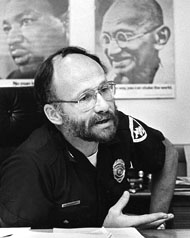


— Observations and experience of a veteran police chief from a 33-year career.
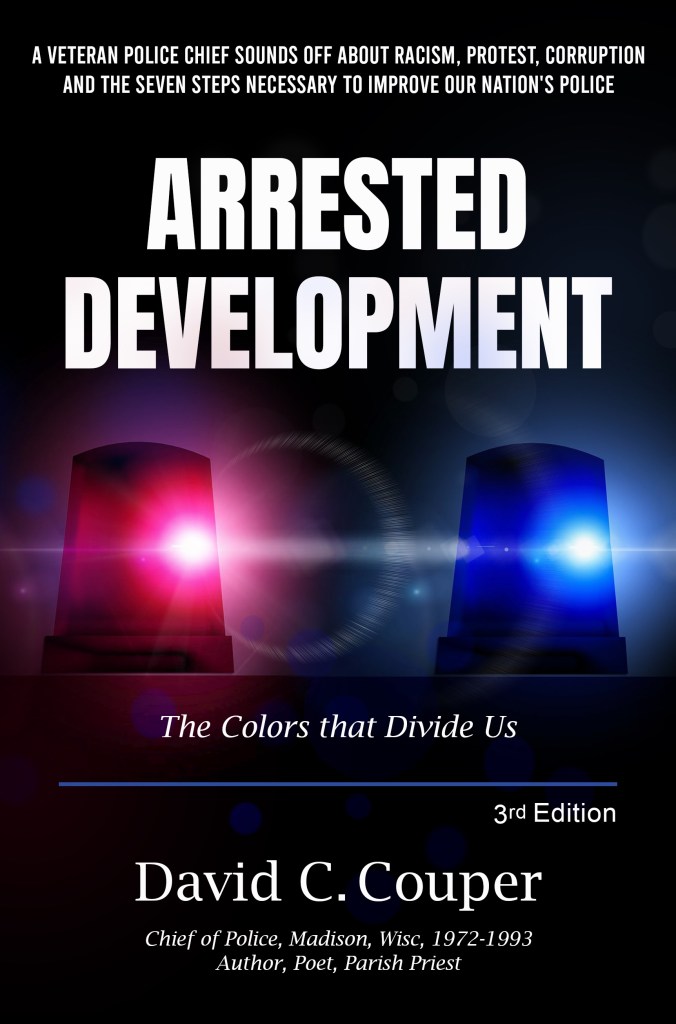
— Studying and reflecting on the nature of police in a free, diverse, and democratic society after his retirement.
— Focusing on leadership, organizational transformation, community-oriented policing, training, selection, uses of force, and control of crowds.
— Blogging here since 2011.
— 1,500+ posts on how to improve America’s police.
— Over 1,800 followers.
— 500,000 views from over 130 countries from around the world.
On Defining a “Good Cop” — They see themselves as guardians, but able to be a warrior when the situation demands. They are smart, educated, good listeners, respectful, well-trained and able see themselves as community helpers, sorting out problems, advising citizens, modeling outstanding citizen behavior. During their career, they work to continuously improve, raising their Emotional Intelligence, and always acting with fairness and equality; managers and de-escalators of conflict, controlled in uses of force.
— I am back on my feet now and available for consultation and teaching on how to improve your police and their organization. You can contact me at davidc6758@gmail.com.
Checkout my poetry blog at https://letmylifeteachnow.wordpress.com/
The proper policing of a free and diverse society such as ours requires trust, collaboration, and accountability between police and those whom they serve.
Use the search engine (on the right column of this page) or scroll through the following pages to find a topic of interest.

 Improving Police: A Necessary Conversation
Many police officers invest time to build reputation, but then here comes the new cop who just committed murder and reputation is just gone in an instant. Police force should be strict with the attitude and values for most of the people look at them as one.
LikeLiked by 2 people
This article on improving the police is a timely and crucial contribution to the ongoing conversation about law enforcement reform. The thoughtful exploration of the challenges faced by police forces and the acknowledgment of the need for change are commendable.
I appreciate the balanced approach taken, recognizing the vital role that law enforcement plays in society while also addressing the concerns and criticisms that have arisen. The emphasis on community engagement, de-escalation training, and fostering positive relationships between police and the communities they serve resonates as a step in the right direction.
The call for transparency and accountability within police departments is a sentiment shared by many, and it’s encouraging to see these aspects highlighted in the article. The acknowledgment that improvements are not just necessary but achievable through collaborative efforts is a positive and hopeful message.
The inclusion of real-world examples and success stories of police departments implementing positive changes adds depth to the narrative. It illustrates that progress is not just theoretical but can be achieved through practical, tangible initiatives.
In a time where the relationship between law enforcement and the public is under intense scrutiny, this article contributes to fostering a constructive dialogue. It encourages readers to think critically about the issues at hand and inspires hope that positive change is possible. Kudos to the author for addressing a sensitive topic with sensitivity, insight, and a call for collective action. It’s articles like these that propel the conversation forward and pave the way for a safer, more just society.
LikeLike
Firstly, fostering better communication between law enforcement and the public is essential. This entails encouraging officers to participate in community events, engage in non-enforcement interactions, and actively listen to concerns raised by citizens. Simultaneously, as civilians, we must strive to understand the challenges and pressures faced by officers in their line of duty.
Furthermore, advocating for comprehensive training programs that emphasize de-escalation techniques, cultural sensitivity, and implicit bias awareness is imperative. Investing in the mental health and well-being of officers is equally vital, as it directly impacts their ability to perform their duties effectively.
Additionally, promoting transparency and accountability within police departments is non-negotiable. Implementing measures such as body cameras, civilian oversight boards, and regular performance evaluations can help maintain trust and integrity within law enforcement agencies.
Moreover, supporting initiatives aimed at reforming outdated policies and practices is crucial for long-term progress. This includes addressing issues related to racial profiling, excessive use of force, and discriminatory policing tactics.
Ultimately, police improvement is not a solitary endeavor but rather a collective responsibility. By fostering a culture of mutual respect, understanding, and collaboration, we can work towards creating safer communities for all.
Let’s remember, that change starts with us. Together, we can pave the way for a more equitable and just future.
LikeLike
Hmm… this reply is very formal. Could it be AI generated? Has the basics here.
LikeLike
Another police shooting in Chicago. Why??
Every year the police kill apx. 900 people, 8372 since 2015. Race has little to do with it even though blacks do, in fact, account for a “disproportionate” share of these deaths, 26%. Hispanics 18%, White 51%, Asian 2%. The population is 12% black, 57% white, 18% Hispanic, 6% Asian.
The claim of “systemic” racism is often used to account for this “disparate impact.” The problem with that argument, despite its ambiguity, is that those with a vested interest in pushing the racism argument, ignore the much less ambiguous facts that account for the variance in police killings and police contacts by race.
Offending rates and police contacts do vary by race. White people, Black people, Hispanic people and Asian people do not break the law equally nor do they have similar numbers of contacts with the police. Police go where they are called to go by crime victims and interact with the suspects of crime whom they find in those areas. Cops today do not go on “fishing” expeditions, they are simply too busy and have no interest in interacting with anyone, unless they must. Offending and contact rates are a much better explanation for police killings than racism. If that were not the case then Asians would account for 6% of the police killings, they account for less than 2% nationwide.
If we could control for offending and contact rates and these disparities still existed then we would need to look further, perhaps find instances where police killings resulted from racist behavior. That is very difficult these days because the police are simply not racist.
What causes the police to kill people? Behavior that causes an officer to believe the individual presents a risk of death to them or someone else. This was certainly the case a few days ago as the preliminary investigation indicates that this young man shot a police officer. The Mayor of Chicago is personally devastated to see yet another black man lose his life during an interaction with the police but offers no advise to avoid it. In this case it’s simple “Don’t shoot at the cops.”
Interactions with the police are rarely pleasant, that’s not the nature of this business even though the best cops go to great lengths to craft their interactions to avoid resentment, sometimes placing themselves at greater risk in doing so.
The guidelines for eliminating risk in police interactions are simple:
And the most important contributing factor in all of these killings,
People believe what they want to believe and those with a vested interest in doing so, like the Mayor of Chicago, have a vested interest in driving racial conflict, in the true Marxist tradition.
Unfortunately, it’s the poor people that he serves who suffer much higher rates of fear and victimization as a result.
LikeLike
Hmmm. Well, I understand your position on this — “obey and you won’t get hurt.” However, I believe this situation of police use of “questionable”deadly force to be far more complex; especially in a diverse society such as ours. How can we not talk about guns, education, health care and job opportunities along with the history we all share of blatant racism? Policing in a free society must be seen as “fair and impartial” as well as in keeping with Procedural Justice. You take a strong conservative position while I tend to be more liberal. I believe the right practices regarding use of force will eventually be found in the middle, via media! We both might be wrong.
LikeLike
A fair point David. My position is, let’s start with the understanding that when an officer tells you to do something, you just do it and stay safe. Then we’ll talk about how we can uphold the law more effectively without resorting to force and generating resentment. I suspect that if everyone commits to obeying the police, with the exception of accidental killings such as Breanna Taylor, the number of killings will drop to reflect only those committing suicide.
Black people do not need special treatment or consideration. That is patronizing and condescending, it merely continues the cycle of resentment. What may have been true of he police 40 years ago is no longer the case, cops are not racist. Demanding police reform on that assumption is having predictable results, more tragedy for Black families.
It’s always a pleasure to kick this around with you!
LikeLike
Likewise. I understand your points here. In a society in which all members have fairly equal opportunity, education and status (kind of like summer camp or my marine platoon— rules are the rules… it’s when I consider the world today, it ain’t quite that simple. Like Voltaire, while I may totally disagree with everything you say, I will defend to the death your right to say it! And at the same time disagree with respect!
LikeLike
“That is very difficult these days because the police are simply not racist.”
Cops like other people were not born to be racists; however, they were taught to be racists and still are today racists.
” Behavior that causes an officer to believe the individual presents a risk of death to them or someone else.“
SOP excuse for a cop when there was no evidence that the person present a risk of them to them. As a matter of fact, it was many times, the cops’ behavior that led to the death of the individual when there was no need for it because the cops had no discipline in controlling their behavior.
Cops in many cases, actually start fights with the public and in many cases, threaten violence to people when the people exercises their constitutional rights like not being searched or having the right to film the police in public.
Many people got killed or injured while totally complying with the cop’s orders or got killed or injured when they didn’t threaten the police at all.
Marxist tradition? Where is your proof?
The cops are always on a fishing expedition. Many departments will tell the public that they have no ticket quote when they actually do. LAPD Chief Bill Parker told his motorcycle cops to write tickets or they don’t ride the motorcycles. In Ferguson, Missouri, the police were on a fishing expedition to provide revenue for the city and the DA, the city council, and the judge knew about it but didn’t do anything to stop it.
Due to the war on drugs, the cops are always on a fishing expedition. In Ohio, the legislature passed a law where now people who have their assets seized by the cops are now entitled to a court trial, which has got many police and DAs mad because they now have to prove that the seizures were justified.
Kansas legislature passed a bill which is going to be signed off by the governor that reformed the forfeiture assets law in that state:
https://www.youtube.com/watch?v=BaVopjubZho
LikeLike