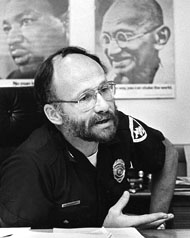
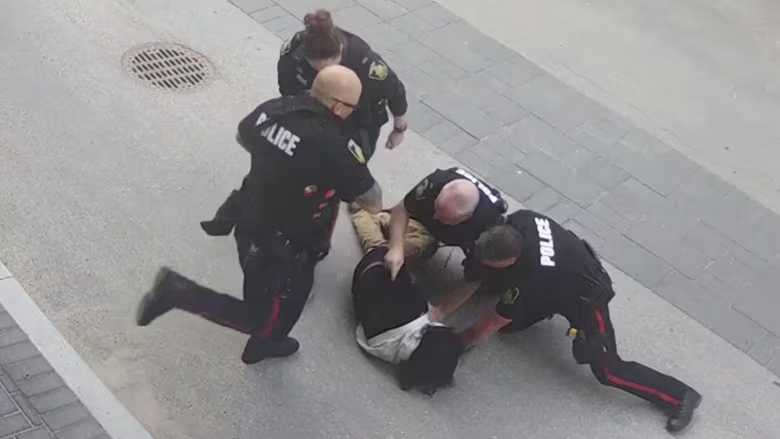
Sociologist Egon Bittner (1921-2011) defined the role of the police as “a mechanism for the distribution of non-negotiably coercive force employed in accordance with the dictates of an intuitive grasp of situational exigencies.” In short, policing is about applying coercive force to uncooperative citizens; “I’m asking you to do this; if you refuse, I will force you to do what I have lawfully requested of you. Your choice.”
I encourage you to read Bittner’s full essay. You can find in the NCJRS Virtual Library. Here is a further quote from Bittner: “Society has also failed to develop any criteria that would allow the judgement of whether a given forceful intervention was necessary and proper; police actions involving the use of force are rarely reviewed or judged by any competent authority.”
Still mostly true today.
Bittner wrote this in the early 1970s. He was a good friend of my mentor, Prof. Herman Goldstein, but I had never met him. The first quote has stuck with me through the years. When I first thought about it, I wondered about the training that is provided to a surgeon in the field of medicine. Not that a surgeon would use non-negotiable force, but rather that surgery involves a body invasion, albeit with permission. And the invasive act is deemed medically necessary to restore health to the patient. So our society requires surgeons to be highly trained, licensed, and supervised with many hours of supervised clinical practice.
I trained in the Asian martial arts and was a street cop for many years. I approached making an arrest of an uncooperative person as operating “surgically.” I approached having to use “non-negotiable physical force” on another person as a something that needed to be done effectively and with using a minimum amount of force. I knew it was a difficult task to invade the space of another human being and it was necessary for me to do It in a controlled and unemotional manner.
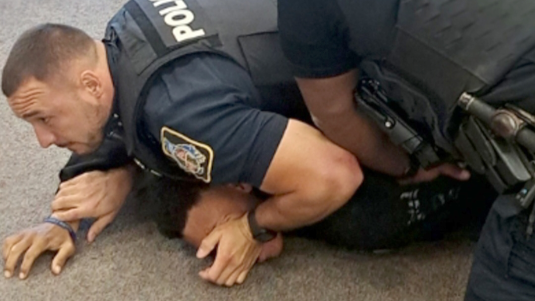
For many years, I was a police defensive tactics instructor for the state of Minnesota, I went around the state training and coaching police officers in performing this task legally and effectively. Unfortunately, due to the limited number of hours allocated to this subject, I was only able to introduce the concept without being able to clinically supervise their practice. Only a very few police officers went on to engage in extensive practice and application. The result is what citizens see today as police try to gain compliance from unwilling subjects in a manner that could be labelled “catch-as-catch-can!”
An hour or two during an in-service training day was hardly sufficient. But shouldn’t police be experts in the control of human persons with a minimum amount of force? Not doing this would be like teaching young surgeons about the ideas and methods of surgery for an hour or two and see how it goes in practice.
Somehow this situation must change. Police leaders must demand extensive training and re-training opportunities for their officers in making physical arrests legally and with a minimum amount of force. The voice of a police officer is still the most effective compliance tool. New officers must be trained to the point they are tactically proficient in making “surgical,” emotionally-controlled, legal arrests.
Why is this important? It has to do with maintaining trust and support of the community. The fourth principle of Peel’s Nine Principles of Policing has to do with the use of force — the more force police officers have to use in making an arrest, the less the public support their police. And when policing a democracy, support is essential for both the effectiveness and safety of the police officers involved in it. When a physical arrest is not done properly, i.e., surgically, we all suffer.
Is anyone out there in the police field doing a model job in this important (and necessary) task of policing?
What do you think?


 Improving Police: A Necessary Conversation
I admire Bittner for really starting the conversation about what the police actually do. He also said, in that paper, that the job of the police is not possible in a free society when the public can see what officers ‘sometimes’ have to do to maintain order.
The idea here is that we, as Americans, do not like authoritarian state actors. The same thing was true in Great Britain during Peel’s time. He had to “sell” the idea of police to a very reluctant populace, hence his 9 principles.
However, Bitner’s statement that people rarely view or judge police action is not true today. Technology now allows us to see what cops sometimes (but very rarely) need to do to maintain order. Those actions are judged by a vocal minority of people who rarely possess any expertise on the law or law enforcement generally. They promote discord because they have a vested interest in doing so (they gain notoriety, money, and power). As a result, police are no longer doing what is necessary to maintain order and the most vulnerable of our citizens are suffering as a result.
LikeLike
Thanks for digging deeper into Bittner’s work. Some very good points… Yes, the task is difficult and the work essential… the community and their police must care for (and take care of) one another. Press on.
LikeLike
I would offer a partial solution in “Virtuous leadership.” Let me know if you would like a copy of an article I’m working on.
LikeLike
Sure. Send me a copy.
LikeLike
. “They promote discord because they have a vested interest in doing so (they gain notoriety, money, and power).”
Cops promote discord for the same reasons you mention.
https://freedom.press/news/the-nypd-has-a-serious-press-freedom-problem/
LikeLike