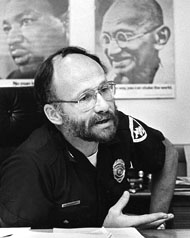
In the 1980s, I wrote the following in my publication, How To Rate Your Local Police. The following is from chapter three, “Leadership Characteristics.”about the leadership characteristics of those who are called to lead our natin’s police:
== LEADERSHIP CHARACTERISTICS ==
What kind of person is the chief?
The police chief should be a visible and accessible leader who thoughtfully strives to improve the effectiveness of police services. The leadership ability of the chief is the single most important ingredient in a good police agency. Police agencies, like all large bureaucracies, tend to resist change. Improvements can be made only if the person at the top is willing to challenge the status quo, take risks, be innovative, and build a coalition of support for change. Improvements are not automatic with a committed police chief, but they are impossible with one. Change for the sake of change is wasteful and inefficient. But because all police agencies need to improve the fairness and effectiveness of their services, a willingness to change, to continuously improve, is essential for all police chiefs. To make those improvements, the chief must have a clear vision of the agency’s objectives, the role of police in a democratic society, and of how to go about achieving them. Additionally, a police chief must have the self-confidence, persistence, and passion to chart an improvement course and see it through.
Finally, to the list of essentials for a police chief, add personal integrity, the respect of the community and elected officials, and the ability to inspire and motivate his or her officers to share the vision and work to the best of their abilities.
What tone does the chief set for the agency?
The chief sets the tone for the agency through both actions and words. An aggressive tone could translate into physically and abusive officers, insensitive to citizen’s rights to due process. Or the chief can emphasize restraint, requiring all officers to always exercise civility and to meticulously observe the legal rights of all citizens they encounter.
In a large dimension, the police chief also sets the tone in the community for discussion of all public safety and law enforcement issues. The chief must present a coherent crime control philosophy as well as concrete crime prevention strategies, striking a balance between the conflicting demands of freedom and public order, majority rule and minority rights, government authority and individual rights, and resisting the pressures from various powerful interest groups. For example, to “do something” to remove an annoying group of protesters, or “clear the streets” of poor or homeless people who are not breaking the law. A thoughtful chief must defend the right of unpopular groups to exercise their Constitutional guarantees to freedom of speech and assembly, as well as safeguard the physical safety of those who choose to exercise these rights, protect powerless, unpopular and disfranchised groups from police harassment or intimidation, and insure that all citizens, regardless of gender, class, race, ethnicity, or sexual orientation, receive the same respectful level of police services.
A strong, effective police chief will not hesitate to take public stands on controversial issues facing the community, balancing the legitimate law enforcement needs of the officers and the safety concerns of the community. It is the chief’s responsibility to educate each group about the other’s interests and perspectives. While a perfect solution to many of these conflicts is rare, the effort put forth to listen to one another is essential in a diverse and free society such as ours.
Does the chief articulate the policies and direction of the agency clearly and understandably?
If there is community resistance or disagreement over certain police practices, the chief must acknowledge these differences, discuss them in a fair and open manner, explain how the practice fits in with the overall direction of the agency, and then resolve the dispute by either modifying the practice or by clearly explaining why one course of action was chosen over another.
The chief must be able to:
- Mediate complex community problems,
- Speak out on controversial public safety issues.
- Offer citizens a coherent definition of the role of police in a democratic society.
The chief’s roles are many and complex:
- Spokesperson on crime control and public safety.
- Advisor on personal security.
- Preserver of due process guarantees.
- Defender of minority rights.
- Protector of the weak, the poor, the sick, the mentally ill, and the injured.
- Manager of a complex bureaucracy; and
- Guardian of the rule of law and our democratic values.
____________________________
The following are excerpts from a May 23, 2025 newspaper report on selecting a chief of police for the City of Madison. A city where I served for over 20 years as their police chief (1972-93).
[Selecting a police chief is a complex and difficult job for community leaders. By state stature (62.13) chiefs of police and fire in Wisconsin’s larger cities are to be selection by a Police and Fire Commission of five members appointed by a sitting mayor for 5-year terms of office and confirmed by the city council. Police and fire chiefs can only be removed for cause.]
Here’s a summation of the process going on in Madison from The Capital Times by Enjoyiana Nururdin is a local government reporter:
What Madison is Looking For in Its Next Police Chief
“…[The Commission] now plans to hold meetings at the end of May and later in June to discuss candidates for the job. Interim Chief John Patterson is among the applicants…
“First-round interviews with applicants are scheduled for June 18, 24 and 26. Commissioners plan to conduct these interviews behind closed doors and will not hear public comment until after finalists are chosen.
“But advocates, elected officials, former police officers and residents see a variety of priorities for the Madison Police Department’s future leader.
“At one of the commission’s April meetings, several representatives of the Madison Community Policing Foundation’s advisory boards spoke about their goals. South, west and central district advisory board representatives said they preferred a chief with experience and knowledge about policing in Madison specifically. Some said they preferred an internal hire over a candidate from elsewhere.
“The ideal candidate will define the future of policing in Madison, and embody justice, innovation and collaboration, and ensure all residents feel safe, valued and heard, the representatives said.
“’We need a police chief who has successfully managed a large, complex urban department, someone who understands the delicate balance between proactive crime reduction, resource allocation and community engagement,’ Shar-Ron Buie said. ‘We need a chief who understands that public safety is not just about making arrests but about creating systems that address the root causes of crime and crisis before they escalate’…
“Buie advocated for hiring someone who understands how to interpret and utilize data, embraces community policing values, and increases the intersection between social services, safe and secure housing, civil rights, and law enforcement. Buie also emphasized the need for being sensitive to the complex needs of people of color, including immigrants, to effectively build trust and repair harm from histories of systemic racism nationally and in Madison.
“Paul Quinn, another advisory board member, said the next chief should be willing to stay long enough to invest the time and energy needed to see change take place.
“Madison is searching for a new police chief this year after Shon Barnes resigned to lead the Seattle Police Department. Barnes had led Madison police for about four years, from February 2021 up to announcing his departure in December last year.
“Jean Papalia, a retired Madison police officer, told the Cap Times a good chief places trust in officers and enables their ability to solve problems using their community connections and discretion. She said effecting change might take longer and look different when officers engage in community policing strategies because it involves collaboration across agencies, networks and support systems.
“’Sometimes problem-solving is just your ability to reach out,’ she said, recalling when Madison mayors put together neighborhood intervention teams. ‘It was when police officers and everybody from the city would meet all together and we would talk about the neighborhood problems.’
“Papalia worked in the Williamson Street area for over a decade. When neighborhood police were introduced, she said she worked out of the fire station to start. Papalia was hired by former Madison Police Chief David Couper, who led Madison police for 20 years and is now a priest in the Episcopal Church.
“Couper told the Cap Times a quality chief will be someone innovative and integrated into the community themselves. He sought to decentralize the police force by assigning officers in neighborhoods across Madison, starting with the South District.
“Couper hypothesized that it takes eight to 10 years to actually see the effects of most significant systemic and cultural changes in the department, hence needing leadership that has a more personal stake in how Madison police operates.
“’I think it’s extremely necessary at this stage now that they hire someone who is going to put roots down here,’ Couper said. ‘The officers in the department won’t be willing to do anything creative without a manager who they know will be leading because they want to have a longer-term relationship’…
“’Police are models of how a government official should work in a free society, and that’s a very important job,’ Couper said. ‘When they fail, the trust could quickly be eroded, and it takes years to build that back up.’
“’Within your city, you must have a bank account of trust, and the holders of that trust are generally people that you have the most contact with, and generally poor people, people of various racial identities. Those are the people who really depend on you to see if you can walk your talk,’ he added.
“Couper said mistakes are likely going to be made by the next chief but working together as a community to explore what works and what doesn’t for everyone is important…
“Some of the initiatives that stuck around included changing the way officers patrol and manage demonstrations, putting officers on horseback and bikes, and assigning officers to a small, south side district station. He was instrumental in diversifying Madison’s police force with more women and people of color — though most officers today at all ranks remain white men.
“Couper also established a customer survey of sorts for one in 50 residents [persons having contact with police] to report back to the department on the quality of their contact with the police. He hoped the results could be valuable in strengthening bonds between the community and police.
“Recent quarterly surveys by the police department show 73% of respondents trust the Madison Police Department most of the time. Most respondents said Madison officers show concern for community members…
The city’s five Police and Fire commissioners, who are appointed by the mayor and confirmed by the City Council, plan to gather public feedback after their first interviews before making a final decision at the end of August.
————————————
References: How to Rate Your Local Police and Arrested Development: A Veteran Police Chief Sounds Off.

 Improving Police: A Necessary Conversation
David I appreciate your thoughtful article about Police Leadership. I remember interviewing you about your great work as a police chief in Madison. I also interviewed other chiefs for my book on Police Leadership. It’s entitled “Police Leadership in a Democracy…A Conversation with America’s Police Chiefs”. As a result of my interviews and this book, I was awarded a PhD in Criminology from UC Berkeley in 2008. You can check out the book on Amazon, which is a bit pricey these days. Always, enjoy and appreciate your Improving Police articles. Best wishes Jim
Dr Jim Isenberg
On Sat, May 24, 2025 at 12:55 PM Improving Police: A Necessary Conversati
LikeLike
Thanks, Jim. Belated Congratulations!
LikeLike