The President’s Army or the People’s Police?
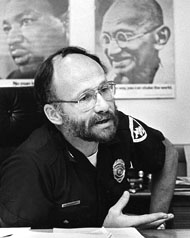
When I took my first oath as a police officer in 1960, it was to protect and serve the people and to uphold the Constitution. That oath did not bend with politics, nor did it change over the years. It did not allow me to ever ignore violations of a person’s civil rights.
Today, that oath and the basic premise of how to police a free society is under attack.
In the past, I have cited journalist Radley Balko (author of Rise of the Warrior Cop). He has long warned that American policing is drifting toward militarization. Now, under the Trump administration, he says we are seeing the “worst-case scenario”: law enforcement transformed into a paramilitary force loyal not to the public, but to one man.
Soldiers, Not Servants
Billions of our tax dollars are being funneled into ICE and Border Patrol while more independent institutions like the FBI and DEA are gutted. Masked agents pull people into vans. Families are torn apart. Detention centers are built where lawyers cannot reach clients.
This isn’t public safety. It’s intimidation.
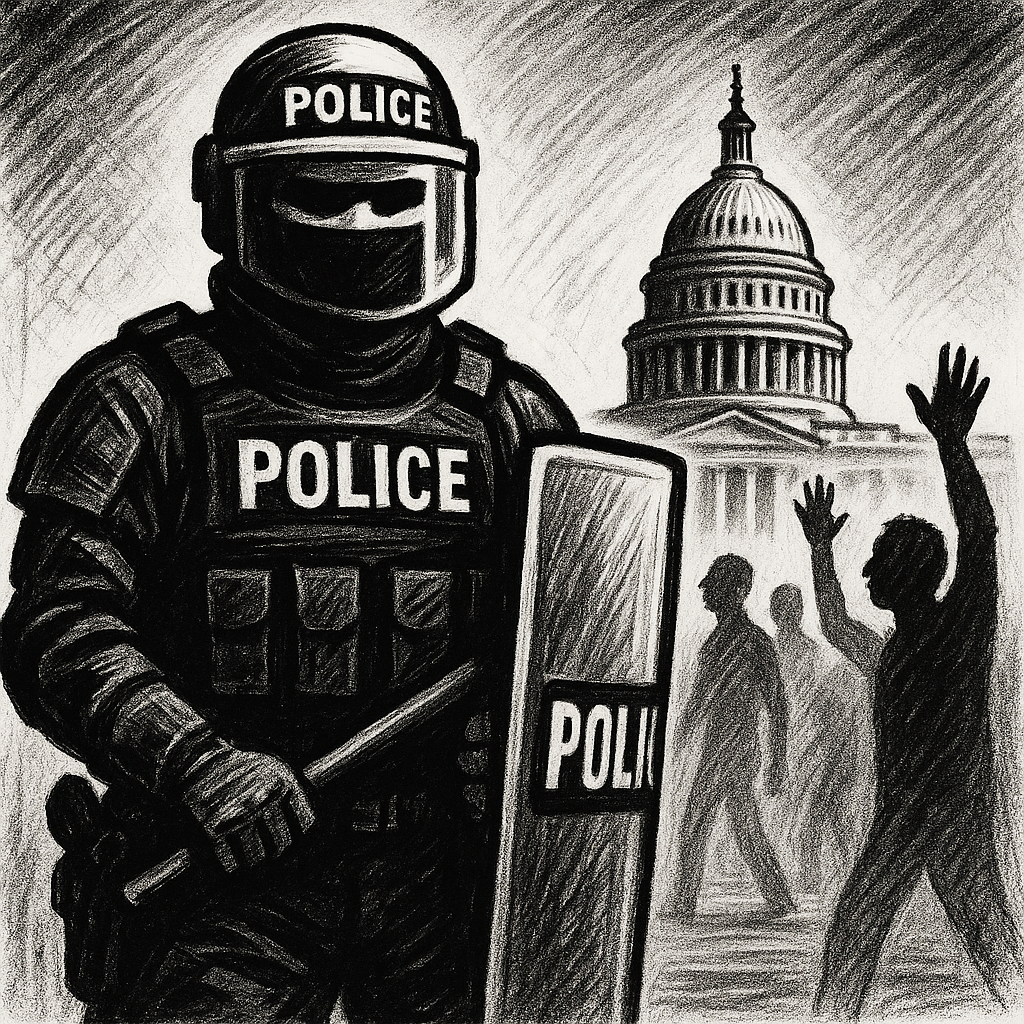
And it’s changing police culture. Militarization doesn’t just mean armored vehicles and assault rifles. It means officers begin to see their job as war, and the community as enemy territory. Once that line is crossed, neighbors stop being citizens with rights and become targets.
A Manufactured Crisis
The crises used to justify this escalation are political, not real. Crime has been dropping in many cities. Protests in Los Angeles and Washington, D.C., were treated as excuses to unleash federal troops and armed raids. Courts have largely erased civil accountability for federal agents. Masks and secrecy erase even the last shred of public accountability.
What’s left is not policing — it’s occupation and intimidation.
The Danger to Local Police
Local officers face a critical choice. Do they serve the community, or do they serve a political agenda?
Every time a local department partners with unconstitutional detentions or racial sweeps, it loses legitimacy. And legitimacy — the trust of the community — is the lifeblood of effective policing. Without it, cooperation dries up, and policing becomes impossible except through force.
I spent my career building community-oriented policing because I knew safety requires partnership, not fear. Once that trust is gone, it is almost impossible to rebuild.
The Line That Must Hold
What are about to experience a defining test for American policing. Officers cannot allow themselves to be used as soldiers in a president’s personal army. Your oath is to the Constitution. Your duty is to the people.
History shows what happens when police become tools of repression: democracies collapse not because of the strongman alone, but because institutions let him.
This is no time for neutrality. For the sake of the badge, and the nation, police must stand on the side of rights and the Constitution — or risk losing both.
______________________
Read Ezra Klein’s interview today in the NYT with Radly Balko HERE.

 Improving Police: A Necessary Conversation
Chief, what will it take to overcome this lunatic.
John Randall (for a short while a former WI Capitol police officer.
LikeLike
A very, very good question, John. Somehow, in the face of all this, we must be calm and willing to stand up for what we believe. Much of what is happening is wrong. We must carefully explain there are better ways to do what is proposed — without being cruel. Improving an agency or a function? There are tried and tested ways to do it — point out this is not the way to do it! Suggest alternatives. Follow your heart.
LikeLike