
How Many U.S. City Police Agencies Require More Than a High School Education for Entry?
The Answer Should Shock You!

Why College Cops?
When we hand a badge and a gun to someone, we grant them the extraordinary power to take freedom—and even life. That power demands more than physical fitness and firearms training; it demands judgment, ethics, and critical thinking. Research is clear: college-educated officers use less force, receive fewer complaints, and build more trust. The question isn’t why we should require degrees for police—it’s why we would ever settle for less.
Nationwide Overview
- Fewer than 1% of local U.S. law enforcement agencies mandate a four-year bachelor’s degree for entry-level officers.
- About 8% of agencies require some college education (but not necessarily a full degree).
- The vast majority—around 80%—require only a high school diploma or GED. AP NewsPoliceOfficer.org.
Burnsville, Minnesota is a notable exception among U.S. police agencies: for decades, it has required a four-year bachelor’s degree for those seeking to become police officers.
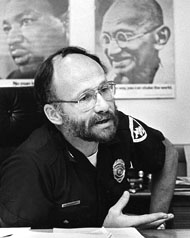
- The Burnsville Police Department (which I led from 1969-1972) has required the 4-year college degree requirement since 1969. I was the chief that first required this level of education for aspiring officers. It has remained so for the past 38 years. Police Chief Magazine
Bottom Line: The 1%
- Beyond Burnsville, only a tiny handful of agencies nationwide—like Coral Springs and the CSO program in Jacksonville—formally require a bachelor’s degree for certain types of entry-level law enforcement or public safety roles. This remains a very rare standard, representing well under 1% of all U.S. police agencies.
So, how does a police department attract college-educated officers without having to require applicants to have a 4-year college degree?
Madison’s Police Department doesn’t have a formal four-year degree requirement like Tulsa or Burnsville, but it still ends up with a highly educated force. They get there through a mix of culture, incentives, and leadership decisions:
1. Organizational Culture and Reputation
- Madison PD has long branded itself as a progressive, community-oriented department. For decades, it attracted recruits who wanted more than “just a job”—people motivated by civic ideals, constitutional values, and reform-minded policing.
- This culture tends to appeal to applicants with college backgrounds in fields like sociology, criminal justice, psychology, and political science.
2. Hiring and Selection Practices
- Even without a written bachelor’s requirement, Madison’s hiring board (called the Police and Fire Commission: see long-standing Wisconsin state statute 62.13) strongly favors candidates with higher education.
- Officers with four-year or graduate degrees tend to score higher in the competitive testing, interviews, and scenario-based evaluations.
- Over time, this “informal preference” raises the educational profile of the force.
3. Compensation and Incentives
- Madison historically offered salary incentives or faster promotion opportunities for officers with bachelor’s or master’s degrees (18% salary increase for a 4-year degree and 21% for a master’s degree!).
- Combined with civil service rules, this created a built-in career advantage and strong incentive for educated officers, encouraging recruits to complete or pursue degrees before applying and giving them the opportunity to obtain a degree after employment.
4. Leadership Influence
- Chiefs like me (and successors who kept many of my reforms) set expectations that education matters.
- In my book, Arrested Development and in my blog, I noted that departments that emphasize college-level preparation gain officers who are more ethical, restrained, and adaptable—qualities Madison valued and selected for.
5. Self-Selection of Applicants
- Because of Madison’s reputation, college-educated applicants disproportionately apply.
- In many U.S. cities, people with a bachelor’s degree don’t think of policing as a viable career; in Madison, the opposite is true—the culture has made it respectable and attractive.
Even though a four-year degree isn’t mandatory on paper, most Madison officers end up holding bachelor’s degrees, and many pursue graduate education. It’s a combination of culture, recruitment branding, selection practices, and leadership emphasis that sustains that outcome.
I reflected on the resistance I encountered when I first proposed the four-year degree requirement in Madison:
“During this period, there was also opposition to raising educational standards for police, because of the fear that this would make the hiring of minorities more difficult… My efforts to get the police commission to set a baccalaureate degree requirement was always thwarted by the access-to-education argument. … Looking back, even though the Madison department didn’t have a formal four-year college degree requirement, I was still able to attract and select many applicants with college degrees–including many from minority backgrounds… Madison police were perceived to be educated men and women” — Arrested Development: A Veteran Police Chief Sounds Off…”
College-educated police officers simply make sense. To accept less is to put the safety and security of a city under stress and even in danger. Now more than ever, we need educated cops!


American cops need to have a 2 year or 4 year police academy training like they have in Europe, preferably 4 years.
LikeLike