
Introduction
I spent over 30 years in municipal policing, serving in four cities and leading in Madison for two decades. Since my retirement, my path led me into parish ministry and into peace and justice work. I have watched, reported on, and lived this combined work for over 60 years.
I know what it means to police an American city. I also know that many of you may view my focus on community-oriented policing, diversity as a strength, and controlled use of force as an “alternative” or ‘liberal” view. But today, I am speaking to you about the fundamental integrity of our profession and how we respond to the broken state of our immigration system and what this means for the future of local policing in our great nation.
Let me be clear: I fully support the arrest and deportation of any undocumented resident who commits a dangerous crime. If someone commits a violent act, they have overstayed their welcome, and they need to leave. However, while the current federal rhetoric claims to target “murderers, rapists, and drug dealers,” the reality on the ground is different. Less than 7% of federal arrests fall into those categories (check these data out yourself). What we are seeing—particularly with our neighbors in Minnesota—is wholesale deportation that is not targeted at the dangerous, but at those most vulnerable.
When federal agents overwhelm a city, as they have in Minneapolis, they disrupt the peace police and county deputies are sworn to maintain. So, I am asking you to stand up and speak to your residents. I am asking you to lead.
The following is a protocol you might consider implementing.
Purpose and Mission
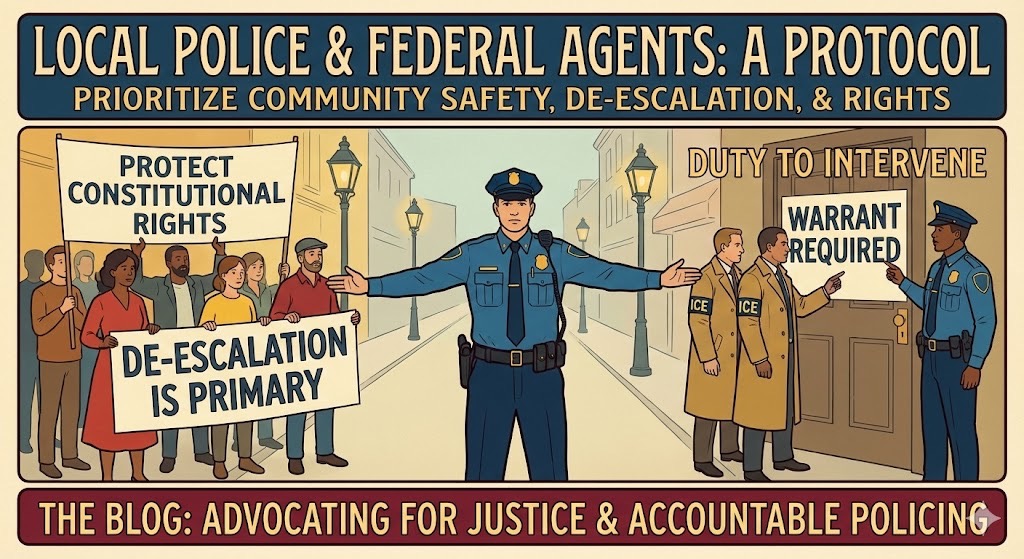
The role of local police and sheriff’s deputies is to serve and protect everyone in the city, regardless of their immigration status. Because federal agents are not municipal police and operate under a different mission, local officers must prioritize community safety, de-escalation, and constitutional rights during federal actions.
Response to 911 Calls Regarding Federal Agents
When residents report the presence of ICE or other federal agents in their neighborhoods, local law enforcement will respond.
- Arrival and Documentation: Officers will show up to the scene to document and report the actions of federal agents.
- De-escalation: The responding officer’s primary goal is to de-escalate conflicts arising from the federal presence.
- First Amendment Protection: Officers will protect the residents’ Constitutional right to assemble peacefully, speak freely, and record the event to petition the government.
Defining the Line: Intervention vs. Obstruction
Officers must navigate the delicate balance between upholding state law and avoiding interference with federal operations.
The Duty to Intervene (The Priority)
- Life and Safety: Per the standard established after the death of George Floyd, officers have a “duty to intervene” if they see a life in danger or the use of unreasonable physical force.
- Serious Injury: Officers must act to keep all individuals safe from serious injury during an encounter.
- Illegal Entry: Officers will ensure that private homes are not entered by agents who do not possess a court-signed warrant.
- State Law Violations: If federal agents violate state laws regarding arrest, searches, or use of force, they can be charged under state law.
Avoiding Federal Obstruction
- Non-Interference with Lawful Acts: Local officers are cautioned not to obstruct federal operations that are being conducted lawfully.
- Primary Duty: The job of local law enforcement is not to enforce federal immigration laws, but to maintain the peace and ensure accountability.
Identification and Accountability
Local law enforcement officers and deputies must remain identifiable and accountable throughout these interactions. Physical force should only be used when it is absolutely necessary to save your life or the life of another person.

 Improving Police: A Necessary Conversation