A Crisis of Allegiance
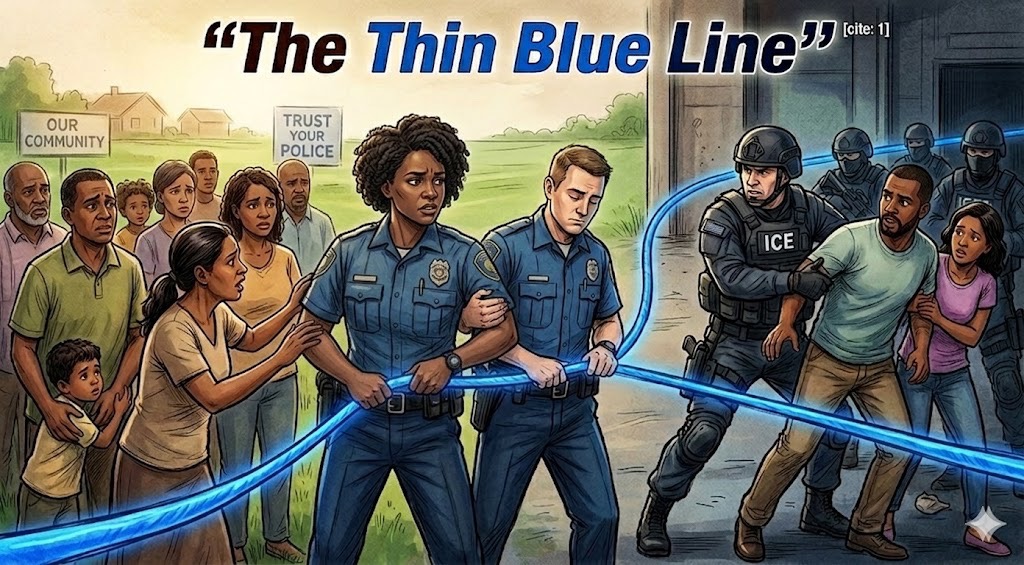
A dangerous collision is imminent between federal overreach and the front-line reality of local policing. Across America, fifty years of painstaking investment in community trust—the very bedrock of public safety—is being traded away for a subcultural silence. We are witnessing a battle for the soul of the badge. When local leaders stand by as federal agents deploy excessive tactics against the residents they swore to protect, the public is left with a haunting question: “Whose police are you, anyway?”
The subculture of policing is not an accident; it is a powerful occupational identity system. Sociologist Jack Van Maanen argues that this subculture creates a closed informational loop where the street is viewed as a place of threat, and one’s colleagues are the only place of safety. This culture is built on a shared danger, mutual dependency. suspicion of outsiders and the belief that no one outside of policing can understand the work.
This environment produces a sequence of responses: solidarity leads to loyalty, and loyalty ultimately produces silence. For many local officers, ICE agents are not seen as “federal bureaucrats” but as fellow badge carriers and risk-takers. When this badge identity supersedes jurisdictional boundaries, silence in the face of misconduct becomes a form of complicity.
While misplaced allegiance plays a role, local police and elected officials are also held in place by significant structural “anchors.” Local governments rely on the federal government for equipment, training and intelligence. Publicly opposing ICE risks professional isolation and loss of federal monies and assistance.
Most police chiefs serve at the pleasure of mayors, while Sheriffs are elected. Speaking out against federal enforcement is often framed by critics as being “soft on crime,” triggering political backlash.
Federal supremacy doctrine can lead chiefs to believe—even incorrectly—that opposing ICE risks obstruction liability. This often leads to moral compartmentalization, where officers tell themselves, “Not my lane, not my problem”.
To find a way forward, we must return to the “Nine Principles of Policing” established by Sir Robert Peel for the newly-created London police over 150 years ago. These principles remind us that the basic mission of the police is to prevent crime and disorder, and that their ability to perform these duties is entirely dependent upon public approval.
Specifically, Peel’s principles dictate the degree of public cooperation diminishes proportionately to the necessity of the use of physical force. Further, that police must maintain a relationship with the public that reflects the democratic tradition that “the police are the public and the public are the police”. And that the test of police efficiency is the absence of crime and disorder, not the visible evidence of police action.
When federal agents disrupt a community with aggressive tactics, they often leave behind a wake of fear and disorder that the local police must then manage. If local police stand by passively, they effectively abdicate their role as the community’s primary guardians and risk losing community support which is essential to their effectiveness.
The conversation must shift from political rhetoric to professional ethics. True professionalism requires deconstructing the idea that loyalty to the badge is synonymous with loyalty to peers. Professional loyalty should be to the high standards of the profession of policing, not to those who work within it.
I am suggesting that local police leaders must find the courage to clearly state to federal agents:
“You will not make my community less safe by destroying the trust we have built. We expect you to follow accepted standards of policing in our city.”
This is not a call for rebellion, but for professional maturity. Local police can and should assist federal authorities in removing truly dangerous offenders. However, they cannot abandon their sworn duty to protect life and constitutional rights of all residents within their own jurisdiction.
If a local officer used force in the same manner as some federal agents—entering homes without warrants or using excessive force—would a chief intervene or discipline them? If the answer is yes, then the ethical principle is clear: jurisdiction does not nullify moral duty and the legal duty for police to intervene does not stop at the local level.
Conclusion
Community-oriented policing only works if leaders deliberately redefine loyalty—not as loyalty to fellow badge holders, but as loyalty to the constitutional process. If local police do not clearly define where they stand, the public will decide for them, and the legitimacy earned over the last half-century will vanish. Silence is no longer neutrality; it is complicity!

 Improving Police: A Necessary Conversation
I used to have great respect for the police.
Now, I teach men and women they are no longer here to serve and to protect but they are like the Gestopo they are to enforce the government laws whether ethical or not
As well we see the police breaking the laws with impunity
They have gone down the toilet since the scamdemic
LikeLike
I sense you may be confusing immigration enforcement agents as “police.” They are not. For the most part, our state, county and local police are fairly well respected according to national surveys. But they can and should be improved — hence this blog! Thanks for for your comments.
LikeLiked by 2 people
That may be true in your country but that is the way it is in Canada
LikeLike
That would surprise me. Can you tell me more?
LikeLike
The ‘Protect and Serve’ motto was a 1950s marketing success for the LAPD, but it has led to a persistent misunderstanding of the role. There is a vital distinction between being an individual’s ‘servant’ and being a Public Servant.
LikeLike
Rather than defining “servant” as “public servant,” I prefer to use Robert Greenleaf’s work and definition regarding “Servant Leadership.” See Greenleaf.org.
LikeLike