Why Georgia’s on my mind — what I learned while working with police in Georgia and why I now have more hope for the future of our police.
Two months ago, an old friend contacted me. It was Michael Nila, founder of the popular “Blue Courage” values program for police. Years ago, Michael and several colleagues got together with me to talk about developing a positive, values-driven program for our nation’s police.
Michael told me that a new police chief had formed a new police department just south of the Atlanta area and had read my book on policing. He asked Michael if he could bring me down to Georgia to share what I had learned about leadership and policing a democracy.
Now some of you may be thinking, “Of course, David has a lot of experience in this area. He must have done this a lot over the years.” No so. My book has been available since 2012 and has sold over 1,000 copies. My blog on improving policing has over 700,000 views and more than 1,500 posts. But I must tell you that no police leader in America has asked me since the publication of this book to talk about what I learned and why it was written.
This may shock many of you, but the first of the “Four Obstacles” I identified in my book that is preventing police in our nation from achieving professional status is “anti-intellectualism.” It is followed by “violence, corruption and disrespect.” Anti-intellectualism as the inability to think about or discuss a subject in an understandable and intelligent way without involving one’s personal emotions or feelings. It is also ignoring research findings that apply to their work and making decisions in life and work based on feelings and ignoring relevant research and studies. Overall, it is the fear of experimentation, trying new things out with a goal of growth and continuous improvement. In short, pursuing excellence.
Chief Frank Trammer in Stockbridge, GA was the chief who wanted me to come down and share what I know about policing a democratic, free, and diverse community. Last week I showed up. It turned out to be a great day and I want to share with you what I learned.
Coming into the Atlanta area, I finally got the feeling I was searching for, that we can be a fair and just, racially integrated nation. As a northerner, I often don’t get this feeling. Coming to Atlanta and working with integrated, educated, and well-trained police did this for me. Thank you!
While conversing, listening, and sharing with Michael, Chief Trammer, Stockbridge officers, and a few others from adjacent police departments, I came to understand that we are in a potential transformational moment for policing in America.
Another great experience I had was to finally meet Patrick Johnson who lives in nearby Kennesaw. Eight years ago, I came into contact online with Patrick, a bright, young electrical engineer and entrepreneur who had developed a way for police to answer an important question, “How Are We Doing? How Do We Know?” (I wrote a blog about this in 2017 and, despite hardly any police leaders buying into the software program, Patrick received a standing ovation and the national “Champion in Technology Award” in 2017 from NOBLE, The National Organization for Black Law Enforcement Executives.)
Unfortunately, I learned that the online site has been shutdown (openpolicing.org). However, there is a Facebook narrative still available. Michael and his co-founder had been making the effort for eight years to encourage police to try use the program to assess their “customer-performance.” It is a sad loss. But after he tried and tried (even to give away the product), only two police chiefs were willing to try it. And when they left their replacements dropped it. The same thing happened to me with the customer survey I used in Madison for six years. Too scary? Perhaps. Necessary? Absolutely.
While we are suffering from the death of George Floyd in Minneapolis (I did a deep-dive into this tragedy), the pandemic, and a caustic political climate, American policing is also suffering not only the exit from their ranks, a reluctance of our best and brightest young men and women to consider a career in policing, and, yes I will say this, a lack of courageous executive leadership throughout the field. That, dear friends, is a recipe for disaster.
But any talk about improvement, change, reform, or reimagining policing in America can begin only when police collectively know who they are, what they are about, and where they are going and who’s going with them. That is what having a vision is. (Three vision statements drove me during my tenure in Madison: “Closer to the people we serve,” “Quality from the inside out.” and “Diversity is our strength.”) When the vision is clear, the mission will follow. [See mission example below.]
In my book, years before the death of Michael Brown in Ferguson, MO in 2014, I identified Four Obstacles that are preventing police improvement in our nation. After every questionable shooting by police, they have been attacked and vilified. The issue? The use of violent force and disrespect in their contacts with citizens (obstacles #2 and #4). Since that time, and until George Floyd was killed by police in Minneapolis (2020), a series of high-visible killings of young Black men by police had routinely occurred throughout our country. Each time, we nationally experience outrage, urban violence, destruction, and calls for police reform often using the words, “When will you stop killing us?”
In response since this time, President Barack Obama put together a task for on “21st Century Policing,” and a national organization of educated police leaders (The Police Executive Research Forum, of which I have been a member for over 40 years) issued “Principles on Use of Force.”
Also recently available to police has been the work of Prof. Tom Tyler at Yale on Procedural Justice along with the work of Daniel Goleman on Emotional Intelligence, and how members of the European Union control police use of deadly force (btw: the standard much higher than ours and the rate of police uses of deadly force in Europe is much, much lower than ours –the standard is “absolute necessity”).
Suffice it to say, there exists a great amount of research and literature is to help police grow and improve if only they would use it. So here we are. And where I believe we are is on the cusp of a great opportunity for police and their communities to “re-imagine” what and how they do what they do. Along with the importance of doing it together with those whom they police.
The topic of “re-imaging” policing has been a constant one both during my three decades in active policing and in the years beyond. I recently found that the Obama Foundation has taken on the same quest: “The Reimagining Policing Pledge is a call for mayors and local officials to review and reform use of force policies, redefine public safety, and combat systemic racism within law enforcement. The killings of George Floyd, Breonna Taylor, Ahmaud Arbery, and the loss of far too many Black lives to list, have left our nation anguished and outraged.” To which I totally agree.
Where do we go from here? Well, the building blocks to re-imagine, reform, and thereby improve policing are all there. They only need to be used. And to use them in today’s social and political climate will take courage – blue courage – young men and women in policing today who will stand up, lead, and work with their communities to become a better, more-trusted, supported, and capable.
Police reform first became an issue in America in the 1930s with the repot of the Wickersham Commission (1931) which, among other issues, identified the use of torture by police to gain confessions. Then President Johnson’s Commission (1967), the Kerner Commission on civil unrest (1968), Standards from the American Bar Association (1971), President’s Task Force on 21st Century Policing (2015), and the PERF report on deadly force principles (2016). I could go on with specific police-related peer-reviewed research, but my point is that there is an existing body of knowledge that is available to police and civic leaders to help them re-imagine and improving policing in their communities. The knowledge is out there. The application — and applicators — await.
One of the most pressing issues that came up from the officers at Stockbridge was the matter of police recruitment. Of course, recruitment is more than just compensation. It’s also about the selection process, manner of training, the community, and being led by mature, forward-thinking leaders. Most police agencies today have not only lost officers during the pandemic, they also are having great difficulty attracting and hiring new officers.
Here’s what we did in the 1970s in the midst of anti-war and police protest (remember “pigs?” We asked young men and women in our community to help us because we want to become the “Other Peace Corps.” Here was one of our billboards that went up throughout our community.
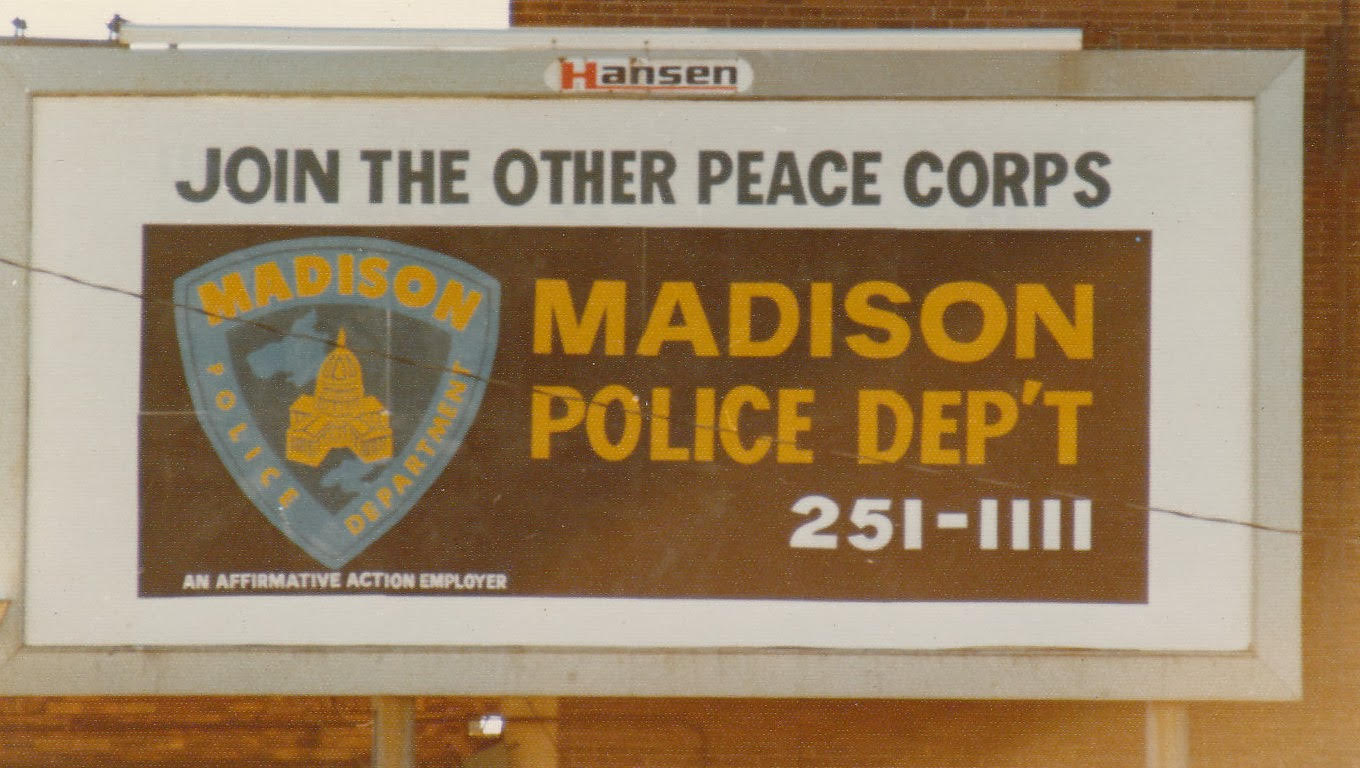
How would that look like today? Try something like this suggestion. Ask for help from advertising experts and get Facebook, X (Twitter), other social media sites and spruce up your webpage!
_____________________________________________________
Tired of Bad Cops and Bad Policing?
So Are We!
Join Us! Help Us Improve.
Yes, We Mean It!
Stockbridgepolicega.org
____________________________________________________
What’s the chance of a major transformation of police in America? The odds are against it. But what I hope will occur is the development of small, centers of police excellence in communities that have the resources and will to do this – a city like Stockbridge. In short, the development of a scattering of model police agencies that are committed to sharing with others what they learn and are doing. Perhaps, one day, these communities would become the sparks that ignite a national re-imagination and improvement of the policing function in our nation – a function highly consistent with our nation’s stated values – “life, liberty, and the pursuit of happiness (and justice!).”
And as I said earlier, all this will take courage from those in blue and in civic government! But police must lead this. For I know and strongly believe that police reform will NEVER occur outside the ranks of police themselves.
Who will step up? Will you?
____________________________________
Mission of the Madison Police Department (early 1980s)
We believe in the dignity and worth of all people.
We are committed to:
— Providing high-quality, community-oriented police services with sensitivity.
— Protecting Constitutional rights.
— Problem Solving.
— Teamwork.
— Openness.
— Planning for the future.
— Continuous improvement.
— Providing leadership to the police profession.
We are proud of the diversity of our work force which permits us to grow and which respects each of us as individuals, and we strive for a healthful workplace.
_________________________
— This question was asked in Stockbridge when I was sharing what I have learned: “What sustained and sustains you on your lifelong mission to improve police?” My answer: “Three things, passion, persistence and patience!”
— Passion is our love of this important work and how it helps rather than hinders the historical values of our society. Persistence is staying in the game when the going gets tough. Patience is realizing the world and our colleagues, are not perfect and that modeling is the best way to lead.
______________________________
[For what it’s worth… my experience, how I tried to “re-imagine policing” is contained within my book, “Arrested Development,” this blogsite, and a biography written about my life and efforts by journalist and author Rob Zaleski.]
______________________________
[For what it’s worth… my experience, how I tried to “re-imagine policing” is contained within my book, “Arrested Development,” this blogsite, and a biography written about my life and efforts by journalist and author Rob Zaleski.]


David,
As I recall, you were Chief in Burnsville, MN. My condolences for the tragedy that occurred there yesterday.
Do you have any thoughts on how police reform efforts could impact these kinds of incidents?
Patrick
LikeLike
Yes. Their deaths had an impact even though I left 1/2 century ago. I don’t know the circumstances but part of being a guardian is always for us to be tactically proficient. May these heroes rest in peace and their loved ones find comfort…
LikeLiked by 1 person
Being a guardian also means being willing to put your life on the line. If you are not willing to do so, then you should be in the military or a police officer.
LikeLike
I meant to say you shouldn’t be in the military or a cop.
LikeLike