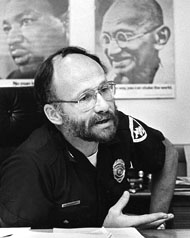

Making Choices: Which Way Do I Go?
One of my most viewed posts over the past 12 years is Making Choices: The Moral Aspects of Policing. So today, I’d like to expand on the importance of morals, our ideas of right and wrong, when we talk about improving policing in America.
Despite all this effort over the years such as from the 1967 President’s Commission, the Kerner Commission, the 2015 Obama Task Force Report, and research around Procedural Justice, along with the continuing steadfast work of my professional organizations, the International Association of Chiefs of Police (IACP) and the Police Executive Research Forum (PERF) over the past 50 years, I have a strong feeling that all this has done little to improve the collective understanding of what is right or wrong in policing nor an agreement about the best way to do it.
And, yes, the recently-released video of the death of Sonja Massey, in Springfield, IL, a 36 year old Black woman, who called police for help has prompted this blog. How in the world did that sheriff’s deputy ever pass muster? The release of that horrifying video added much to my deep concern and malaise along with further information about the offending deputy and how he continued to make bad decisions on the job.
In 1960, when I first became a police officer, I was required to acknowledge and sign a code of ethics [see below]. Most police departments continue this practice with new recruits. I would hope that every police officer today did likewise as part of their training. While morals are those things which we believe to be right, ethics are how morality is to be practiced — the “rules of the game.”
The first paragraph of the Code sets the tone: “As a law enforcement officer, my fundamental duty is to serve the community; to safeguard lives and property; to protect the innocent against deception, the weak against oppression or intimidation and the peaceful against violence or disorder; and to respect the constitutional rights of all to liberty, equality, and justice.“
I urge you to review the Code and my earlier blog on the subject of making moral choices regarding not just what is legally permissible but that which is right. Our decisions may be legal, but are they moral — the right thing to do?
A primer on morality would no doubt include “The Golden Rule;” present in the teachings in all the world’s enduring religions: “Do not do unto others what you would not want done to you!” Simple, yet complex. Don’t treat other people as you would not want to be treated — the basis of justice and, for example, Community Oriented Policing and Procedural Justice. Ends are not to justify means. Citizens are not our enemies. Even bad guys get to be treated fairly. Everything that was illegal before we pinned on a badge is still illegal! Ethics: how we daily practice our profession.!
The Golden Rule remains the collective wisdom of how human beings should interact with one another whether you are religious or not.
Another example. Just because Graham v. Connor says it’s permissible to use deadly force in many police encounters, doesn’t mean it is the right thing to do. (Kill because I can kill, or back away because I should? — That’s often the choice.) And when police officers take a life, there are always two victims. Deep down, we know killing is a moral injury even when it is both legal and morally justified.
A 2019 article in the FBI Bulletin addressed this topic, “While research aimed at assessing the epidemiology of moral injury remains in its infancy, various studies focusing on active military service members and veterans indicated that 15 to 45 percent of those exposed to traumatic events appeared to suffer from moral injury… many scholars have emphasized that police officers also likely experience its impact due to the high occurrence of morally injurious experiences in police work.”
Given the subculture of policing, and reviewing the body cam video of Massey’s unfortunate death, what do you think could have happened if no video account existed and the subculture kicked in to protect the officer and other officers rush in to support the shooter stating “she was much closer, threatening with scalding water, a knife was within her reach, and the officers feared for their lives. Many of us in leadership positions have seen those kind of reports during our careers.
Police must make the choice with regard to using force, it may be legal, but is it the right thing to do at this moment?
One of the problems of teaching police ethics is that I fear we do Inot have a strong understanding of who we are and the best moral ways to do what we do.
We have not done the difficult work to deeply embrace and internalize the concept of “sanctity of life” — everyone’s life. Many of us have failed to understand that our job is primarily being a guardian and helper (not warrior) and not understanding the idea we have a duty to model the ethical values of our diverse and democratic society in our practices.
Moral learning takes time, effort, and strong , emotionally intelligent leaders. It means standing up to the present police subculture because a police chief is not only is the leader of the police but also the leader of community residents and those most vulnerable in it. To do this takes guts, community trust, and tenure — the time to get it done!
As I age approach my sunset, I leave this for you, young officers. You who will one day hopefully aspire to lead. What is must change. I think you know it and what must be done. I pray you will make moral choices, stand by them, and be a moral model — it’s your choice.
__________________________________________
From 2013:
“For the most part, police are not legally obligated to act morally, but it behooves them to do so. And a police department that does not operate morally is always in conflict with its citizens and, thus, becomes ineffective in their ability to both protect and serve their citizens.
- When you question a police act you need first to ask, ‘Was it legal?‘
- Secondly, ‘Was it moral — was it the right thing to do given the circumstances?‘”
______________________________________
The Law Enforcement Code of Ethics
As a law enforcement officer, my fundamental duty is to serve the community; to safeguard lives and property; to protect the innocent against deception, the weak against oppression or intimidation and the peaceful against violence or disorder; and to respect the constitutional rights of all to liberty, equality, and justice.
I will keep my private life unsullied as an example to all and will behave in a manner that does not bring discredit to me or to my agency. I will maintain courageous calm in the face of danger, scorn or ridicule; develop self-restraint; and be constantly mindful of the welfare of others. Honest in thought and deed both in my personal and official life, I will be exemplary in obeying the law and the regulations of my department. Whatever I see or hear of a confidential nature or that is confided to me in my official capacity will be kept ever secret unless revelation is necessary in the performance of my duty.
I will never act officiously or permit personal feelings, prejudices, political beliefs, aspirations, animosities or friendships to influence my decisions. With no compromise for crime and with relentless prosecution of criminals, I will enforce the law courteously and appropriately without fear or favor, malice or ill will, never employing unnecessary force or violence and never accepting gratuities.
I recognize the badge of my office as a symbol of public faith, and I accept it as a public trust to be held so long as I am true to the ethics of police service. I will never engage in acts of corruption or bribery, nor will I condone such acts by other police officers. I will cooperate with all legally authorized agencies and their representatives in the pursuit of justice.
I know that I alone am responsible for my own standard of professional performance and will take every reasonable opportunity to enhance and improve my level of knowledge and competence.
I will constantly strive to achieve these objectives and ideals, dedicating myself before God to my chosen profession… law enforcement.
_________________________________
[The IACP adopted the Law Enforcement Code of Ethics in October 1957. The Code of Ethics stands as a preface to the mission and commitment law enforcement agencies make to the public they serve.]

 Improving Police: A Necessary Conversation
I am reminded of the sign in President Bill Clinton’s campaign office that read “its the economy stupid” to ensure they remembered the key was economic problems. If we are serious about improving policing, we need a sign that reads “it’s the subculture stupid.”
LikeLike
Right on, Karl. Subcultures can be changed — But it takes a lot of time and effort — and that’s when leadership kicks in.
LikeLike
Agree David. But in the last 50 years I haven’t seen appreciable change. If anything, things may be going in the wrong direction with the increased militarization and officers imitating what they see on TV and in movies.
LikeLike
I fear you are right, Karl. I wonder whether the IACP and PERF members ever listen to what those of us who have served, taught, and analyzed police over the years have to say? Part of their annual meetings? And so it goes…
LikeLike
What about police unions. Since we in America, blame unions for anything and everything, we can then blame the police unions for creating the problems with policing in America as well.
LikeLike