Policing a Free Society
Dane County Historical Society — April 19, 2026
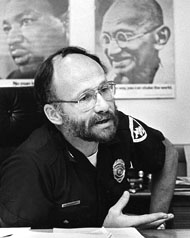
I had the pleasure (and blessing) of sharing some of my thoughts about policing in the city I served for over 20 years with two of my former officers.
It came about at the bequest of the Dane County Historical Society. We met at an historical site, the Italian Workingman’s Club in Madison.
I was joined by Pia Kinney-James who was the first Black woman we on the department and Noble Wray who was the first Black officer promoted internally to become the city’s chief of police.
Moderating the event was, Nino Amato, a colleague of mine when I taught years ago at the University of Wisconsin-Platteville and a former Madison Alderman.
Here we go. My take on my values and philosophy on policing a free and democratic society and how they may have impacted policing in Madison, Wisconsin.
—————————-
The Ghosts of Yesteryear
On October 18, 1967, the campus of the University of Wisconsin–Madison became a battlefield. Students protesting Dow Chemical — the makers of napalm — were met with a response that left the community scarred and the police department isolated, with more than 70 officers and protesters hospitalized.
Three years later, in August 1970, four men bombed Sterling Hall on the UW campus to protest the university’s research ties to the U.S. military and the Vietnam War. A researcher was killed, and three others were injured.
When I was appointed to lead the Madison Police Department two years after that, on a contentious 3–2 vote from the Police and Fire Commission, those days still hung over the city like a heavy fog.
Many members of the department, along with factions in the community, wanted to continue the fight with protesters and did not welcome my peacekeeping efforts. I spent the first years trying to hold onto my job while raising a family of six children. Those were difficult days.
Opposition kept building, and two close advisors — Professors Frank Remington and Herman Goldstein — pulled me aside: “David, the community needs to know what will be lost if you are forced out. Tell them now.”
So I told them in a speech to the Downtown Rotary Club titled “The First Seven Months and the Next Seven Years.” I presented it with real urgency.
First, decentralize. The department had been centralized since the mid-1800s; we needed to get out of a single downtown headquarters and work closer to the people we served.
Second, build a people orientation. I would recruit well-educated officers and train them — especially in leadership — to understand human behavior, partner with residents, and look for the root causes of problems.
Third, develop our capacity for conflict management and crisis intervention. After years of fighting over the war, we needed a response to public protest that did not begin with tear gas and a nightstick.
And then eight years out, I said, Madison would be fielding a new kind of officer — a human-behavior and human-services expert, a true professional. Not just a responder to calls, but a community worker and advocate.
I was fighting for my career — but more than that, I was fighting for a police department Madison did not yet have, and I wanted the city to know my dream for it.
Police and Fire Commissioner Stuart Becker once shared an observation with me at my appointment that became the cornerstone of my philosophy. He spoke of the “two ends of State Street” — the University at one end and the Capitol at the other. On the first day of the Dow protest, he noted, the dispute was about the war in Vietnam. But by the second day, it had shifted — and remained — about the violent response by city police.
That friction is why I was chosen to lead: not just to manage a department, but to help heal a city and its police grow.
The Education of a Street Officer
My ideas about policing a democracy began on the streets of Edina and Minneapolis, Minnesota. As a young officer, I saw the limitations of the traditional command-and-control model, and I saw how racism had infected our major institutions. I saw how easily the badge could become a barrier rather than a bridge.
The intellectual spark for change came from the 1967 President’s Commission on Law Enforcement and Administration of Justice. It was a revolutionary document, challenging us to examine the root causes of crime. It taught me that policing in a free society is a delicate balance — protecting the rights of the individual while ensuring the safety of the collective.
Guiding me was the Law Enforcement Code of Ethics, adopted in 1957 by the International Association of Chiefs of Police. It was a mandate to protect the weak against oppression and to respect the constitutional rights of all to liberty, equality, and justice.
To this day, I remember the first sentence: “My fundamental duty is to serve all mankind.” It shaped how I came to see the task of policing; of serving and protecting others.
The Madison of 1972: A Legacy of Exclusion
When I arrived in Madison, I found a department that was “good” by 1950s standards — disciplined and efficient, but also a product of its era: almost entirely white, and exclusively male. The officers did not look like the community they served.
We cannot talk about Madison’s history without acknowledging the shadows. In the 1920s and ’30s, the Ku Klux Klan had a visible presence here. There is a famous, chilling photograph of them parading on our Capitol Square. That legacy of exclusion did not disappear overnight; it lingered in how our minority communities viewed the police. They didn’t see guardians. They saw an all-white wall that did not understand their lives. I wanted to lead an organization that looked like the community it served.
Earlier in my Minnesota career, I had been given a grant by the University of Minnesota to study policing in Europe. What I saw there was transformative: women working in uniform, patrolling the streets of major cities. Our own Presidential Commission in 1967 had not even mentioned women in policing. But in Europe, I saw that the presence of women changed the chemistry of the work itself — prioritizing communication over force and dominance. I knew then that Madison’s future had to be inclusive. Not everyone in the department, or the city, agreed.
The Madison Method: From Warriors to Guardians
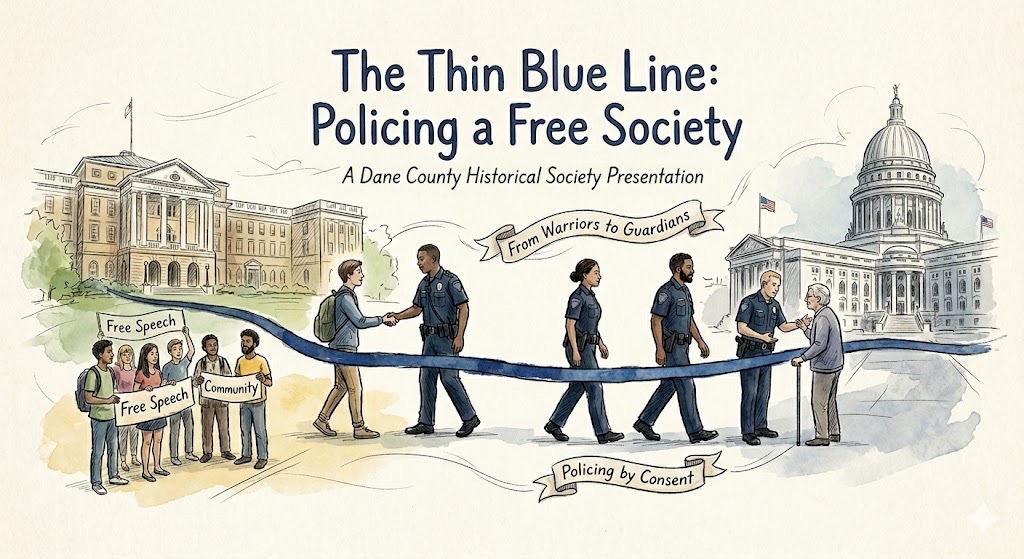
The most visible expression of this new philosophy was what came to be called the Madison Method of Crowd Control. Before this, the standard response to protests was the threat of force: helmets, batons, tear gas, and orders to “clear the streets.”
We flipped the script. Our job at a protest was not to win or control, but to protect the First Amendment. We spoke with protest leaders beforehand. We emphasized de-escalation and soft uniforms over riot gear. In a democracy, dissent is not a crime — it is a vital sign of a nation’s health.
As Tom Mosgaller and his co-authors note in Bending Granite: 30+ True Stories of Leading Change, organizational change is grueling. It is like trying to bend stone. Many old-guard officers felt I was soft, or that I was abandoning traditional police culture. My response was always the same: we were not abandoning our duty. We were fulfilling our highest calling as protectors and guardians of a free, diverse, and democratic society.
A Lifetime of Learning
In my book, Arrested Development: A Veteran Police Chief Sounds Off, I argue that many police departments are stuck in an adolescent stage — reactive, defensive, obsessed with authority. Moving toward a community-oriented model is an act of organizational maturity. It requires police to listen and think — more than they act.
Rob Zaleski’s biography, Beyond the Badge, captured the essence of my journey. It was never just about policies; it was about people — about teaching form and focus, and caring for the men and women leaders are privileged to lead.
My earliest work, How to Rate Your Local Police in 1983, was born from a desire to empower citizens in a democracy — the people who should be grading the police in the first place. Police are accountable to you, not the other way around, and what they do can be measured.
The Path Forward
Looking back on those 21 years, and now having served three decades as a clergyperson, I am proud of our progress, but mindful of the work that remains. We have made strides in diversifying the force — moving from a monolithic demographic toward a department that better mirrors a city roughly 70% white and 30% people of color. But the work of fairness and equality is never finished, it must be on-going.
What I hope for Madison is a commitment to continuous improvement — always seeking to be better. More than 150 years ago, upon the advent of the first public police in London, Sir Robert Peel and his colleagues set out nine principles. Among them: that the police are the public, and the public are the police; and that the more force police use, the less cooperation they will receive. Those principles apply today as much as they did a century and a half ago.
We must continue to professionalize, to diversify, and to lead with non-violent strategies. We must never forget that the authority of police comes not from the gun or the badge, but from the consent of the people.
If you will permit me one word about the present before I close. One of the most serious challenges facing American police today is whether local officers will stand up and protect the residents of their communities from being assaulted in the streets by masked, out-of-control federal agents carrying out civil immigration enforcement. The question is not abstract.
I learned that you cannot police a city you do not love, and you cannot love a city you do not understand. My hope is that the bridge those of us here today have built between the two ends of State Street — between the University’s ideas and the Capitol’s laws — remains strong for the next generation.
Thank you for allowing me to share this history.
I pray our journey forward (and together) continues.


I found this very interesting David, a perspective of a new chief coming into a troubled police agency in the wake of the civil unrest of the 1960s. This speaks to the need to change organizational culture and community expectations, no easy task, but a noble one. It’s no surprise that you struggled to retain your position.
Since your time as chief the “Madison” method has become the model of a better way to handle civil unrest. Your legacy lives on in that department as I tell my students that if they want a real policing challenge, apply to Madison. The enormously high turnover rate speaks of the challenge that department continues to offer in terms of the demands it makes on its officers, and other factors. Quite simply, the job is easier elsewhere.
Why did you have so much pushback on your peacekeeping approach? Because most people, overwhelmingly poor people, want law and order. They want to feel safe and will accept a certain amount of authoritarianism and even brutality from their police in exchange for feeling safe. Sorry, as desirable as your approach is to the intellectual elites, it does not do that.
We can agree that a community focused approach is always preferable to a militaristic approach, as demonstrated by federal officers in Minneapolis, but it has never proved effective in controlling crime and disorder, the fundamental mission of all police. We are also in agreement, that the best officers are well versed in and practice “Human Relations,” whether they choose to be guardians or warriors, the very best can do both well, but it’s a tall order especially at the federal level.
LikeLike
Thanks, always nice to hear from you as we press on! Always work to do!
LikeLike