Active Reserve Duty
I have fought a long, hard fight for nearly three-quarters of a century. It is now time to move front the arena into reserve status. A lot like I did after my tour of duty with the Marines. I am joining the reserve forces. Standing by.
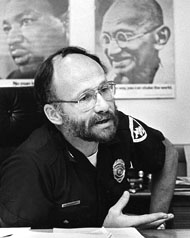
I have walked the beat as a patrol officer, molded minds as a recruit training officer, and hunted shadows as a detective. I have led two city departments as their Chief of Police, lectured in most every corner of this nation and even in Europe. I have authored the books I hoped would be blueprints for a new era and a realization for my dream of what police could and should be in a free society. For over 1,600 posts on this blog, I have poured my soul about my dreams into the digital ether, pleading for a better way to police a democracy.
Even as I continued to monitor, critique, and write about the desperate need for police reform, my path took a profound turn. I entered seminary after active duty and was ordained a priest in the Episcopal Church, serving two Wisconsin parishes for the past thirty years. As a military veteran and pastor, I have spent those decades squarely on the front lines of peace and social justice.
Towards the end of my career in Madison, Wisc., my fellow chiefs who are members of the Police Executive Research Forum (PERF) honored me in our nation’s Capitol with the National Police Leadership Award for the year. That badge of recognition was a beacon of immense hope for me at the time.
But now—after a lifetime spent wrestling for the soul of our communities from both the squad car and the altar—that hope has been completely eclipsed by a cold, crippling reality. The reality of painfully, reluctantly, and with a breaking heart—have come to a conclusion: I have done all that I thought was possible to improve American policing. It is now time to pass that torch to younger officers and move into the ready reserve. Not to quit, but to standby; to be in reserve!
I desperately hope history proves me wrong. But after nearly 70 years in the arena, I can no longer ignore the raw, bleeding truth. Truly lawful, respectful, people-oriented policing will never be the norm in America. If will exist at all, it will be fragile exceptions, a luxury of a few wealthy, innovative cities in our country. For the rest of the nation, the system is no longer just bent; it is calcified.
The Broken Promise: Peel’s Nine Principles
To understand how far we have fallen, we must look to where we began. In 1829, Sir Robert Peel established the London Metropolitan Police, codifying the Nine Principles of Policing. This was humanity’s first deliberate, brilliant attempt to construct a democratic, civilian police force under a free and elected government.
Peel understood that a police force in a democracy must never look like an occupying army. I spent my entire life trying to make his nine truths real. I believed in them with a fervor that defined my existence. Read them below, and see what we have thrown away:
- The Core Mission: The basic mission for which the police exist is to prevent crime and disorder, as an alternative to the military force and severity of legal punishment.
- The Power of Approval: The ability of the police to perform their duties is dependent upon public approval of police actions, existence, and behavior.
- The Necessity of Consent: Police must secure the willing cooperation of the public in voluntary observance of the law to be able to secure and maintain the respect of the public.
- The Cost of Force: The degree of cooperation of the public that can be secured diminishes proportionately to the necessity of the use of physical force. Every deployment of force erodes consent.
- Absolute Impartiality: Police seek and preserve public favor not by catering to public opinion, but by constantly demonstrating absolute impartial service to the law.
- Force as the Last Resort: Police use physical force only when the exercise of persuasion, advice, and warning is found to be insufficient to obtain public cooperation.
- The Fundamental Identity: The police are the public and the public are the police; the police being only members of the public who are paid to give full-time attention to duties which are incumbent on every citizen. We are not a separate caste.
- The Bounds of Authority: Police should always direct their action strictly towards their functions and never appear to usurp the powers of the judiciary.
- The Metric of Success: The test of police efficiency is the absence of crime and disorder, not the visible evidence of police action in dealing with it.
The Reasons Why the Dream Died
I believe we have ignored Peel’s sacred blueprint for the following reasons.
- The Failue of Attraction: We have failed to attract the civic-minded, the educated, and the empathetic. On the rare occasion they do join, the toxic gears of authoritarianism grind them down until they either conform or quit.
- The Cult of the Warrior: The profession is pathologically obsessed with being an army of “warriors” rather than a guild of “guardians.” This vanity has cost lives at a rate that shames us before the civilized world.
- The Wall of Silence: Our organizational culture is built for survival, not evolution. We do not treat mistakes as data; we treat them as threats. We circle the wagons, we bury the truth, and we rot from within.
- The Betrayal of the Unions: The Fraternal Order of Police and local associations have chosen their side. They do not stand for excellence; they stand for immunity. They shield the bad actor at the expense of the profession’s integrity.
- A Moral Void: There is no shared constitutional or ethical compass. No unified set of principles. We have no “North Star” to guide us back to the Bill of Rights when the night gets dark. We have published a Code of Ethics, but fail in its system-wide practice.
- A Century of Ignored Prophets: Wickersham in the ‘30s. Kerner in ’68. The ABA in ’73. Presidential Commissions in ’67 and 2015. The warnings were deafening. The blueprints were lofty. And every single time, police leadership throughout the country stumbled.
- The Failure of Reflection: Despite decades of effort, we remain an institution that struggles to reflect the diversity of the people we serve. We remain a closed loop.
- The Absence of a West Point: We never had the courage to fund a national academy for ethical leadership and how those graduates might serve local and state police. We couldn’t even manage to create a moral and ethical foundation for our own character and future.
My Verdict
Will it ever get better? Unfortunately, history has already answered this question.
FACT: Through mass protests, national commissions, and presidential mandates, the fundamental culture of policing has remained defiantly, arrogantly resistant to change.
FACT: The institution has dug in its heels. The political will has evaporated. The resistance is too vast, too deeply entrenched, and too satisfied with the status quo.
However, I will leave you with a challenge: The Policing Covenant. It is a framework for what could be—a modern promise of “do no harm” in an age of steel and algorithms. It is the floor beneath which no officer should ever fall and has been drafted by former police leaders like myself and today’s forward-thinking leaders who are fellows of the Future Policing Institute.
I offer it now as my departing testament. Read it. Keep it close. Remember it. And when you can, officer, ACT on it!
____________________________________
THE POLICING COVENANT (A Draft)
A Framework for Justice in the Modern Age
OUR PROMISE We, the members of ___________, promise that while doing our best to control crime, we will do everything in our power to do no harm to the communities we serve. This promise extends without exception to every tool, every technology, and every officer deployed in the public’s name.
I. The Sanctity of Life Every life is irreplaceable. The preservation of life is not a tactical priority—it is our moral foundation. We will exhaust every alternative before resorting to force. Restraint is not weakness; it is the highest expression of discipline.
II. The Dignity of Every Person No policing action shall diminish the inherent human dignity of an individual. We will treat every person as we would wish our own family to be treated: with compassion, respect, and empathy.
III. The Primacy of Trust Policing without trust is occupation. Our authority is a loan from the public, not a right of the badge. We will never sacrifice that trust for the sake of expedience.
IV. The Equal Protection of All We commit to equal protection as a moral imperative. We will police every neighborhood with the same standard of care and restraint, regardless of race, creed, or status.
V. The Duty of Accountability We will hold ourselves and one another accountable. The silence that protects misconduct is a betrayal of the honorable. We will speak. We will report. We will act.
SO WE PLEDGE · SO WE ARE BOUND · SO WE SHALL BE JUDGED.


