From Guardians to Warriors: How 9/11 Changed American Policing — and Why It Hasn’t Stopped
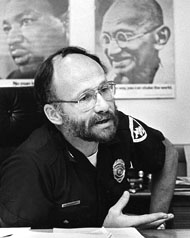
I took my first oath as a police officer in 1960. It was to protect and serve the people and to uphold the Constitution. That oath didn’t bend with politics, and it didn’t change with the times. It never once suggested that the people I served might someday become the enemy.
Somewhere along the way, for too many police departments in this country, that changed. I’ve spent much of the past two decades on this blog trying to trace how it happened, and I want to lay it out here as plainly as I can — because it’s still happening, and it hasn’t slowed down.
Before the fall
I need to say first that militarization did not begin in 2001. When I came up through the ranks — first in Edina, MN and then Minneapolis, then as chief in Burnsville, then in chief in Madison — we had tactical teams and back-up weaponry, and I fielded am emergency response team of my own after 1997, when LAPD officers were outgunned by bank robbers in body armor during the North Hollywood shootout. I supported that decision. Departments need a small, highly trained, carefully used capability for the rare moment when it’s genuinely needed. I made sure we paired our team with a hostage negotiation team, because I never wanted force to be our only tool.
But that was a specialty. It was not who we were day to day. My academy training looked more like a college classroom than the boot camp the Marines had put me through years earlier. We didn’t salute. We didn’t call our supervisors “sir.” If you’d asked me back then whether I was a warrior or a guardian, I would have told you, without hesitation, guardian!
The day everything changed
Then came September 11, 2001.
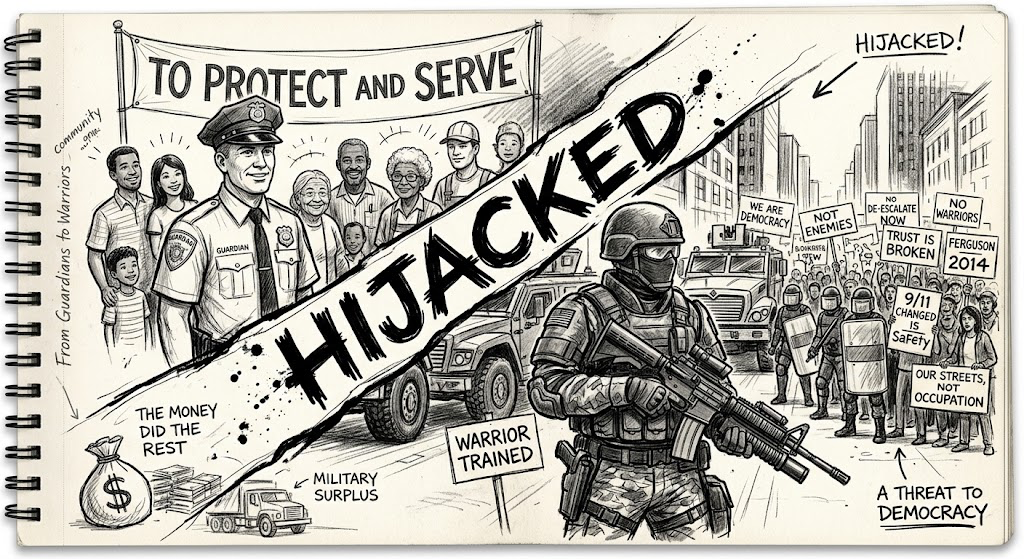
That day cast a pall of fear over this entire nation, and our police were not immune to it. In the years that followed, departments got pulled into “homeland security.” Officers were outfitted in body armor that made them look like robots. Departments acquired chemical agents and military-grade equipment that had no business in routine patrol work. And those tools weren’t only used against violent people resisting arrest — they were turned on citizens doing nothing more than exercising their constitutional right to voice disagreement with their government.
I’ve said this before and I’ll say it again: 9/11 didn’t just change how we fought terrorism abroad. It changed who we thought our own police were for.
The money did the rest
Fear opened the door. Money kept it open. Between 2002 and 2011, the federal government handed out $35 billion in grants to state and local police departments, much of it justified by the “war on terror.” At the same time, surplus military equipment — armored vehicles, weapons, gear built for combat zones — became available to local departments at virtually no cost. Layer onto that the asset forfeiture incentives baked into the decades-long war on drugs, and you had two enormous funding streams pushing every department in the country toward looking, arming, and increasingly thinking like a military occupation force.
By 2011, when so many departments met the Occupy Wall Street protests with riot gear and armored trucks, the shift was no longer subtle. It was the clearest evidence yet of what had been building quietly for a decade.
Ferguson, and the country finally sees it
Then came Ferguson in the summer of 2014, and America wasn’t able to look away any longer. Officers in camouflage stood atop armored vehicles pointing weapons at their own citizens on a residential street in Missouri, and the country asked, in real time, what had happened to its police. That question landed alongside a flood — a tsunami, really — of cellphone video that made the human cost of all this impossible to deny: Tamir Rice, Walter Scott, Laquan McDonald. Within a decade, American policing had traveled from Sheriff Andy of Mayberry to Robocop.
I’ve argued that the hardware is only half the story. Ferguson made people look at MRAPs and body armor, and they should. But I’ve spent just as much of my career worried about what happens inside police academies — training grounds that too often resemble boot camps more than professional schools, emphasizing weapons and tactics while giving short shrift to de-escalation. As of a few years ago, thirty-four states required no de-escalation training at all. You cannot hand a young officer a warrior’s training and a warrior’s equipment and then be surprised when he starts to see the community as enemy territory.
Where we are now
I never imagined, when I first started writing about this, that I would live to see actual soldiers deployed into American cities against American citizens. But that is where we are.
I’ve watched this administration double down on militarization — not just militarized police anymore, but masked federal agents and National Guard troops sent into our cities directly. Washington, D.C.’s tourist corridors. Threats against Chicago, Detroit, New Orleans. This is not public safety. It is political theater, and it comes at a real cost: it erodes trust, it inflames division, and it undermines the very democracy it claims to protect.
I’ve watched this same logic extend into immigration enforcement, with local police increasingly pulled into a federal dragnet that has nothing to do with the community policing relationship they depend on to do their jobs. Every time a local department does the work of federal immigration agents, it breaks a little more trust with the very neighborhoods it needs to keep the peace.
And I’ve spent this past year arguing that we need to raise the legal bar for police use of deadly force itself — because our current standard, set by the Supreme Court’s 1989 decision in Graham v. Connor, gives police far more room to use lethal force than European democracies allow their own police. A militarized posture and a permissive legal standard for killing reinforce each other. You cannot fix one without addressing the other. [For a rationale approach check out the Stanford Law School Model Use of Force Policy.]
What I still believe
None of this is inevitable, and none of it is unchangeable. I still believe what I believed when I put on that uniform in 1960: police in a free society are meant to be guardians of their communities, not warriors occupying them. Soldiers fight enemies. Police serve people. When we let those two roles blur into one, the people we’re sworn to protect start to look like the enemy — and that is a threat to democracy itself, not a public safety strategy.
Twenty-five years after 9/11, the retreat from that principle still hasn’t been reversed.
I intend to keep writing about it until it is.


