Presence Without Accountability: What a Month in China Taught Me About Policing
______________________________________________________________
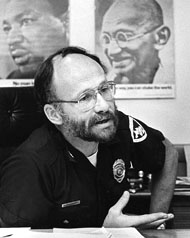
I spent last October in China with my organization “Veterans for Peace.” My son and I went as a traveler, but I couldn’t stop watching the police. After more than sixty years in and around policing, I suppose that’s how I’m wired.
What I saw surprised me. Throughout my visit, I constantly thought, “Most everything I thought about China before I went was wrong, very wrong!” Officers walked their beats on foot, highly visible, with small red and blue lights blinking on their epaulets. Most carried no gun. In a month on the street, I saw very few contacts that looked aggressive or confrontational.
My first instinct was to say China is doing community policing better than we are. After digging into the research, I think that’s half right, and the half that’s wrong matters just as much. Call it presence without accountability. Here at home, we too often have the opposite problem: accountability, at least on paper, without presence.
More people on the street, fewer sworn officers
China’s visible presence doesn’t come from a large sworn force. By official count it has about 2 million regular officers for 1.4 billion people. Per capita, that’s thinner than the U.S. and well below the UN’s global median of roughly 300 officers per 100,000 residents.
The difference is in who else is out there:
- Auxiliary police. By the end of 2024, China had more than 1.2 million auxiliaries, 46 percent of all frontline personnel. They are contract employees who work alongside sworn officers. In a city like Xiamen, a typical emergency call is answered by one sworn officer and at least one auxiliary.
- Volunteer police. In 2017, Shenzhen’s Bao’an District recruited 100,000 volunteers in 29 days, roughly one for every 45 residents.
- Neighborhood “grid” workers. Each urban grid covers 15 to 20 households and has its own assigned monitor.
This matters because Malcolm Gladwell’s new book, The American Way of Killing, argues that America is badly under-policed. He says thin staffing leaves our officers cornered and frightened, and that frightened officers shoot. China has found a way to put far more bodies on the street than its sworn force alone could. It does so cheaply, with auxiliaries and volunteers.
Unarmed, and mostly unthreatened
For decades, Chinese patrol police carried no firearms at all. Gun crime was rare and civilian guns were nearly impossible to get. That changed after the 2014 knife attack at Kunming’s railway station, which killed 29 people while unarmed officers struggled to stop it. Since then, patrols in major cities and transit hubs have carried sidearms under strict rules. For example, in Shanghai, only about 1,000 of 4,000 candidates passed the evaluation to carry a gun on patrol.
Even so, the neighborhood beat officers I saw were generally unarmed. The deeper reason their contacts stay calm is simple: an officer can assume that almost nobody he approaches has a gun. In Urumai, many officers carried 5-foot bo staffs on patrol. But no American officer can assume that most all of their contacts today will be with unarmed citizens. Our warrior training, our fast escalation and our fear all grow from that one fact. Any honest comparison has to start there.
Violence-control kits, everywhere
The thing that struck me most wasn’t the officers. It was the equipment left out for everyone else to use to ensure public safety. And that applies to speed and seat-belt requirements to smoke masks, fire blankets in hotel rooms and how they protect their schoolchildren. It would be very difficult for anyone to bring a firearm into a school. Fences and guards assure that.
On street corners, and inside nearly many businesses and hotel lobbies I entered, there were racks of violence-control gear. A typical kit held a collapsible “man-fork” (a long pole with a U-shaped head that pins an attacker at a distance), a clear plexiglass shield, and sometimes a helmet and a baton. They were there for security guards, shop staff and citizen volunteers to use against someone armed with a knife or a club.
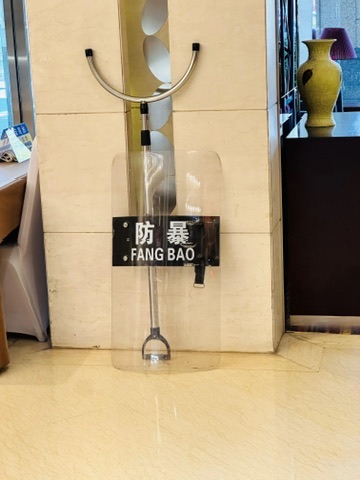
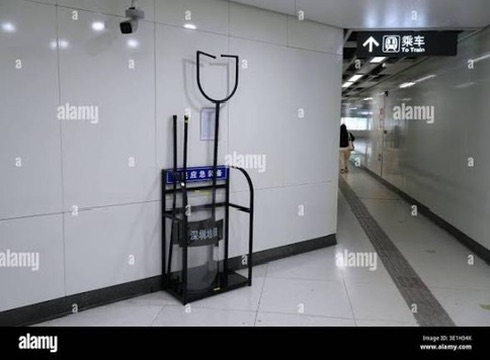
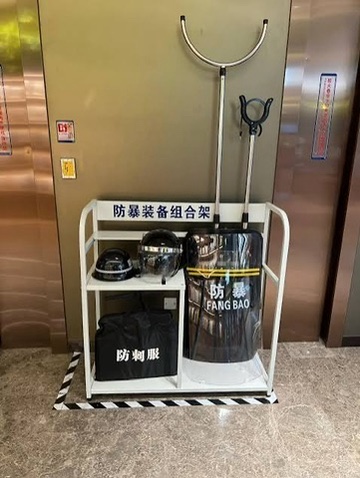
[Photos: a man-fork and shield rack in various public and private locations.]
Video: Police use “man-forks” to control dangerous person.
The idea behind them is worth noticing. The threat China actually faces on its streets is the blade, not the bullet. So it has made sure that within seconds of any public space there are tools for holding an attacker at arm’s length until police arrive. No one has to win a fight. They only have to keep a distance until unformed police arrive.
We, of course, will never pin an armed gunman with a man-fork but the recent shooting death of a woman with a knife near Times Square in New York would be very unusual in China. But we face plenty of people in crisis with knives, bats and broken bottles, and too many of those encounters end with an officer firing at close range. The lesson is about time and distance. Put space between the officer and the person, and you give everyone a better chance to walk away alive.
The part a visitor doesn’t see
This is where my first instinct needed correcting.
Those neighborhood networks are part of what Beijing calls the “Fengqiao Experience,” a Mao-era model of mass mobilization that Xi Jinping has revived. Under the grid system, each monitor reports on the households in his square to local Party committees. Chinese researchers present it as early conflict resolution and community participation. Critics, including some Chinese residents, say it is aimed mainly at political stability and surveillance rather than at crime.
Community policing as I tried to practice it in Madison rested on three things: consent, transparency and citizens helping to set police priorities. China’s model has the visibility and the manpower. But it answers upward to the government, not outward to the people. There is no independent press, no civilian review and no court that a citizen can turn to against the police.
I should also be honest about my own vantage point. A month as a foreign visitor shows you the friendly surface. It doesn’t show you petitioners being detained, or Xinjiang, where police density in 2017 was more than twice the national rate. But what it does show is order and safety over personal freedom. I would add that every society faces that challenge. And today, notably ours: is our quest for individual freedom pushing against the communities right to feel secure and safe?

A People’s Armed Police (武警) armored vehicle near the Uyghur Grand Bazaar in Urumqi, with armed officers on the roof. Photo by the author.
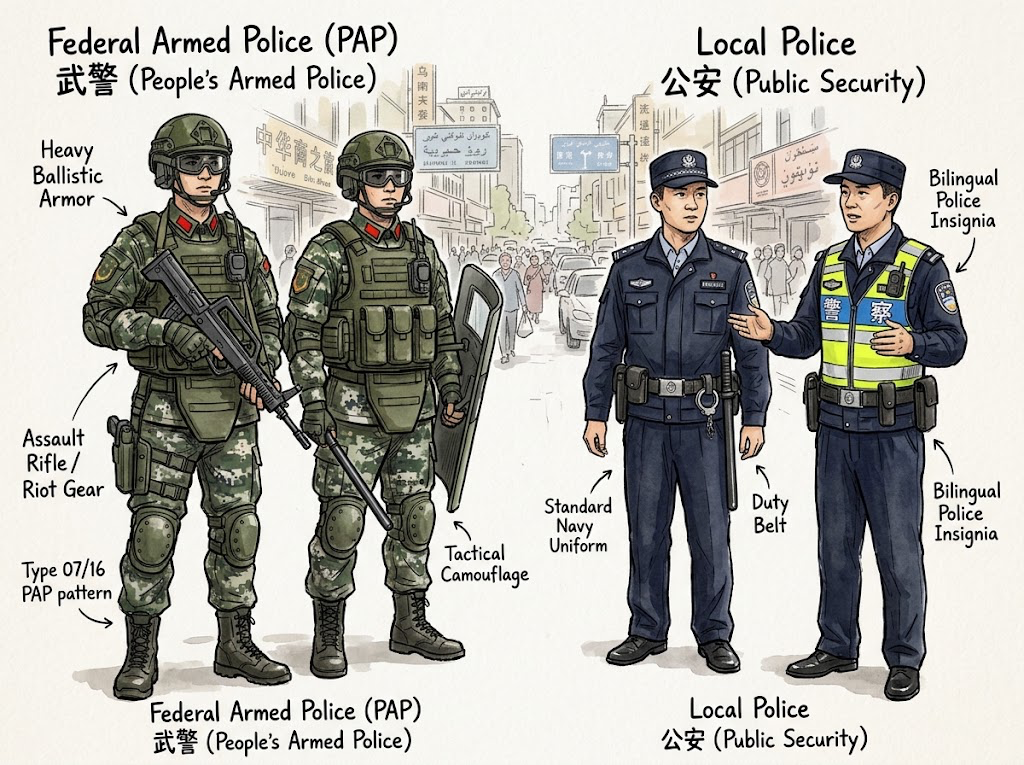
One snowy night in Urumqi, I stood across from an armored vehicle marked 武警, the People’s Armed Police, parked near the Uyghur Grand Bazaar. Two officers stood on its roof under an umbrella, rifles at the ready. A few days earlier I had watched unarmed officers stroll past shops with blinking lights on their shoulders. Both scenes come from the same system.
The Nation’s History: Terrorism, crackdown, and a costly calm
Urumqi’s armored vehicles did not appear out of nowhere. The city has lived through real violence.
- July 2009. Ethnic riots in the Urumqi region killed 197 people, most of them Han Chinese, and injured more than 1,600. The Grand Bazaar was shut for 18 days.
- May 22, 2014. Attackers drove two vehicles into an early-morning street market and threw explosives, killing 31 people and injuring more than 90. It was the deadliest attack in the city in years.
Beijing’s answer was overwhelming force. Within a day it launched a year-long “strike hard” campaign across Xinjiang Province, and more than 1,000 troops and police paraded through Urumqi. After Chen Quanguo became regional Party secretary in 2016, the buildup became permanent. More than 10,000 armed police rallied in the capital. Police posts appeared every few blocks, cameras covered the alleys, and shops had to hire their own guards. Much of that security is evidenced today in frequent bag checks even in some retail establishments.
By the government’s measure, it worked. There has been no major attack in Xinjiang since 2017, and the Uyghur bazaar I walked through was crowded with shoppers and tourists and throughout the city, signage on many businesses was both in Mandarin and Uyghur languages.
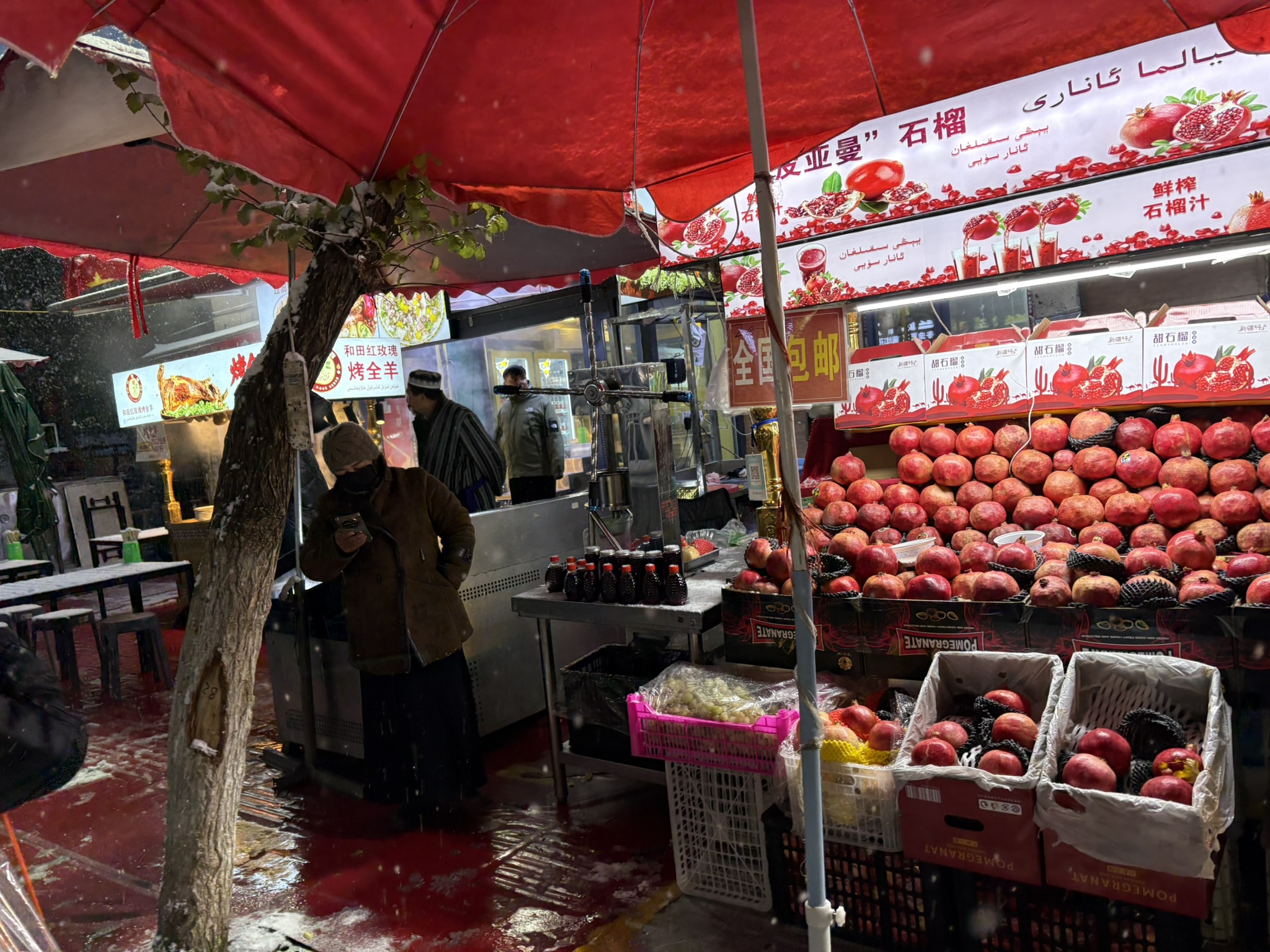
Pomegranate juice and roast-lamb stalls in the Grand Bazaar area of Urumqi, with signs in Chinese and Uyghur.
But the calm came at a price that no visitor sees. In 2022 the UN human rights office concluded that China’s detention of Uyghurs and other Muslims involved serious rights violations that may amount to crimes against humanity. Beijing rejects that finding and calls the program counterterrorism and vocational training.
I spent my career arguing that safety and liberty are not enemies. Urumqi is what it looks like when a government decides they are, and chooses safety. A peace built on fear and surveillance is order, but it is not the trust that community policing is meant to earn.
What we can borrow
We don’t have to adopt China’s political system to learn from what works on its streets. Four lessons travel well:
- Get out of the car. Foot patrol and visible presence change the tone of a neighborhood. People talk to officers they see every day.
- Staff for presence. Gladwell is right that we ask too few officers to do too much. Trained civilian partners, such as community service officers, crisis responders and violence interrupters, can add presence without adding guns.
- Buy time and distance. Equip and train officers to hold a person with a blade at arm’s length, not to end the encounter in two seconds.
- Reduce the guns. The calm I saw rests on a society nearly empty of firearms. Until we face that, our officers will keep walking up to every car as if their lives depend on it.
What we must not borrow is the other half: presence that reports to power instead of to the public. Our task is to build presence and accountability together. That combination is what I mean by community policing, and it still hasn’t been fully tried.


