Awaiting a Controversial Legal Decision
I understand that District Attorney’s decision in the death of Corey Ruiz in Madison, Wisconsin is imminent. I want to say this now, before the inevitable reaction for or against his decision.
Whatever the DA decides, some of us will feel vindicated and some of us will feel betrayed. Both reactions are human. But I want Madison’s citizens to know there is a way out of this, and through it, without unbridled anger and without violence. There is a way that those of us on both sides of this issue can move forward together.
The DA’s job is to answer a narrow legal question: was a crime committed? Our question as a city is larger: what must change so that we are not here again? That question doesn’t depend on his decision. People who put up “Back the Blue” signs and people who march for Corey Ruiz can answer it together. What follows is my attempt to show how.
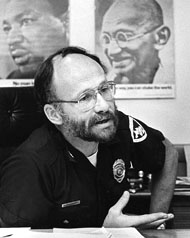
To Those Who Say “Back the Blue:” I know where you’re coming from, because I’ve stood where our officers stand. I wore a militaty uniform as a Marine before I wore a badge. I walked a beat in Minneapolis and taught defensive tactics to cops across the state for years. Then I spent more than two decades as your chief of police. I’ve been to officers’ funerals. I had a partner commit suicide. Another went to prison. I don’t need anyone to tell me the job is dangerous.
So when you put a “Back the Blue” sign in your yard, I hear something I respect. You want officers to know the community has their backs. You’re tired of seeing them blamed for every bad outcome. You think crime deserves a firm response. And when people like me talk about changing the deadly-force standard, you worry I’m tying officers’ hands and putting them at risk.
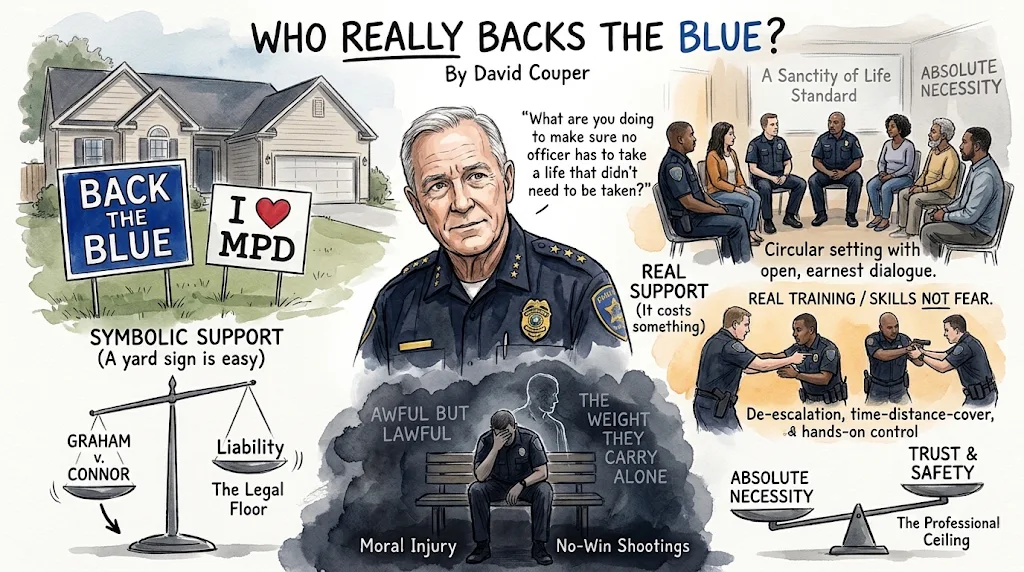
Those are fair concerns, and I want to answer them honestly. My answer is this: if you truly back your police, you will support raising the current deadly force standard, not defend the old one. The current standard in the USSC decision in Graham v. Connor does not protect officers. It protects institutions, and it leaves police officers holding the bag.
Graham v. Connor is a 1989 decision. It says a court should judge an officer’s use of force by whether it was “objectively reasonable” from the view of a reasonable officer at the scene. It was written to settle lawsuits. It tells a judge when a city has to pay. It was never meant to tell a police department how to train or how to lead.
Somewhere along the way, departments started treating that legal floor as their professional ceiling. If a shooting met the Graham test, the case was closed. Nobody asked whether the death was necessary, or whether better tactics could have kept everyone alive. There is a phrase for this: “awful, but lawful.”
Here is what Graham actually buys an officer. It buys a finding that he or she won’t be criminally charged, and that the city probably won’t lose the lawsuit that most surely will be filed. That’s all. It doesn’t buy that officer peace of mind. It doesn’t buy back a professional reputation, a failing marriage, or lost sleep. It doesn’t stop the protests. The legal standard shields the city’s checkbook. It does very little for the officer who pulled the trigger.
Taking a human life is not something an officer walks away from. A study for Florida’s law enforcement leadership program put it plainly: firing your weapon in the line of duty almost always leaves a psychological mark, and sometimes it ends a career in law enforcement A Canadian study followed 18 officers involved in fatal shootings. Several developed substance abuse problems, and most were still dealing with personal upheaval years later. Another study found that the department’s own response after a shooting, and the isolation officers felt, made their post-traumatic stress worse,
I’ve seen this up close. A clearly necessary shooting is hard enough to live with. A questionable one, where the person was in a mental health crisis, or holding a knife across a room, or running away, is far worse. The officer replays it for the rest of his or her life. They sit through the investigation, the DA review, the civil suit, and the news coverage. The officer’s name stays on social media forever. Often the officer’s family pays the price too.
Several of the shootings that have troubled this city since 2012 left the whole city asking whether a death was necessary. A standard that allowed those shootings didn’t protect the officers involved. It left them to carry the weight alone.
Raising the standard is not going soft on criminals. Arrests will still happen. Dangerous people will still go to jail. An officer facing a gun still can use deadly force to save a life, his or her own or someone else’s. Under an “absolute necessity” standard, deadly force stays available whenever a life truly depends on it. What changes is that it becomes the last resort, used after reasonable alternatives have been tried or would clearly fail. That is the standard across much of the democratic world. California has written it into law, and the Police Executive Research Forum has backed a sanctity-of-life approach since 2016.
Toughness isn’t measured by how quickly an officer shoots. It’s measured by skill: keeping distance, using cover, slowing things down, talking someone out of a bad decision, and knowing how to control a person with your hands. Those are the skills I taught for years. They’re harder to learn than pulling a trigger, but they keep officers safer.
The evidence backs this up. When Louisville trained its officers in de-escalation, use of force dropped about 28 percent, and officer injuries dropped about 36 percent. Think about that second number. Better training under a higher standard meant fewer cops hurt. If you want to “back the blue,” that is a result worth demanding.
A yard sign is easy. Real support costs something. Leaders and citizens who truly back their police:
- Give officers a standard that keeps them out of no-win shootings. When the policy says deadly force is a last resort, officers are trained and expected to create time and distance before it comes to that. Fewer officers end up in situations that haunt them for life.
- Pay for the training to meet it. A higher standard without training is only words. De-escalation, crisis response, and hands-on control skills must be practiced monthly, not once a year.
- Fix the system instead of blaming the officer. When something goes wrong, a non-blaming review looks at policy, training, supervision, and culture, the way aviation and medicine do. They’re called Sentinel Events. This response protects officers from being made scapegoats for a system’s failures.
- Stand with officers after a tragedy, and stand with the community too. Police leaders who show up, listen, and tell the truth earn the trust that keeps officers safe on the street. Community support is not a luxury. Officers cannot be safe or effective without it.
An officer who never has to take a life he or she didn’t need to take keeps a career, and personal health and family intact. A city that never loses a resident it didn’t need to lose keeps its trust in police. That isn’t anti-cop. It’s the best thing we can do in Madison for the men and women who wear the badge. A city’s trust of its police is the most important ingredient to community peace and safety.
Since Corey Ruiz died in July, Madison has been asking the same question it asked after Paul Heenan, Ashley DiPiazza, and Tony Robinson died: was this death necessary? Each time, the answer has been “lawful,” and each time, trust has worn a little thinner. The officers involved have carried their own wounds, out of public sight.
We can keep defending the old standard and keep repeating this cycle. Or we can do what police in much of the democratic world already do. We can raise the standard to absolute necessity, train every officer to meet it, and learn from every tragedy instead of defending it.
If you want to help and support peace and justice in the eity, and I do, ask the mayor, your council member and police chief one question. What are you doing to make sure no Madison officer has to take a life that didn’t need to be taken? That’s how we, together, “Back the Blue.” This is how those of us on both sides of this issue can move forward together and demand these changes be implemented.


