
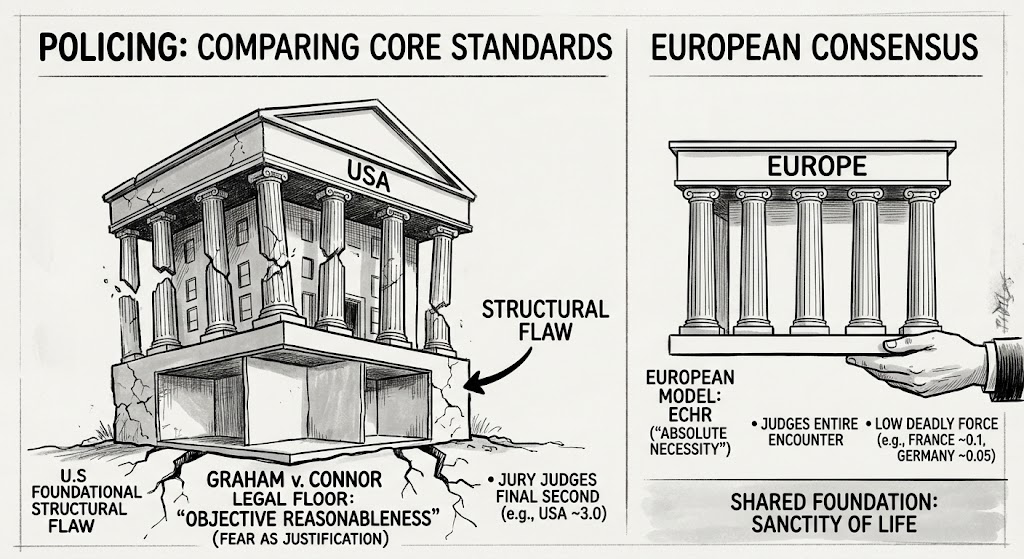
Why Graham Keeps American Police Stuck!
Across the country, progressive municipal police departments pride themselves on progressive transformation. They invest heavily in advanced leadership training, establish robust community advisory councils, deploy comprehensive de-escalation curricula, purchase state-of-the-art body-worn cameras, and institute community-oriented policing models. On paper, these agencies appear to have achieved the gold standard of modern law enforcement. Yet, despite checking every box of contemporary reform, these departments remain vulnerable to catastrophic, life-taking use-of-force incidents.
The root cause of this paradox is not a lack of training, equipment, or good intentions. It is a fatal structural flaw built into the foundational legal framework governing how police officers are taught, led, and judged: adherence to the U.S. Supreme Court’s standard established in Graham v. Connor.
Confusing the Legal Floor
Most American police departments evaluate deadly force through the lens of “objective reasonableness”. Originating from Graham v. Connor (1989), this standard asks only whether an officer’s snap decision to use lethal force was “objectively reasonable” to a fearful officer facing a tense, uncertain, and rapidly evolving situation in the final split second before pulling the trigger. Fear alone becomes the operational justification.
The fatal error made by city attorneys, police chiefs, and municipal leaders is treating this minimum constitutional threshold as if it were a high-quality operational standard. Graham was never intended to define good police work; it was designed solely as the lowest constitutional floor to shield officers from federal civil liability. By maintaining Graham as their department benchmark, even the most progressive agencies bind themselves to a low-bar standard that legitimizes rushed tactical interventions and turns fear into a license to kill.
The International Contrast
To understand why American policing continues to lag behind peer nations—averaging roughly 3.3 fatal police shootings per million residents annually compared to fractions of a percent in Western Europe—one must look at the governing standard.
| Country / Region | Fatal Police Shootings (per million residents/year) | Governing Force Standard |
| United States | ≈ 3.3 | Objective Reasonableness (Graham v. Connor) |
| France | ≈ 0.4 | Absolute Necessity / Proportionality |
| Germany | ≈ 0.15 | Absolute Necessity / Strict Proportionality |
| England and Wales | < 0.03 | Absolute Necessity (Article 2, ECHR) |
Derived from Article 2 of the European Convention on Human Rights, the standard of “absolute necessity” permits lethal force only when no other possible option exists. As affirmed in McCann v. United Kingdom (1995), this standard evaluates the entire tactical planning, approach, and de-escalation effort of the encounter—not merely the final split second before a shot is fired. Critics often dismiss European comparisons due to firearm prevalence in the U.S., but nations like Norway and Finland possess deep hunting cultures and household weapons yet record years with zero fatal police shootings. The difference is not societal weaponry; it is the standard by which police are trained, led, and judged.
Raising the Bar: An Operational Imperative
Abandoning Graham in favor of absolute necessity does not endanger officers; it enhances their safety. Grounding a department in absolute necessity transforms operations in three critical ways:
- Mandatory Time and Distance: Rushing into volatile situations creates the very split-second crises that force lethal choices. Absolute necessity requires officers to create barrier space, seek cover, and slow encounters down.
- Tactical De-Escalation as a Binding Duty: De-escalation shifts from an optional suggestion to an administrative requirement, demanding that officers exhaust alternatives before resorting to force.
- Systems-Level Accountability: By coupling a strict necessity policy with multidisciplinary “sentinel event” root-cause reviews, leadership treats every close call and use of force as an organizational learning opportunity rather than an isolated aberration.
Conclusion: The Path Forward
Local municipal leaders, mayors, and police chiefs do not need to wait for state legislatures or federal courts to rewrite constitutional law. Administrative power rests entirely in local hands to establish a higher internal policy ceiling. To truly protect the community and the officers who serve it, a fine police department must take the courageous step of discarding the low-bar legal floor of Grahamand anchoring its entire culture to the absolute sanctity of human life.


