Gaining Deeper Perspectives on Culture, Systems, and Change
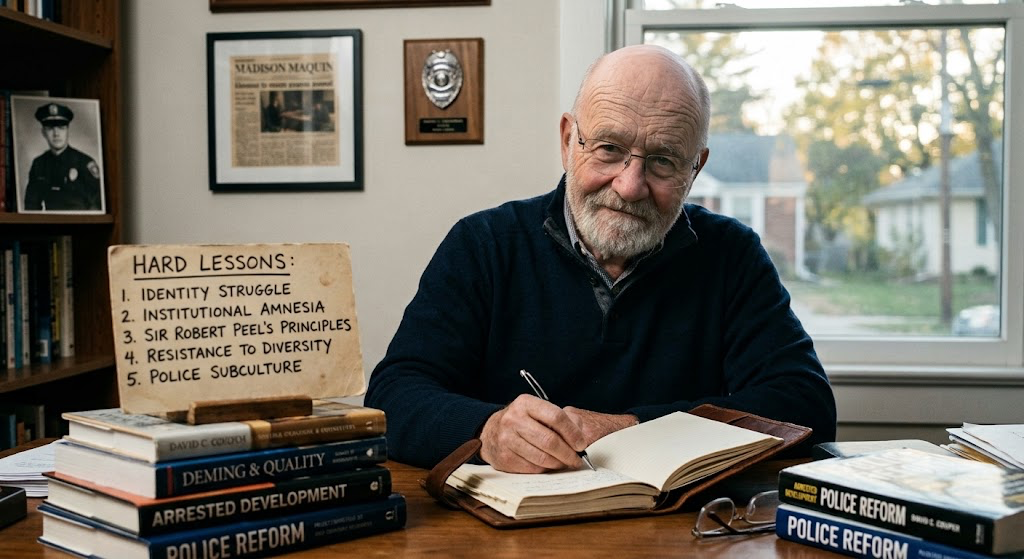
The first of my “Hard Lessons” occurred during the Deming-influenced quality improvement years, during the tenure of Mayor Joe Sensenbrenner and the Madison Area Quality Improvement Network (MAQUIN). I wrote about it in Quality Progress magazine (1989): “Quality Improvement and Government: Ten Hard Lessons I Have Learned.”
The lessons in that article revealed how American government consistently sabotages its own reform through cultural inertia and an obsession with control. Rather than continuously improving, each new regime seems to ignore decades of clear reform blueprints while masking deep systemic flaws. My article argued that public sector institutions are structurally built to resist continuous improvement through authoritarian management, electoral amnesia, and a toxic reliance on executive ego. Because government prioritizes preserving a nineteenth-century status quo and serving short-term political cycles, politicians and bureaucrats routinely dismantle long-term quality initiatives the moment leadership changes or a crisis passes. By substituting top-down fear for frontline empowerment, and treating systemic quality as a temporary political project rather than an essential investment, municipal government — and its police department — actively sabotages the very teamwork, trust, and innovation required to serve the public effectively.
Those of us who were “disciples” during that era learned that quality improvement is not a self-sustaining perpetual motion machine. It is an uphill battle against the natural entropy of bureaucratic institutions. The moment a supportive mayor is replaced, the new one seeks quick political wins and something new. The new mayor decides that participative management threatens traditional leverage: if I didn’t think of it, it certainly can’t be good. Quickly, nothing good is allowed to come from the past. Without relentless, courageous leadership at the top and deep structural roots in the community, even the most revolutionary successes in Madison proved vulnerable to political pushback and the magnetic pull of the status quo.
The real test of a police reformer’s resolve rarely occurs during the honeymoon period of a new job, or while delivering a keynote on procedural justice. It happens when the political winds shift — when a newly elected mayor demands that everything learned from the past administration be “tossed out the window,” or when an entrenched union circles the wagons after a member gets in trouble.
When you challenge the status quo from the inside, you quickly learn that the fiercest resistance often arrives precisely when the stakes are highest: at the intersection of loss of life, public outrage, and the law. For decades, the legal shield for police use of deadly force has been Graham v. Connor and its standard of “objective reasonableness.” But as history, the experience of police in Europe, and street-level reality have repeatedly shown, what is legally permissible under Graham is often neither morally acceptable nor operationally necessary.
Raising the bar — moving beyond mere legal protection toward a higher standard of “absolute necessity” and de-escalation — demands institutional courage.
Yet the persistent tragedy of modern policing is the unwillingness of leadership to step out from behind the minimum legal threshold. When chiefs and city halls treat Graham as a ceiling rather than a floor, they choose short-term legal-liability management over long-term public trust — and the racial disparities that result are difficult to ignore.
This second look at the hard lessons of police improvement — of trying to fix a system that isn’t producing the outputs we need or want— moves past theoretical reform to confront the raw friction of leadership: the blowback from city hall when honest analysis makes politicians uncomfortable, the ostracism by peers who view high standards as betrayal, and the institutional cowardice that refuses to elevate human life and its sanctity above legal minimums.
Drawing on my half-century of experience on the streets, as chief of police in Burnsville, Minnesota and Madison, Wisconsin; my books Arrested Development and How to Rate Your Local Police; some 1,600 blog posts; and an overall historical perspective, I have developed ten more hard lessons learned since my active career, in the hope that they can be of use to tomorrow’s police leaders.
1. Identity Struggle: “Warrior” v. “Guardian”
Police have increasingly lost their essential identity, retreating from the neighborhood, community-oriented peacemaking model into a militarized “homeland security” mindset. Outfitted in heavy body armor and tactical gear, too many officers view their communities as hostile territory to conquer rather than a public to protect — directly betraying Sir Robert Peel’s foundational vision.
2. Continuity of Presidential Commissions
Decade after decade, blue-ribbon panels — from the Wickersham Commission in the 1930s, to the 1967 President’s Commission on Law Enforcement, to the 2015 Task Force on 21st Century Policing — have diagnosed the same systemic flaws and issued brilliant blueprints for reform. The hard lesson is not that we don’t know what’s wrong. It’s that our institutions suffer from a stubborn amnesia and a refusal to implement change.
3. Ignoring Peel’s “Nine Principles “
Modern policing has drifted far from Robert Peel’s timeless truth, articulated over 150 years ago at the founding of the first civic police force: that the power of the police depends on public approval and voluntary compliance, not coercive force. When departments abandon the principle that “the police are the public and the public are the police,” they alienate the very communities whose cooperation they most need.
4. Resistance to Diversity
True diversification means more than changing a department’s demographic makeup; it requires fundamentally shifting its culture. Departments frequently resist the structural changes needed for racial and gender equity, while internal subcultures isolate or marginalize officers who challenge systemic racism or champion genuine civil rights.
5. Power of Subculture
The informal subculture of policing is a powerful force of inertia that eats progressive leadership for breakfast. Officers who pivot toward empathy, de-escalation, and constitutional policing are often branded by their peers as “weak,” or accused of turning their backs on the badge — proof that changing the rules on paper means nothing if the peer culture punishes compliance.
6. Anti-Intellectualism
Policing has historically rejected rigorous academic frameworks, critical thinking, and a sociological understanding of human behavior in favor of tactical drills and defensive posturing. With initial academy training averaging less than five months, and looking more like a military boot camp than an educational arm of the profession, officers are asked to navigate complex human crises with dangerously insufficient tools — and a demeaning atmosphere.
7. Corruption and Misconduct
Endemic corruption does not start with massive criminal conspiracies; it begins with free coffee, discounted meals, “tests-lying” and looking the other way at minor rule-bending. When leadership tolerates any ethical lapse, it creates a permissive environment that eventually shields brutality, ticket-fixing, and civil rights violations.
8. Illusion of Progress vs. True Growth
Unlike professional sports or private industries, which evolve rapidly in strategy, skill, and performance over fifty years, policing has substituted superficial modernization — more aggressive chemical agents, heavier vehicles, higher-tech gear — for genuine moral and operational evolution.
9. Reluctance of Top Leadership
Quality improvement requires patient, long-term cultural transformation. Too many police leaders capitulate to short-term political cycles, prioritizing public relations and defensive posturing over the difficult, daily work of modeling ethical behavior and accountability.
10. Fear of Hard Conversations About Race and Justice
Attempting to reform policing holds up an uncomfortable mirror to a polarized nation. When police leaders, educators, students, and citizens reject empathy, self-reflection, and difficult dialogue about race and justice — dismissing them as weakness or political correctness — they sabotage the very pipeline of thoughtful, compassionate people needed to wear the badge.
—————————————
Conclusion
Ultimately, these hard lessons of mine are not meant to breed cynicism, but to serve as a realistic compass for those brave enough to lead tomorrow.
True quality improvement in policing was never intended to be an easy, seamless victory; it has always been a disciplined, relentless battle against bureaucratic inertia and institutional fear.
For the next generation of police leaders, reform will require more than just mastering management theories or deploying new technology—it will demand the unyielding moral courage to measure every action against human dignity, elevate Peel’s principles above political expediency, and hold fast to the belief that the police and the community are, and must always remain, one and the same.
____________________________
Resources
Quality Management and Leadership Models
- Total Quality Management (TQM) & W. Edwards Deming: Pioneered by statistician W. Edwards Deming. Applied during Mayor Joseph Sensenbrenner’s administration in Madison, Wisconsin (1983–1989) to institute data-driven continuous improvement and frontline empowerment.
- Primary Text: Deming, W. E. (1986). Out of the Crisis. MIT Press.
- Original Article: Couper, D. (1989). “Quality Improvement and Government: Ten Hard Lessons I Have Learned.” Quality Progress, 22(7), 30–34.
Legal Standards & International Comparisons
- Graham v. Connor, 490 U.S. 386 (1989): The U.S. Supreme Court ruling establishing the standard of “objective reasonableness” under the Fourth Amendment for evaluating police use of force. It serves as a legal floor against civil liability rather than an operational ceiling for best practice.
- Case Record: Justia Supreme Court Center.
- European Standard of “Absolute Necessity”: Enshrined in Article 2 of the European Convention on Human Rights and the UN Basic Principles on the Use of Force and Firearms by Law Enforcement Officials (1990). Restricts lethal force strictly to instances where it is unavoidable to protect human life.
- Model Policy Guidance: Developed by the Stanford Center for Racial Justice (Stanford Law School), advocating for U.S. police departments to adopt the “absolute necessity” standard and mandatory de-escalation protocols.
Historical Commissions & Reform Blueprints
- Wickersham Commission (1931): The Report on Lawlessness in Law Enforcement, which first documented systemic abuse and police misconduct nationally.
- President’s Commission on Law Enforcement (1967): The Challenge of Crime in a Free Society, outlining broad structural reform needs across criminal justice.
- Kerner Commission (1968): Report of the National Advisory Commission on Civil Disorders, highlighting how isolated patrol practices created an adversarial dynamic between police and minority communities.
- President’s Task Force on 21st Century Policing (2015): The COPS Office Final Report emphasizing trust, legitimacy, oversight, and de-escalation as primary pillars of modern public safety.
- Police Executive Research Forum (PERF): Guiding Principles on Use of Force (2016) and Transforming Police Recruit Training (2022), calling on agencies to adopt policies anchored in the sanctity of human life above the Graham minimum.
Operational Principles & Terminology
- Peelian Principles (1829): The nine principles of law enforcement attributed to Sir Robert Peel upon founding the London Metropolitan Police, establishing that “the police are the public and the public are the police”.
- Community-Oriented & Problem-Oriented Policing: Formulated by Herman Goldstein (1979) and expanded by Robert Trojanowicz (1990), shifting policing from reactive enforcement to collaborative community problem-solving.
- “Testi-lying”: Coined during the 1994 Mollen Commission investigation into NYPD corruption, describing police perjury used to validate unlawful searches or arrests.
- Moral Injury in Law Enforcement: Psychological and existential trauma suffered by officers who take a life or use force in situations that were legally permissible under training but operationally or morally unnecessary.


