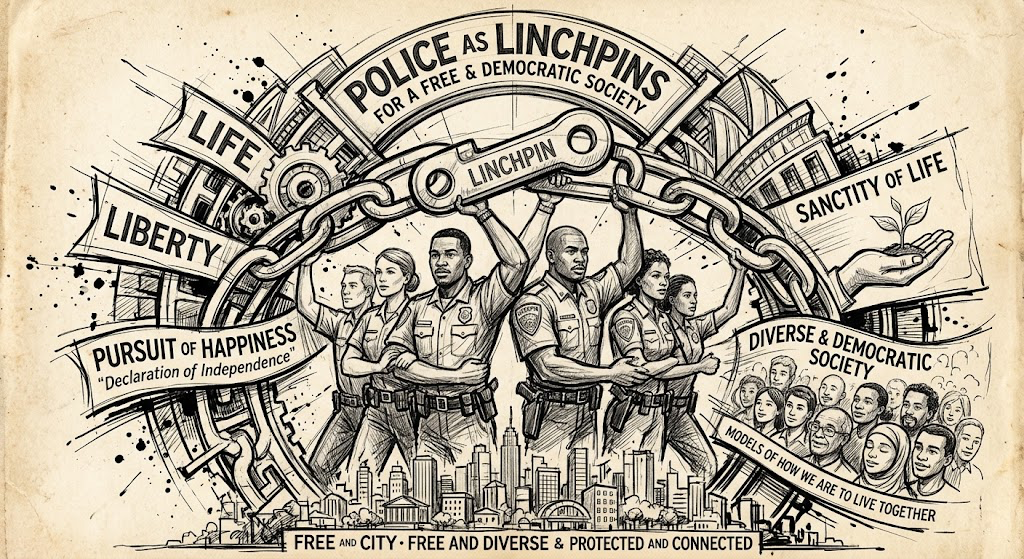
Our nation’s founding document does not begin its famous list with liberty. It begins with life. “Life, liberty, and the Pursuit of Happiness” places the sanctity of life first because everything else a free society promises its citizens — their liberty, their pursuit of happiness, their right to disagree with one another and still belong to the same nation — depends on staying alive to exercise it. A democracy that cannot secure that first promise has nothing left to offer on the other two.
This is not a sectarian idea dressed up in founding-era language. Every enduring faith tradition I have studied or served — Jewish teaching that each person is made b’tzelem Elohim, in the image of God; Christian teaching that every soul carries infinite worth; Islamic teaching that to save one life is to save all of humanity; Buddhist and Hindu teachings on the sacredness of sentient life; the traditions of Indigenous peoples on this continent long before any of us arrived — each, in its own language, arrives at the same place. In a nation as religiously and culturally diverse as ours, the sanctity of life may be the one moral conviction nearly all our citizens already hold in common, even when they agree on almost nothing else. That makes it something rarer than a value. It is common ground.
A democracy survives on the willingness of people who deeply disagree to keep arguing with words instead of resorting to force. That willingness depends on a promise the state makes to all of them: that the force it reserves for itself will be used to protect life, not spend it. The moment citizens come to believe that promise is unevenly kept — honored for some people in some neighborhoods, treated lightly in others — the willingness to keep arguing instead of fighting begins to erode. That erosion does not happen in courtrooms or legislatures first. It happens on street corners, in the ordinary encounters between officer and citizen that make up the daily texture of public life.
This is why I have long argued that police officers are linchpins of a free society, not merely its enforcers. A linchpin is a small, unglamorous piece of hardware that nonetheless holds the whole wheel to the axle; remove it, and everything built on top of it comes apart. Officers occupy exactly that position in a democracy. They are the most visible, most frequent, most physically present representatives of the state that most citizens will ever encounter — far more often than a judge, a legislator, or a president. In the space of a single traffic stop or a single call to a home in crisis, an officer either models the value the whole society claims to hold, or quietly teaches the people watching that the claim was never really true. Multiply that moment by the millions of encounters a year across this country, and it becomes clear that officers are not incidental to how Americans learn to trust — or distrust — one another across their differences. They are central to it.
That is the argument I have made for years on this blog and in Arrested Development: A Veteran Police Chief Sounds Off.., and it is the argument I make again here: a police officer trained only to the legal minimum of what force the law permits has been taught the wrong lesson, and will teach it to everyone watching.
A police officer trained and led to treat every life — the person in crisis, the suspect, the officer’s own — as sacred, and to exhaust every other option before taking one, has been given something closer to the truth this country was founded to protect.
In a diverse democracy where citizens will never agree on everything, the officer’s daily choice to preserve life rather than end it may be one of the last places left where all of us, whatever we believe, can still see the thing we all, in our better moments, profess to value. That is not a burden we place on police unfairly. It is the honor, and the weight, that comes with being a linchpin of what we are trying, together, to become and to hold together.


