
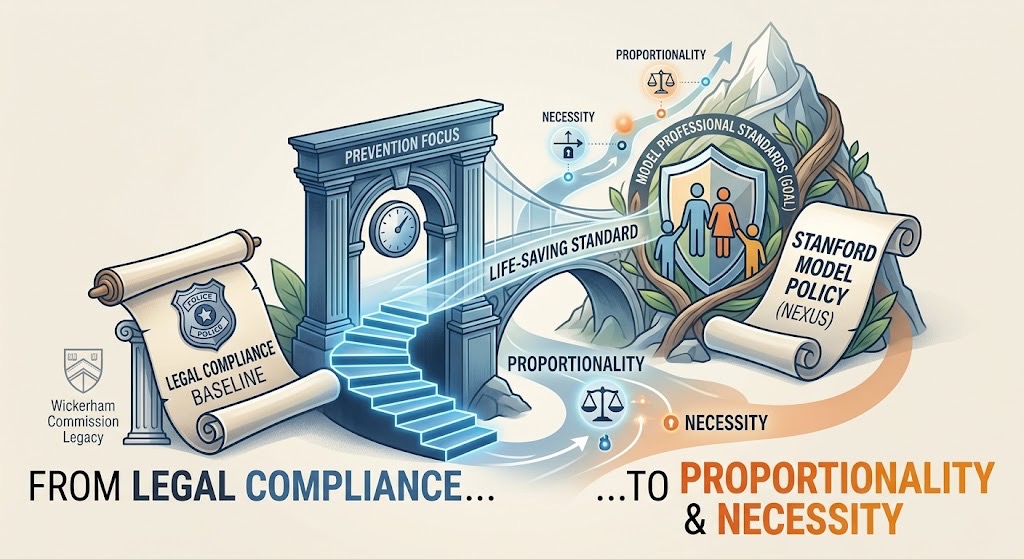
Rethinking the Rules of Engagement: Moving Beyond Graham v. Connor
The legal baseline for police use of force in the United States, established by the Supreme Court in Graham v. Connor(1989), hinges on the concept of “objective reasonableness.” While this standard protects officers from civil liability for decisions made in split-second, high-stakes situations, it was never intended to be an operational ceiling or a blueprint for saving lives. By treating the legal minimum as the maximum professional standard, many agencies inadvertently set the stage for avoidable tragedies, erodes public trust, and ignores the moral costs for the officers involved.
To achieve true reform and build a safer, more constitutional system of policing, we must actively “raise the floor.” In this post, we explore a powerful tool for doing exactly that: The Stanford Law School Model Use of Force Policy. We’ll look at how it raises the standard from “reasonable” to “necessary,” and provide concrete action steps for local leaders to implement these changes today.
You can find the full Stanford Law School Model Use of Force Policy online HERE.
POLICE DEPARTMENT GENERAL ORDER
USE OF FORCE AND TACTICAL DE-ESCALATION
Section I. Preamble and Core Philosophy
1.1 Sanctity of Human Life
The preservation of human life and human dignity is the highest value of this Department and takes precedence over all other operational objectives. Officers shall respect and protect human life in every encounter.
1.2 Beyond Constitutional Baseline
While Graham v. Connor (1989) sets the minimum constitutional baseline for civil liability (“objective reasonableness”), this Department demands a higher operational standard. Merely meeting the legal floor of Graham is insufficient. Officers must operate under the standard of Absolute Necessity and Proportionality to prevent harm, protect human life, and maintain community trust.
Section II. The Absolute Necessity Standard
2.1 Definition of Absolute Necessity
Force of any kind—and particularly lethal force—is authorized only when it is absolutely necessary to accomplish a lawful law enforcement outcome.
Absolute Necessity exists ONLY when:
- All available non-lethal means, tactical de-escalation methods, verbal persuasion, and less-lethal options have been completely exhausted, OR are objectively unavailable/ineffective given the immediate circumstances; AND
- The force used is the minimum amount required to control the threat; AND
- The potential harm created by using force does not outweigh the threat posed to human life.
2.2 Proportionality
The level of force applied must be strictly proportional to the severity of the offense and the degree of immediate danger posed. Officers must not apply force that is out of balance with the goal of protecting life and preventing serious injury.
Section III. Pre-Force Requirements and Tactical De-Escalation
3.1 Mandatory De-Escalation
Officers shall use tactical de-escalation strategies to stabilize situations, reduce tensions, and gain voluntary compliance prior to using force, whenever safe and feasible.
3.2 Core Tactical Principles
Officers are required to utilize the following tactics to avoid or minimize force:
- Time, Distance, and Cover: Create physical distance, utilize available cover/concealment, and slow down the pace of an incident to allow for clear communication and resource deployment.
- Tactical Communication: Use verbal warnings, persuasive communication, active listening, and de-escalation dialogue.
- Specialized Resources: Request Crisis Intervention Team (CIT) officers, mental health clinicians, negotiators, or additional tactical support early in the encounter.
3.3 Assessment of Preceding Conduct
In evaluating whether force was absolutely necessary, the Department will review the totality of the incident, including the officer’s actions leading up to the decision to use force. Tactics or decisions by officers that unnecessarily create or escalate the threat will be considered in evaluating policy compliance.
Section IV. Use of Deadly Force
4.1 Standard for Deadly Force
Lethal force is an extreme measure of last resort. An officer may use deadly force only when absolutely necessary to protect the officer or another person from an imminent threat of death or serious bodily injury, and when no lesser degree of force can safely neutralize the threat.
4.2 Definition of Imminent Threat
An imminent threat is not merely a potential or future threat. A person poses an imminent threat ONLY when they have:
- The present ability, opportunity, and clear intent to cause death or serious physical injury; AND
- The threat is immediate and actively progressing, leaving no time to attempt alternative responses.
4.3 Prohibitions on Deadly Force
Deadly force is strictly prohibited in the following circumstances:
- Fleeing Suspects: Against a fleeing individual who presents no immediate, active threat of death or serious injury to others.
- Moving Vehicles: Against occupants of a moving vehicle, unless an occupant is actively using deadly force by means other than the vehicle itself (e.g., firing a weapon), or the vehicle is intentionally being used as a weapon of mass destruction and no path of evasive escape exists.
- Property Offenses: To prevent property destruction or theft.
- Warning Shots: Warning shots are strictly forbidden.
Section V. Duty to Intervene and Render Medical Aid
5.1 Mandatory Duty to Intervene
Any officer present and observing another officer using force that clearly exceeds the Absolute Necessity standard shall immediately intervene—physically, verbally, or tactically—to stop the unauthorized force, regardless of rank or seniority.
5.2 Duty to Report
Failure to intervene in unauthorized force constitutes a severe policy violation subject to immediate suspension and disciplinary action. Any intervention must be reported to a supervisor immediately.
5.3 Medical Assistance
Immediately following any application of force, officers shall assess the individual for injury, render first aid within the scope of their training, and immediately request Emergency Medical Services (EMS).


