
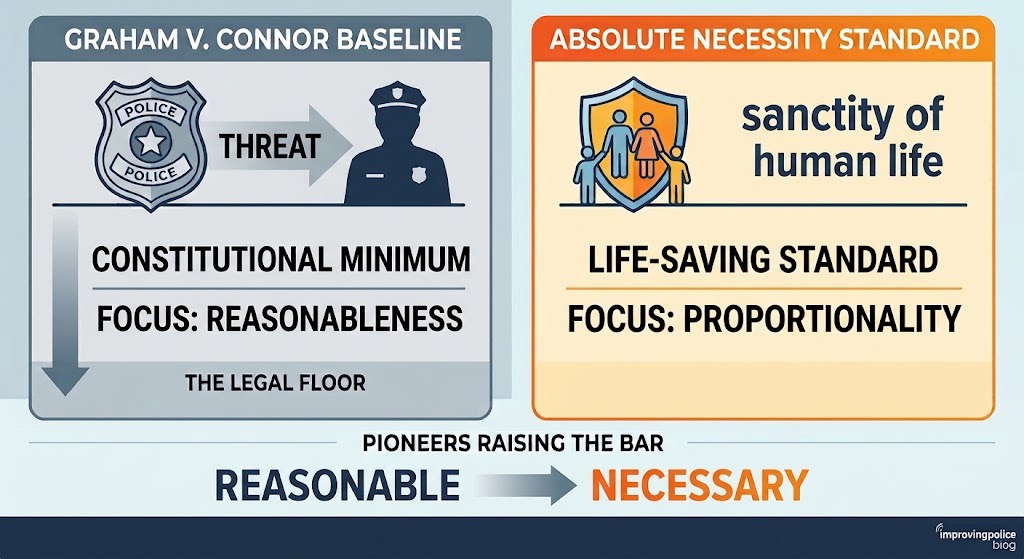
The Stanford Law School Model Use of Force Policy explicitly addresses the core limitation of Graham v. Connor (1989): that Graham establishes only the constitutional baseline of “objective reasonableness“—a legal shield against civil liability, rather than an operational standard for saving lives.
To bridge this gap, the Stanford Model Policy mandates that force—especially lethal force—be used only when strictly necessary and proportionate, requiring that non-lethal options be exhausted or objectively unavailable (moving closer to the international standard of “absolute necessity”).
Across the country, several major police departments and pioneering states have passed legislation or administrative rules that move past Graham and incorporate higher standard criteria.
Key Agencies and Jurisdictions Raising the Standard
1. California Legislative Reform (AB 392) and Major CA Agencies
- The Legislative Pivot: California passed Assembly Bill 392, altering the legal justification for deadly force from force that is “reasonable” to force that is “necessary.” Under California Penal Code § 835a, officers may use deadly force only when they reasonably believe it is necessary to defend against an imminent threat of death or serious bodily injury.
- Agencies Affected:
- Los Angeles Police Department (LAPD): Revised its core use-of-force directives to require officers to evaluate de-escalation, proportional responses, and necessity prior to resorting to deadly force.
- San Francisco Police Department (SFPD): Adopted Department General Order 5.01, which establishes the sanctity of human life as its core principle and mandates that lethal force be used only when no reasonable alternative exists to protect against imminent threat.
2. Police Executive Research Forum (PERF) “Guiding Principles” Adopters
Following PERF’s release of 30 Guiding Principles on Use of Force—which explicitly advised departments to adopt policies more restrictive than Graham v. Connor—a network of progressive municipal agencies updated their internal policy manuals:
- Baltimore Police Department (BPD): Rebuilt its force policy under federal consent decree oversight to require de-escalation, duty to intervene, and exhaustion of reasonable alternatives before using deadly force.
- Seattle Police Department (SPD): Implemented policy changes establishing that force must be necessary, reasonable, and proportionate, accompanied by mandatory tactical de-escalation and disengagement strategies.
- Chicago Police Department (CPD): Updated General Order G03-02, creating a standard requiring officers to use de-escalation tactics whenever feasible and framing deadly force as a last resort.
3. State-Level Legislative Overhauls (Raising the Standard by Law)
Beyond administrative policy shifts in single agencies, several state legislatures have elevated the use-of-force threshold across all municipalities within their borders:
- State of Washington (Initiative 940 / HB 1310): Enacted statutory provisions mandating that officers exercise reasonable care, exhaust all available and appropriate de-escalation tactics, and use force only when necessary.
- State of Maryland (Police Accountability Act of 2021): Created a statewide statutory use-of-force standard replacing Graham-only defaults, making lethal force unlawful unless it is necessary to prevent imminent death or serious bodily harm.
4. Historical Precedents in High-Policy Administrative Standards
- Madison Police Department (Madison, WI): Historically served as an early blueprint for administrative restraint, establishing internal use-of-force policies, tactical patience, and community-oriented frameworks in the 1970s–1990s that went significantly beyond federal constitutional minimums.
Core Mechanics: How These Agencies “Raise the Bar”
Departments that move toward the Stanford Model generally incorporate three key mechanisms that Graham v. Connor does not require:
- Shift from “Reasonable” to “Necessary”: Under pure Graham, force is legal if a “reasonable officer on the scene” would have acted similarly out of split-second fear. The higher bar requires demonstrating that no non-lethal alternative was reasonably available.
- Mandatory Pre-Force Tactical Patience: Requiring officers to create time, distance, and cover—treating the events leading up to the use of force as part of the evaluation, rather than evaluating only the final moment the trigger was pulled.
- Mandatory De-Escalation Duty to Intervene: Making de-escalation an affirmative operational mandate rather than an optional suggestion.
_______________________________________________


