The Gap Between Policy and Practice in American Policing
A working paper
The Paradox
A department can do almost everything right on paper. It can recruit college-educated officers, build a workforce that looks like the community it serves, invest in de-escalation and crisis-intervention training, keep its policy manual current, and hang a mission statement in the lobby that speaks of dignity, service, and guardianship. And still, on a given night, on a given street, an officer who was hired for exactly those values will reach for force faster than the department’s own values would predict — and walk away legally protected for having done so.
This paper starts from sixty years of combined observation — a career spent building and leading a department that tried to become one of the “good” ones, and years since spent watching, writing, and organizing around what happens after the plaques go up. The question is not why bad departments produce bad outcomes. It is why good-looking departments falter, and whether that faltering is an accident of individual officers or a predictable feature of how police organizations actually work.
The idea explored here has three parts. First, that police organizations run on two systems at once — a written one and a lived one — and the lived one wins under stress.
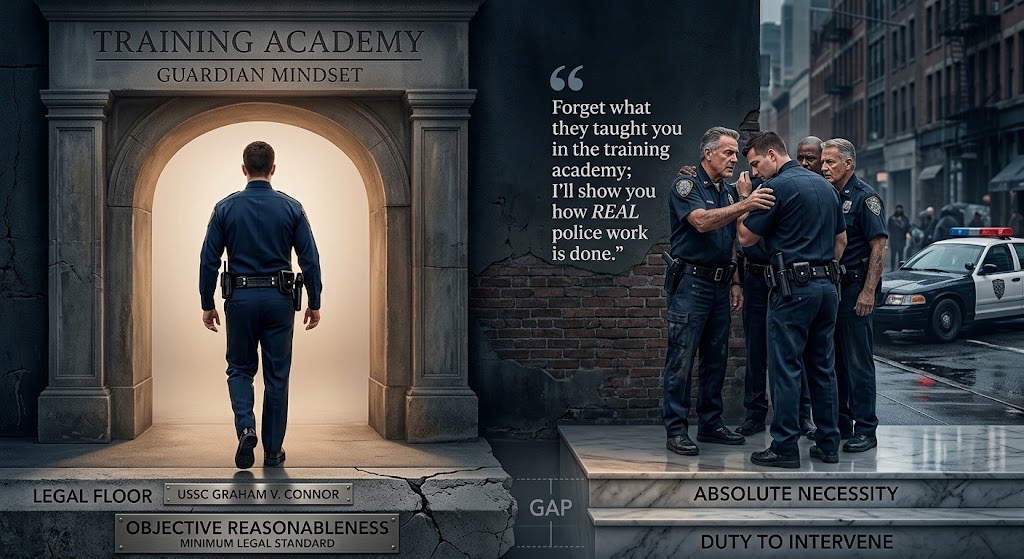
Second, that the legal floor departments have been content to stand on, Graham v. Connor‘s “objective reasonableness” standard, was never meant to be a ceiling, and treating it as one is itself a policy choice with consequences.
Third, that the only variable shown to reliably close the gap between the written department and the lived one is leadership — sustained, first-line-to-chief, twenty-four-hours-a-day leadership, not a training curriculum or a mission statement.
Two Cultures, Not One
Organizational theorist Edgar Schein described culture in any organization as operating on three levels: the visible artifacts (uniforms, mission statements, policy manuals, the appearance a department presents to the world), the espoused values (what the organization says it does and how it says it accomplishes its mission), and, underneath both, the unstated assumptions that actually drive behavior— assumptions that, when they diverge from the published and trained values, mean the organization’s culture is not as sound as its paperwork suggests. A department can be extraordinarily disciplined about the first two levels — and Madison, in its era, was — while the third level, the one nobody puts in a policy manual, quietly sets the actual rules of the street.
This is the core of the paradox. “Good on paper” is a description of artifacts and espoused values. It says nothing about the underlying assumptions an officer actually carries into a stressful stop — assumptions formed not in the academy classroom but in the squad room, the patrol car, and the unwritten judgments of senior officers about who gets backed up, who gets promoted, and whose account is believed when force is used.
The Working Personality
Officers do not arrive at this gap by accident. Jerome Skolnick’s classic account of the police “working personality,” developed in the 1960s and still cited as foundational, described how the combination of danger, authority, and the pressure for efficiency reshapes how officers see the world— producing a heightened suspicion of people generally and a “visual shorthand” for sizing up danger based on cues like dress, behavior, age, and race. This is not a character flaw recruits bring with them; it is what Skolnick called a working personality, produced by the job itself, and it forms whether or not the recruit walked in the door as a genuine community-oriented guardian.
Layered on top of the working personality is what departments euphemistically call “culture” and what researchers more specifically call the code of silence — the informal expectation that officers do not provide adverse information against each other, a pattern serious enough that the Christopher Commission’s investigation of the LAPD identified it as perhaps the single greatest barrier to holding officers accountable for misconduct. Critically, the research on the code of silence does not treat it as spontaneous peer loyalty. It treats it as something that forms — or fails to form — depending on whether leadership visibly and consistently role-models the values it claims to hold, since when an organization’s desired values are not sincerely embraced and demonstrated by its leaders, the code of silence becomes more, not less, likely. That single finding does most of the work of this paper’s argument before we even get to legal standards.
The Real Academy Is the Field
If the working personality is where the raw material forms, field training is where it hardens into department-specific practice — and this is where my own observation about the veteran officer and the recruit turns out to be one of the most documented phenomena in policing research, not an old war story. It shows up almost word-for-word across the literature: recruits are told by their field training officers to forget what the academy taught them, because now the real learning begins, a line researchers describe as capturing the disconnect between classroom lessons and how the job is actually practiced on the street. One empirical study of field training specifically examined what values Field Training Offiers (FTOs) transmit and found that even where the explicit, stated values passed on to recruits were positive, a set of negative implicit values was being communicated at the same time— with the recruit’s read of the FTO’s status inside the department shaping which set of values actually took hold.
This is the mechanism by which a department with excellent academy curricula and a guardian-oriented mission statement produces warrior-postured street behavior anyway: the academy teaches the espoused values, but the FTO — usually a senior, informally high-status officer — teaches the underlying assumptions, and the underlying assumptions are what govern decisions made under threat, at speed, with no one from command present.
Graham v. Connor: A Floor Mistaken for a Ceiling
My instinct about Graham v. Connor (1989) is where the legal analysis and the cultural analysis meet. The Supreme Court’s holding was narrower than it is usually treated: it established that excessive-force claims are judged by whether the officer’s actions were “objectively reasonable” from the perspective of a reasonable officer on the scene, without the benefit of hindsight, and without regard to the officer’s actual intent, evaluated against the facts and circumstances confronting the officer at the time. It is a rule for civil liability — a constitutional minimum below which conduct becomes actionable.
It was never written as a description of best practice, and it explicitly does not ask whether force was necessary, only whether it was reasonable in the moment— a distinction that matters because a necessity standard asks whether force was needed at all and whether less forceful options existed, while Graham’s standard does not reach that question.
My own profession’s own research arm has said this plainly. The Police Executive Research Forum’s (PERF) “30 Guiding Principles on Use of Force” explicitly frame Graham as “necessary but not sufficient” for departments to rely on, arguing that the decision does not give officers enough guidance on the use of force and that its narrowness helps explain why fatal shootings often clear legal and prosecutorial review even when the force involved wasn’t proportional or necessary. PERF’s principles — modeled in part on the UK’s “National Decision Model,” whose own standard for officers is that force be used only to the extent necessary, proportionate, and reasonable in the circumstances— call on departments to adopt policies that exceed Graham’s constitutional floor rather than resting on it. Stanford’s “Model Use of Force Policy” takes the same position, proposing necessity and proportionality as the operative standard rather than reasonableness alone, and recommending that department policy set a stricter bar than the constitutional minimum.
This is the missing piece in most “good on paper” departments. A police department can do everything else right and still leave its own operational floor exactly where the Constitution set it for liability purposes, rather than raising it to where the department’s stated values would put it.
When that gap exists, an officer who is procedurally just, community-oriented, and emotionally intelligent about most of the shift can still, in the one encounter that matters, retreat to what the policy actually authorizes rather than what the mission statement aspires to — because the policy, not the mission statement, is what protects them legally and what the department will actually defend them on.
Guardian by Training, Warrior Under Pressure
The guardian-versus-warrior framework I’m describing has moved from rhetoric to a body of empirical research over the past decade, and the findings map closely onto my observation.
Surveys of new officers find that a guardian orientation is measurably associated with more favorable attitudes toward de-escalation and procedural justice and less favorable attitudes toward use of force, while a warrior orientation predicts the opposite pattern.
Separately, Tracey Meares, Tom Tyler, and colleagues have shown in randomized studies that procedural-justice training — teaching officers to explain their actions, listen, and treat people with dignity during ordinary encounters — measurably reduces both use-of-force incidents and complaints against officers, a finding that has been cited by national policing task forces as evidence that culture change through training is not merely aspirational.
But the same research tradition contains the warning embedded in this question. Warrior and guardian mindsets are not sequential stages a department outgrows — researchers increasingly describe them as coexisting orientations an individual officer can hold simultaneously, with the warrior posture centered on tactical readiness and decisive action under threat, something researchers describe as not optional, since without it officers die.
High emotional intelligence, strong procedural-justice practice, and genuine community orientation do not retire the warrior posture; they sit alongside it. What determines which one governs a given encounter, when the officer perceives a threat, is not which training module ran longer — it’s the underlying assumption, formed in the working personality and reinforced in field training, about what the department will actually stand behind when force is used and a life is on the line. If the department’s operational floor is “objectively reasonable,” a threatened officer’s warrior posture will reliably win that argument in real time, no matter how many hours of guardian-oriented training preceded it — because the policy, not the training slide, is what the officer’s split-second judgment is calibrated against.
What Actually Runs a Police Department
This is the operational point buried in my question, and it deserves to be stated as its own proposition: a department’s real Standard Operating Procedure is not the SOP manual. It is whatever the department will actually defend, discipline, or celebrate after the fact.
Officers learn this quickly and accurately, regardless of what the manual or the mission statement says, because it is demonstrated to them — in the briefing room, in who gets a commendation and who gets a talking-to, in whether the chief backs the street or the policy in a close case, in what command is willing to say publicly the day after a controversial use of force.
This is why a strong cadre of ethical, values-driven leadership genuinely can change an organization in a way that policy revision alone cannot — and also why it is such demanding, unglamorous work.
The research on the code of silence is explicit that role-modeling, not policy language, is the lever, and that when leaders sincerely embrace and demonstrate an organization’s stated values, the code of silence and the behaviors it protects become less likely to take hold.
Leadership in this sense is not a single decision or a single retraining initiative. It is a daily, largely invisible practice: who a sergeant pulls aside after a shift, what a lieutenant says when reviewing a use-of-force report that was legally defensible but avoidable, whether a chief is willing to raise the department’s own bar above what the Constitution requires and defend that decision publicly when an officer who followed the higher standard is second-guessed for hesitating. It has to run at every rank, continuously, because the working personality and the field-training pipeline are also running continuously, and they do not pause for a new policy memo.
Toward a Different Operational Floor
None of this argues against training, diversification, or procedural justice — the evidence is strong that they matter and move outcomes in the right direction. It argues that they are necessary but not sufficient, in exactly PERF’s phrase, unless a department also does the less comfortable work of raising its actual operational standard above Graham‘s constitutional minimum, and then makes sure — through leadership, not just policy language — that officers believe the department means it. A few implications follow directly:
- Raise the floor explicitly. Adopt a strict necessity-and-proportionality standard, as a growing number of state legislatures and model policies (including Stanford’s) already do, rather than resting on Graham’s reasonableness standard as the operational ceiling.
- Audit the field-training pipeline, not just the academy curriculum. The academy teaches espoused values; FTOs teach underlying assumptions. A department serious about culture has to select and hold FTOs accountable to the same standard it wants recruits to internalize.
- Make de-escalation and disengagement legally and organizationally safe, not just trained. An officer needs to know the department will back a decision to slow down, create distance, or disengage — even when the law would have permitted force — or the guardian training will lose to the warrior posture every time the stakes are real.
- Treat leadership as an operational function, not a value statement. The research is consistent that role-modeling by leadership, sustained across every rank and every shift, is what actually closes the gap between written policy and lived practice — which means it has to be evaluated and demanded, not assumed from a chief’s tenure or a department’s reputation.
Conclusion
The uncomfortable finding buried in my sixty years of watching this from both inside and outside the institution is that “good on paper” and “good on the street” are not the same accomplishment, and one does not guarantee the other.
A department can hire well, train well, and write well, and still leave its actual operational floor exactly where the Constitution set it for the purpose of civil liability — and that single unaddressed choice is enough to let the working personality, the field-training pipeline, and the pressure of a threatening moment override everything else the department has built.
Raising that floor, and then leading — every day, at every rank — so that officers believe the department will stand behind the higher standard, is not a training initiative. It is the actual, ongoing work of running a good police department, and it is never finished.
This paper draws on organizational-culture research (Schein), classic and contemporary police-subculture scholarship (Skolnick; field-training and code-of-silence research), procedural-justice research (Tyler and colleagues), the guardian/warrior literature, and use-of-force policy analysis (PERF’s 30 Guiding Principles; Stanford’s Model Use of Force Policy).


