Why the Best Leaders Don’t Rise
There’s a Big Difference Between Leaders and Managers
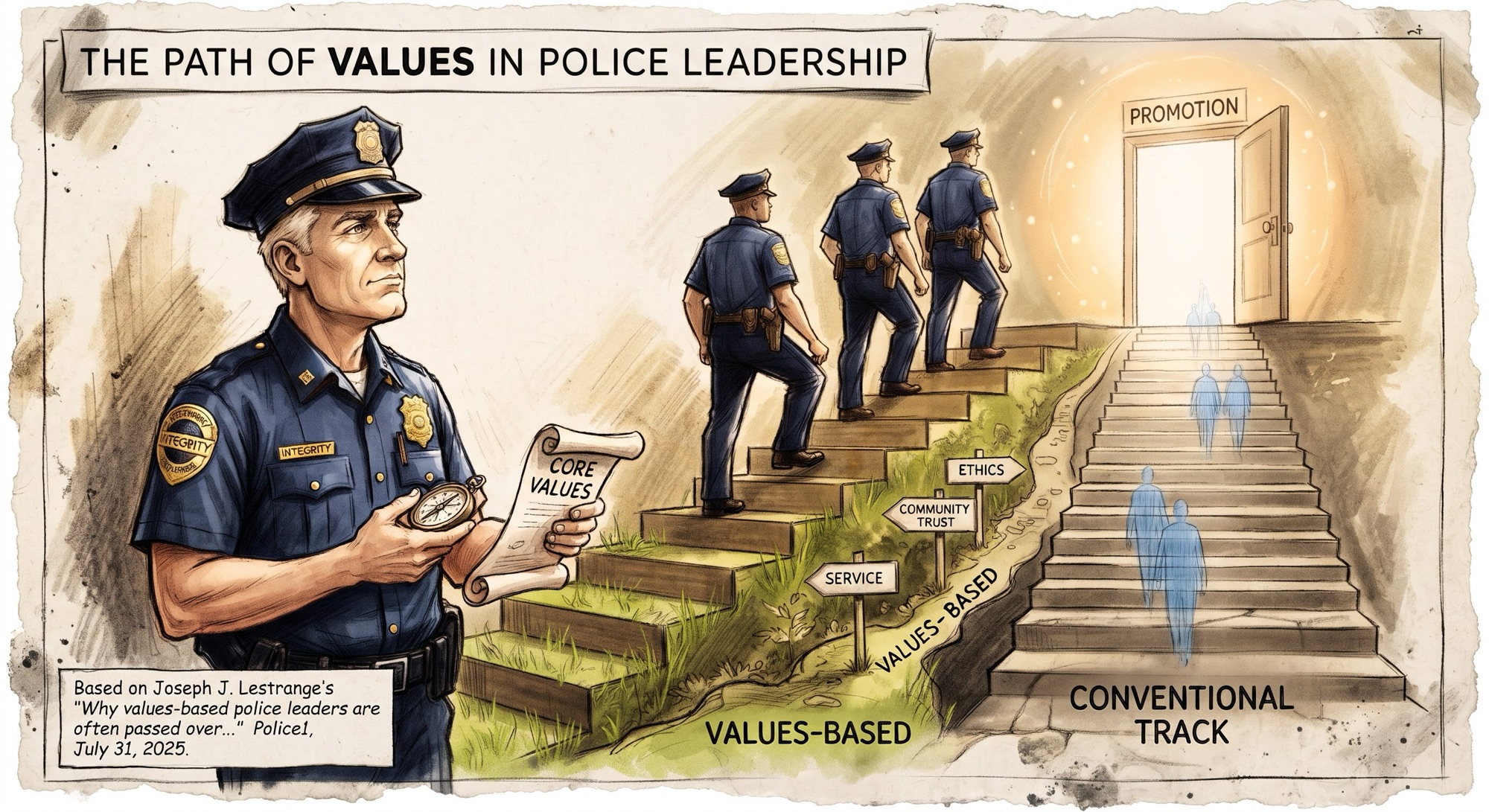
Dr. Joseph Lestrange, a retired federal law enforcement executive, wrote a Police1 piece, “Why values-based police leaders are often passed over — and how to change that,” asking why values-based police leaders so often get passed over. These are the officers who are ethical, innovative and community-minded. His answer is that it isn’t for lack of talent. It’s because they won’t conform. It’s a piece every mayor, chief and police commission should read.
- Politics over principle. Promotions follow alliances more than merit.
- Humility goes unrewarded. Self-promotion is what gets noticed. When outsiders and reformers promote themselves, it’s often read as arrogance.
- Insecure bosses. Superiors can see strong, fresh talent below them as a threat.
- Conformity and bias. Assertiveness is praised in some people and penalized in women, outsiders and people of color.
- In-groups and loyalty networks. Promotions flow through informal networks that keep outsiders out. Even “national searches” tend to recycle the same chiefs.
- The turnover trap. New chiefs reshuffle people to reward loyalty, and earlier progress gets erased.
He then offers seven strategies for rising with integrity: Play the long game with ethical political skill. Promote results rather than yourself. Find sponsors outside the department. Use emotional intelligence. Help the culture evolve rather than reject it. Keep a circle of trusted advisors. Stay loyal to the mission rather than the tribe. His conclusion: departments that want reform must actually promote these leaders, not just admire them.
What his list tells us: we promote managers
Lestrange is right, and none of this surprised me. Read his list closely and you’ll see what’s going on. Our promotion systems in police agencies are very good at finding managers. They are not very good at finding leaders.
I have written about this difference for years. In 2020 I wrote in “Once More, Once Again — On Leadership” that what’s missing in American policing is the development of leaders, not managers. A leader is self-giving. A manager is too often “all about me.” Leaders care for those they work with and for those they serve. Robert Greenleaf called it servant leadership, and it works.
A few years earlier, I shared a Forbes piece on the differences between managers and leaders. Managers manage work; leaders lead people. Manager is a position; leader is a quality. A manager accepts the status quo; a leader challenges it. Now look at Lestrange’s six barriers again. Most of them reward the manager’s virtues — fitting in, playing the game, protecting the boss, keeping things as they are — and punish the leader’s.
When we first began changing Madison in the 1980s, I drew up a chart comparing the old “reform style” of police leadership with the new style we were working toward. I reposted it in 2017. A few lines from it:
| Old style | New style |
| Tell subordinates. | Ask and listen to employees. |
| Boss as order giver. | Coach and teacher. |
| Maintain the status quo. | Create, innovate, experiment. |
| Control and watch employees. | Trust employees. |
| When errors occur, blame employees. | Errors mean failed systems — improve them. |
Lestrange’s barriers read like a description of the left-hand column. Forty years later, too many departments are still choosing their leaders from it.
I don’t say this from some high perch. As I wrote in “On Leadership”, for many years I was comfortable practicing top-down leadership. It took me time to see it wasn’t working, and more time to find the courage to change. Most managers can become leaders. But they won’t if the system keeps rewarding them for staying managers.
What I’d add
In my book, Arrested Development: A Veteran Police Chief Sounds Off…” I argued that many police departments are stuck in an adolescent stage — reactive, defensive and obsessed with authority. Lestrange shows us one of the ways they stay there: promotion systems that, as he puts it, favor the familiar over what the future needs. Several of his barriers are the very things the “12 Principles of Quality Leadership” were written to overcome:
- A department run on alliances and loyalty is the top-down, power-oriented decision-making the principles ask us to avoid.
- Where strong subordinates are seen as threats, nobody is encouraging creativity and risk-taking or tolerating honest mistakes.
- In-group promotion destroys mutual respect and trust. It also ignores the principle of asking and listening to the employees who do the work.
Most of his seven strategies are wise counsel for the individual reformer: play the long game, let results speak, raise hard truths with good timing and empathy. That advice is sound. And Lestrange is just as clear that agencies themselves must change: promotion systems that favor the familiar have to change, and we must stop recycling the same leaders. One of our Quality Leadership principles points the same way: improve systems and examine processes before blaming people. If good leaders have to tiptoe to survive, the problem is the system, not them.
He writes that the shift from tribal loyalty to mission loyalty “must be driven from the top.” I agree, and I’d put it first. Kouzes and Posner, whom I cited in “A Leadership Check”, name four “moments of truth” for any leader, and one of them is the behaviors you reward. In a police department, nothing is rewarded more loudly than a promotion. Every one tells the whole organization what really counts. Chiefs have to build promotion systems that reward teamwork, problem-solving, coaching and community service. Only then will values-based leaders stop being the exception.
The turnover trap deserves its own word. In “Learning Hard Lessons” I wrote about what happened to quality improvement in Madison (Wisc.) when political leadership changed: the new people wanted something new, and nothing good was allowed to come from the past. Lestrange sees the same thing inside police departments. Reform that lives in one chief’s office dies when that chief leaves. It has to be built deep-down into how the organization selects and develops its people.
What citizens can do
This isn’t only a matter for chiefs. In How to Rate Your Local Police I wrote that leadership is the single most important factor in shaping a police department. That book was written for mayors, council members, police commissioners and ordinary citizens — the people who should be grading the police in the first place. So here are a few questions I’d add for anyone rating their department today:
- How are promotions decided? Is there a written standard, and does it include coaching, problem-solving and community trust — or only test scores and seniority?
- Do the people a candidate supervises, and the community they serve, have any say?
- Who were the last three people promoted to command? Did any of them come from outside the usual networks?
- What happened to the last lieutenant or captain who pushed for change?
- When the chief changes, what survives?
Last year I told Madison’s Police and Fire Commission that a chief who doesn’t earn the trust of the officers will, at best, manage the department, but never lead it forward. The same is true at every rank.
Lestrange ends where I would: departments that truly seek reform must promote these leaders, not just admire them. Leaders cast light, not darkness. The job is to find them, promote them and protect them. It’s still the work in front of policing in America.


